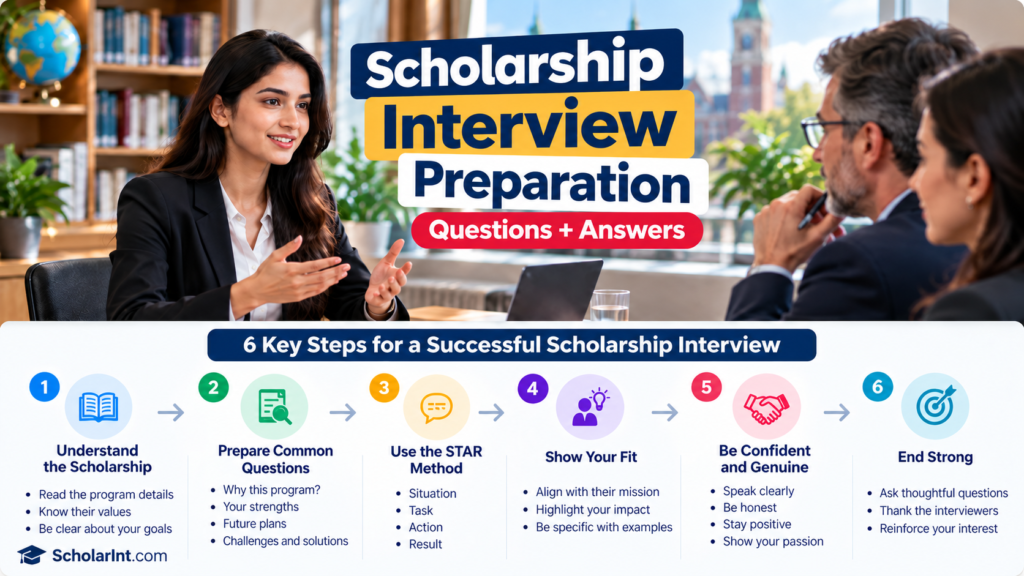
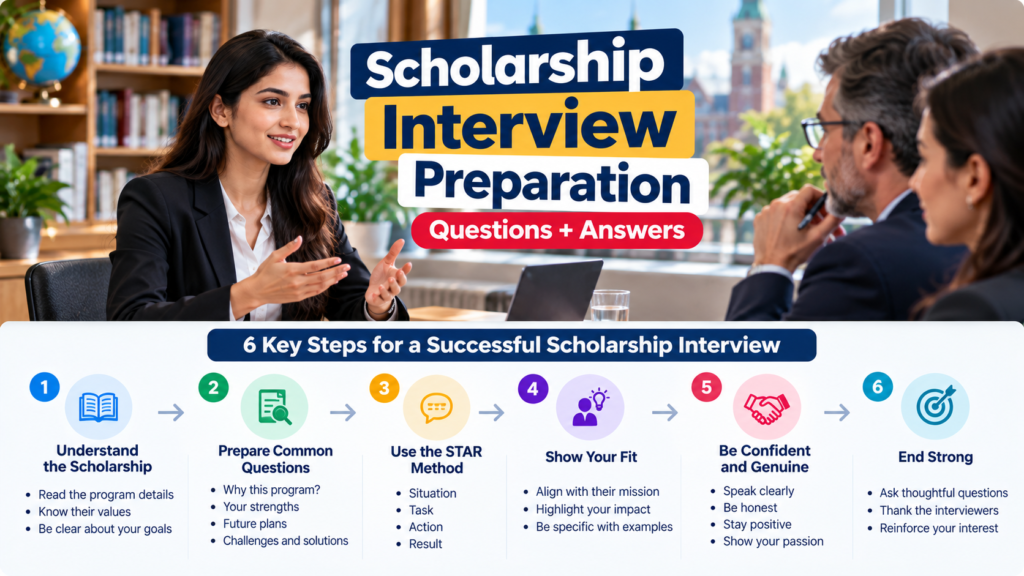
A scholarship interview can feel stressful, especially when the award is highly competitive. The good news is that most interviews are not designed to trick you. The panel usually wants to understand your goals, your background, your motivation, and whether you are a good fit for the scholarship.
This guide will help you prepare step by step. You will find common scholarship interview questions, strong answer structures, ready-to-copy answer frameworks, a mock interview script, what to wear, what to do before and after the interview, and a final checklist.
Quick Rule: Do not memorise full answers word for word. Prepare your key points, examples, and stories. Then answer naturally in your own words.
What Is a Scholarship Interview?
A scholarship interview is a conversation between you and one or more people who are involved in selecting scholarship winners.
The interview may be:
- Online through Zoom, Teams, or another platform
- In person at a university, embassy, or scholarship office
- One-to-one
- Panel-based
- Short and formal
- Longer and more conversational
The interview panel may include university staff, professors, scholarship managers, alumni, or external experts.
What Do Scholarship Panels Usually Look For?
Most panels are trying to answer a few simple questions:
- Does this student understand the scholarship?
- Are their academic and career goals clear?
- Do their past actions support what they are saying?
- Can they explain why this programme is the right fit?
- Will they use the opportunity well?
- Can they communicate clearly?
- Do they show leadership, maturity, service, or research potential?
Your interview should match the story already shown in your application. If your motivation letter says you want to work in public health, but your interview answers suddenly focus on banking, the panel may become confused.
Before the interview, review your scholarship motivation letter and make sure you remember the main examples and goals you used.
How to Prepare Before the Interview
1. Read Your Application Again
Read your CV, motivation letter, research proposal, and application form.
Be ready to explain anything you wrote.
2. Research the Scholarship
Know:
- What the scholarship funds
- Who the scholarship is for
- The values or goals of the programme
- The university or organisation behind it
- What scholars are expected to do
3. Research Your Course or Programme
Be ready to explain why you chose the exact course, not only the university.
You should know:
- Main subjects or modules
- Research areas
- Programme structure
- How the course connects to your goals
4. Prepare Your Best Examples
Think of real situations that show:
- Leadership
- Teamwork
- Problem-solving
- Academic achievement
- Community service
- Research ability
- Handling failure
- Working under pressure
You do not need ten stories. Four or five strong examples can often answer many different questions.
The STAR Method for Scholarship Interviews
For questions about your experience, use the STAR method.
- S – Situation: What was happening?
- T – Task: What were you responsible for?
- A – Action: What did you do?
- R – Result: What happened?
Question: “Tell us about a time you showed leadership.”
Weak answer:
I am a good leader and I always help people.
Better answer:
During my final year, our student science society had low attendance at outreach events. I was responsible for coordinating volunteers. I created a simple schedule, divided tasks clearly, and started a reminder group for volunteers. At the next three events, attendance improved and we were able to run all planned activities without cancelling any sessions. This taught me that good leadership is often about organisation and communication, not only giving instructions.
Ready-to-Copy Answer Framework: “Tell Us About Yourself”
This is often the first question. Keep your answer around 60–90 seconds.
READY TO COPY — INTRODUCTION FRAMEWORK
Thank you for the opportunity to speak with you.

I am currently [your current degree/job] at [institution/organisation], where I focus on [field or main area].

My interest in [subject/field] developed through [short experience, project, or problem].

During my studies/work, I have gained experience in [2–3 relevant areas].

One experience that shaped my goals was [short example].

I am now applying for [scholarship/programme] because I want to build stronger skills in [specific area] and use them to [future goal or impact].
1. Why Do You Want This Scholarship?
This question is not only about money.
A good answer can include:
- Why the programme fits your goals
- What the scholarship allows you to do
- What you hope to contribute
- Why this opportunity is the right next step
SAMPLE ANSWER
I am applying for this scholarship because it would allow me to study [programme] and build stronger skills in [specific area].

What attracts me most is not only the financial support, but also [mentoring/network/research opportunity/community aspect].

My long-term goal is to [future goal]. This scholarship would help me move toward that goal by giving me access to [specific training or opportunity].

I also hope to contribute through [leadership, research, community work, peer support, or another area].
2. Why Did You Choose This University?
Do not answer only with rankings.
Mention:
- A specific course
- A research area
- A programme feature
- A lab or centre
- An academic approach
- A professional opportunity
Better answer:
I chose this university because the programme combines environmental science with policy and applied research. I am especially interested in the climate adaptation module and the opportunity to work on real policy projects. This fits closely with my goal of working on climate-resilient urban planning.
3. Why Should We Choose You?
This question can feel uncomfortable, but you do not need to boast.
Use three parts:
- Your strongest relevant quality
- Evidence
- How you will use the opportunity
READY TO COPY — “WHY YOU?” FRAMEWORK
I believe I am a strong candidate because I have combined [academic strength / research / leadership / service] with a clear goal in [field].

For example, [brief real example].

This experience showed me that I can [skill or quality].

If selected, I would use the scholarship to strengthen my skills in [specific area] and contribute through [specific contribution].
4. What Are Your Career Goals?
Keep your answer realistic.
Explain:
- Your first step after graduation
- Your long-term direction
- Why the course matters
Example:
After graduation, I plan to work in public-health research, ideally in a role where I can use data to improve health programmes. In the longer term, I hope to lead projects that improve access to evidence-based healthcare in underserved communities. This degree would give me the research and analytical skills I need to move toward that goal.
5. Tell Us About a Challenge You Faced
Choose a real challenge that shows growth.
Avoid making the answer too dramatic if it does not need to be.
Use STAR:
- What was the problem?
- What did you do?
- What changed?
- What did you learn?
SAMPLE ANSWER
During my final-year project, our first set of laboratory results was inconsistent.

I was responsible for checking the data and preparing the next experiment.

I reviewed the protocol, discussed the problem with my supervisor, and found that sample handling was not consistent across all trials.

We standardised the procedure and repeated the experiment. The later results were much more reliable.

The experience taught me to stay calm when a project does not work and to solve problems by checking evidence step by step.
6. Tell Us About a Failure
Do not say you have never failed.
Pick a real example where:
- The mistake was not dishonest
- You took responsibility
- You learned something
- You changed your approach
Example:
I once underestimated how much time a group research report would take. I focused too much on the analysis and left editing too late. We submitted on time, but the final document was not as polished as it could have been. After that, I started planning projects backwards from the deadline and setting an earlier internal deadline for review.
7. Tell Us About Your Leadership Experience
Leadership does not always mean being president of a society.
You can show leadership by:
- Organising a project
- Helping a team solve a problem
- Mentoring others
- Taking responsibility
- Starting an activity
- Improving a process
If your scholarship values leadership, prepare at least two strong examples.
8. How Will You Give Back?
Many scholarships want to know what happens after they invest in you.
Avoid vague answers like “I want to help my country.”
Be specific:
After completing the programme, I plan to return to my region and work in renewable-energy project development. I also want to support university students through short workshops on energy modelling and project design, because access to practical technical training is still limited in many institutions.
9. What Is Your Biggest Strength?
Choose a strength that matters for the scholarship.
Then prove it.
Example:
One of my strongest qualities is persistence. During my thesis, I had to learn R from the beginning because my project required statistical analysis. I followed an online course, practised with small datasets, and asked for feedback from a senior student. By the end of the project, I was able to complete the analysis independently.
10. What Is Your Biggest Weakness?
A good weakness answer has three parts:
- A real weakness
- What you are doing about it
- Evidence of improvement
READY TO COPY — WEAKNESS FRAMEWORK
One area I have been working on is [real weakness].

I noticed this when [brief example].

To improve, I started [specific action].

Since then, I have [evidence of improvement].

I still work on this, but I am much more aware of it now.
11. What Will You Do If You Do Not Receive the Scholarship?
This question checks resilience.
Do not sound hopeless or angry.
Example:
This scholarship is very important to me, but if I am not selected, I will continue looking for funding and strengthening my application. I would also review what I could improve and apply again where possible. My long-term goal will remain the same.
12. Do You Have Any Questions for Us?
Always prepare one or two useful questions.
Good examples:
- What support is available to help scholars build professional networks?
- Are there opportunities for scholars to take part in community or leadership projects?
- What qualities have successful scholars shown in previous years?
- How does the programme support scholars after graduation?
Avoid asking questions that are clearly answered on the website.
Ready-to-Use Mock Scholarship Interview
Use this section with a friend, teacher, or family member. Ask them to read the questions without telling you which one is next.
MOCK INTERVIEW — PRACTICE QUESTIONS
1. Tell us about yourself.

2. Why are you applying for this scholarship?

3. Why did you choose this course and university?

4. What is your strongest academic achievement?

5. Tell us about a time you showed leadership.

6. Tell us about a challenge you faced.

7. What is one failure that taught you something important?

8. What are your short-term career goals?

9. What are your long-term goals?

10. How will this scholarship help you?

11. How will you contribute to the scholarship community?

12. What issue in your field interests you most?

13. What is your biggest strength?

14. What is one weakness you are working on?

15. Why should we choose you?

16. What will you do if you are not selected?

17. How do you handle pressure?

18. Tell us about a time you worked in a team.

19. How do you plan to give back after graduation?

20. Do you have any questions for us?
How Long Should Your Answers Be?
There is no exact rule, but many answers work well in about 60 to 120 seconds.
If the question is simple, answer simply.
Do not turn every answer into a five-minute speech.
If the panel wants more detail, they will ask a follow-up question.
How to Sound Natural Instead of Memorised
Do not memorise complete paragraphs.
Instead, prepare:
- Three key points for each common question
- Four or five strong stories
- Your main academic goal
- Your main career goal
- Your reason for choosing the programme
You can write these as short notes.
For example:
Leadership story: science society → 18 volunteers → poor attendance → new schedule → three successful events → learned communication
This helps you remember the story without sounding rehearsed.
Online Scholarship Interview Tips
For an online interview:
- Test your camera and microphone
- Check your internet connection
- Use headphones if sound quality is better
- Choose a quiet room
- Keep the background clean
- Place the camera at eye level
- Keep your CV and application nearby
- Join 5–10 minutes early
- Turn off phone notifications
Do a test call with a friend the day before.
What Should You Wear?
You do not need expensive clothes.
Choose something:
- Clean
- Simple
- Professional
- Comfortable
For most interviews, smart business or business-casual clothing is enough.
What If You Do Not Know the Answer?
Do not panic.
You can say:
That is a good question. I have not worked directly on that issue, but based on what I know…
or:
I am not fully sure, so I do not want to guess. My current understanding is…
Being honest is better than inventing an answer.
What If Your English Is Not Perfect?
You do not need perfect English to give a strong interview.
Focus on:
- Clear sentences
- Simple vocabulary
- Speaking slowly
- Answering the actual question
If you do not understand a question, say:
Could you please repeat or rephrase the question?
That is completely acceptable.
Common Scholarship Interview Mistakes
1. Memorising Answers Word for Word
This can make your answers sound unnatural.
2. Giving Long Answers
Answer the question first, then add the example.
3. Talking Only About Financial Need
Funding matters, but the panel also wants to understand your goals and potential.
4. Giving Generic Answers
Use real examples from your own experience.
5. Not Researching the Scholarship
You should know what the programme supports and values.
6. Speaking Negatively About Other Applicants
Focus on your own strengths.
7. Pretending to Know Something You Do Not
It is fine to say you are still learning.
8. Forgetting What You Wrote in Your Application
Review everything before the interview.
9. Not Preparing Questions for the Panel
Have at least one thoughtful question ready.
10. Using AI to Invent Stories
AI can help you practise, but every example you give must be true.
How Your CV Helps During the Interview
Your CV is often the panel’s quick reference document.
They may ask about:
- A research project
- An internship
- An award
- A gap in your education
- A leadership role
Review your academic CV and prepare one or two sentences about every important item.
After the Interview
You usually do not need to send a long message.
If appropriate, a short thank-you email is enough.
Ready-to-Copy Thank-You Email After a Scholarship Interview
READY TO COPY — THANK-YOU EMAIL
Subject: Thank You for the Interview

Dear [Name/Scholarship Selection Committee],

Thank you for taking the time to speak with me today about the [Scholarship Name].

I appreciated the opportunity to discuss my background, goals, and interest in [programme/field].

Our conversation strengthened my interest in the scholarship and the opportunity to contribute to [programme/community].

Thank you again for your time and consideration.

Best regards,
[Full Name]
24-Hour Interview Preparation Checklist
- Read your motivation letter again
- Review your CV
- Review the scholarship website
- Prepare four strong STAR stories
- Practise your 60-second introduction
- Prepare two questions for the panel
- Check interview time and time zone
- Test camera and microphone
- Prepare your clothes
- Keep water nearby
- Join early
- Stay calm and answer honestly
Frequently Asked Questions
How many questions are asked in a scholarship interview?
There is no fixed number. Some interviews may have five or six questions, while longer interviews can include many more follow-up questions.
How long does a scholarship interview last?
It can range from around 15 minutes to an hour or more, depending on the programme.
Can I keep notes during an online interview?
Yes, but keep them short. Looking down to read long answers can make you sound memorised.
Should I memorise my introduction?
Practise it, but do not memorise every word. Know the main points and speak naturally.
What if I become nervous?
Pause, breathe, and answer slowly. A short pause is better than rushing.
Can the interview panel ask technical questions?
Yes, especially for research scholarships, PhD programmes, or technical fields. Review the basics of your subject and your own research.
Should I send a thank-you email?
It is usually fine to send a short professional thank-you message if the programme allows normal email contact.
Final Thoughts
A strong scholarship interview is not about giving perfect answers.
It is about being clear, honest, prepared, and specific.
Know your application. Know the scholarship. Prepare real examples. Practise answering out loud. Then focus on having a conversation rather than performing a memorised speech.
If you need to contact a supervisor before an interview or application, our guide on how to email a professor includes ready-to-copy messages for PhD supervision, funding, meetings, and follow-ups.
Scholarship Mock Interview
Choose your options and start practising.
Practice score only. It does not predict scholarship selection.