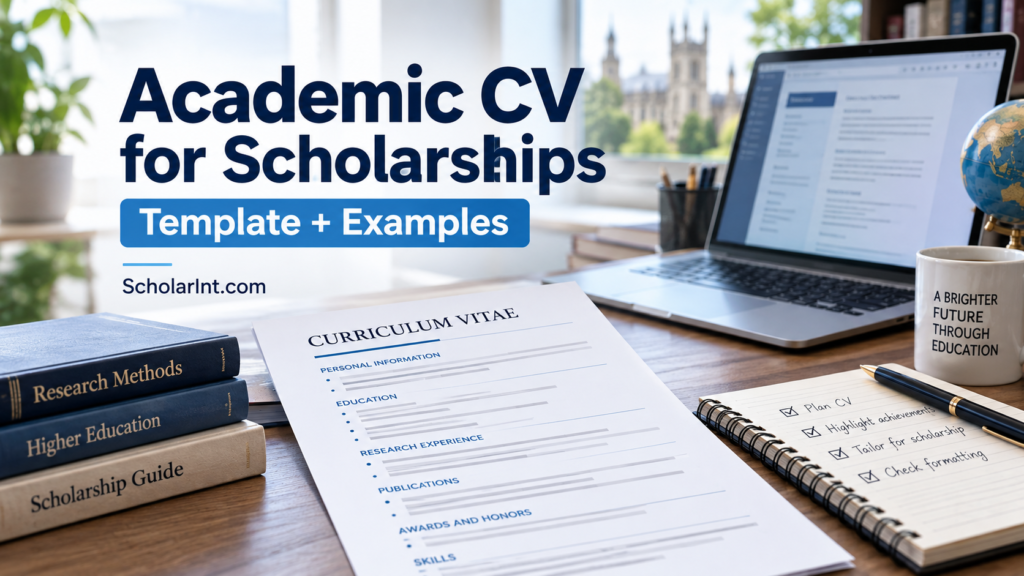
A good academic CV can make a scholarship application much easier to understand. It gives the reviewer a quick picture of your education, research, skills, awards, projects, and experience.
The problem is that many students either make their CV too long, too decorative, or too similar to a job resume. A scholarship CV should be simple, honest, easy to scan, and focused on the things that matter for the programme you are applying to.
This guide shows you exactly how to write an academic CV for scholarships. You will also get a copy-ready template, a full Master’s scholarship CV example, a research/PhD CV example, useful action words, common mistakes, and a final checklist.
Important: Always follow the scholarship or university instructions first. If the application asks for a specific CV format, page limit, or Europass CV, use that format.
What Is an Academic CV?
An academic CV is a document that summarises your academic background and the experiences that support your study or research goals.
It can include:
- Education
- Research experience
- Academic projects
- Publications
- Conference presentations
- Scholarships and awards
- Teaching experience
- Internships
- Volunteer work
- Leadership
- Technical skills
- Languages
For a scholarship application, your CV should help the reviewer answer one main question:
“Does this student have the background, skills, and potential to succeed in this programme?”
Academic CV vs Resume: What Is the Difference?
| Academic CV | Resume |
|---|---|
| Focuses on education, research, academic work, and achievements | Focuses mainly on professional skills and job experience |
| Can be longer when research experience requires it | Usually short and highly job-focused |
| May include publications, conferences, thesis, and research interests | Usually does not include detailed academic research |
| Used for scholarships, graduate study, research, and academic roles | Used mainly for jobs and internships |
If you are an undergraduate student with little research experience, your academic CV may still look similar to a resume. That is completely fine. The important thing is to focus on relevant evidence rather than trying to make the document look “academic” with complicated language.
How Long Should a Scholarship CV Be?
There is no single perfect length.
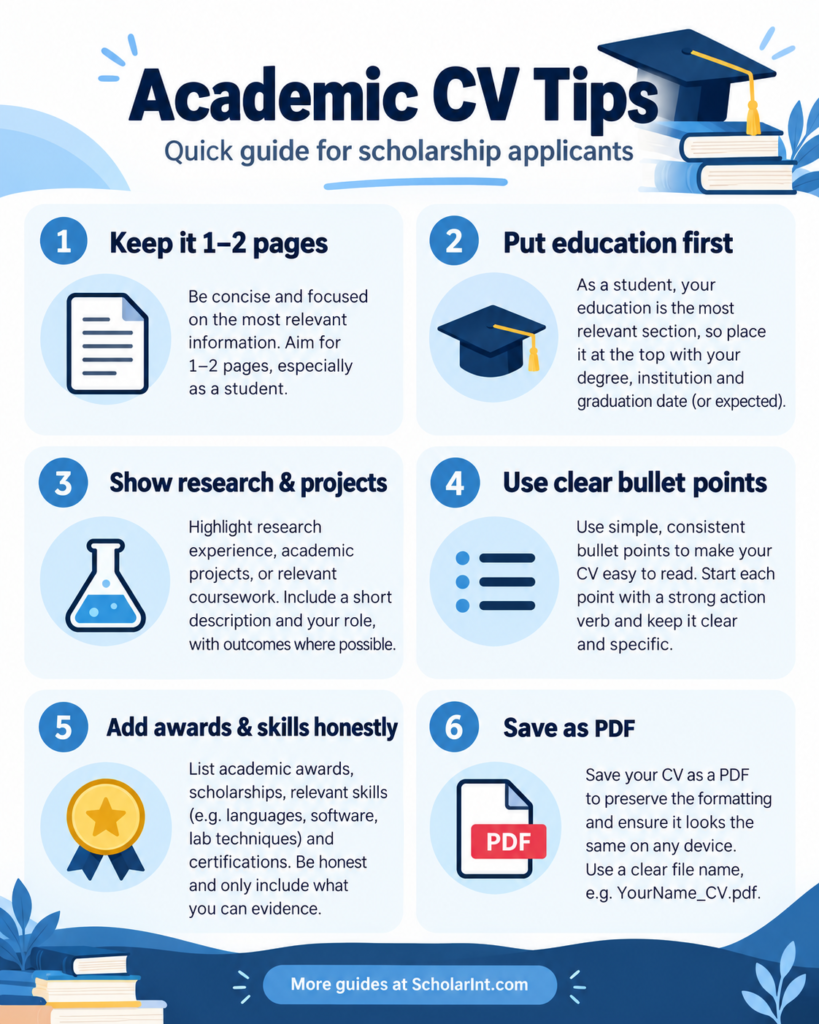
For many undergraduate and Master’s scholarship applicants, one to two pages is often enough. A PhD or research applicant may need more space if they have publications, conferences, research projects, or teaching experience.
Do not add weak information just to make the CV longer.
A clear 1.5-page CV is better than a 4-page CV filled with unrelated details.
Best Order for an Academic Scholarship CV
A simple order that works for many students is:
- Contact Information
- Short Academic Profile or Research Interest
- Education
- Research / Academic Projects
- Work, Internship, or Teaching Experience
- Awards and Scholarships
- Leadership / Volunteering
- Technical and Academic Skills
- Languages
- Publications / Conferences, if applicable
- References, if requested
You do not need every section. Use only the sections that add value to your application.
1. Contact Information
Keep this section simple.
Include:
- Full name
- Professional email address
- Phone number with country code
- City and country
- LinkedIn profile, if useful
- ORCID or Google Scholar profile for research applicants, if useful
You usually do not need to include:
- National ID number
- Passport number
- Religion
- Marital status
- Parents’ names
- Full home address
- Photo, unless the programme specifically asks for one
Example:
Ayesha Khan
Lahore, Pakistan
ayesha.khan@email.com
+92 3XX XXXXXXX
linkedin.com/in/ayeshakhan
2. Academic Profile or Research Interest
This section is optional, but it can be useful when your CV needs a clear direction.
Keep it to around two to four lines.
Weak example:
I am a hardworking and passionate student looking for a challenging opportunity to improve my skills and achieve success.
Better example:
Final-year Biotechnology student with research experience in molecular biology and basic bioinformatics. Interested in genomics, disease biology, and data-driven biomedical research. Seeking a funded Master’s programme that combines laboratory work with computational analysis.
3. Education
List your most recent education first.
Include:
- Degree name
- University
- Location
- Dates
- GPA or grade if strong or required
- Thesis title if relevant
- Relevant coursework only when useful
Example:
BSc Biotechnology
ABC University, Lahore, Pakistan | 2023–2027
CGPA: 3.72/4.00
Final-Year Project: “Expression Analysis of Stress-Related Genes in Wheat”
Relevant Courses: Molecular Biology, Genetics, Bioinformatics, Biostatistics
4. Research Experience and Academic Projects
This is one of the most important sections for research-based scholarships.
Do not only write the project title. Explain what you actually did.
A strong bullet usually follows this pattern:
Action + Method + Topic + Result
Weak:
Worked on a research project about water quality.
Better:
Collected and analysed 45 groundwater samples using standard physicochemical tests and compared results with drinking-water quality guidelines.
If you are applying for research-heavy scholarships, look at the type of achievements competitive programmes value. For example, our Rhodes Scholarship 2027 guide explains how academic achievement, leadership, and service can all matter in a major scholarship selection process.
5. Work Experience, Internship, or Teaching
Do not worry if your experience is not a full-time job.
You can include:
- Internships
- Research assistant work
- Teaching assistant work
- Part-time employment
- Laboratory placements
- Clinical placements
- Relevant freelance work
Use two to four bullets for each important role.
Example:
Research Intern – Molecular Biology Laboratory
XYZ Research Centre | June–August 2026
- Assisted with DNA extraction, PCR preparation, and sample documentation.
- Maintained experimental records and organised data for weekly lab meetings.
- Reviewed recent literature on antimicrobial resistance for a research project.
6. Scholarships, Awards, and Academic Achievements
This section can quickly show academic strength.
Include achievements such as:
- Merit scholarships
- Dean’s list
- Academic medals
- Research prizes
- Competition awards
- High-ranking certificates
Add the year and, when useful, one short line explaining the award.
Example:
Dean’s Merit Scholarship, 2025
Awarded to students with outstanding academic performance in the Faculty of Science.
7. Leadership and Volunteer Experience
Scholarship committees often care about what you do outside the classroom.
You can include:
- Student societies
- Community projects
- Mentoring
- Volunteer teaching
- Event organisation
- Fundraising
- Environmental projects
- Leadership roles
Again, focus on what you did and what happened because of your work.
Example:
Volunteer Coordinator – Student Science Society
- Organised a team of 18 volunteers for three science outreach events.
- Helped deliver practical science sessions to more than 150 school students.
- Created a simple volunteer schedule that reduced missed shifts during events.
8. Technical and Academic Skills
Only list skills you can genuinely use.
Possible examples:
- R
- Python
- SPSS
- MATLAB
- GIS
- Microsoft Excel
- Laboratory techniques
- Statistical analysis
- Scientific writing
- Reference management software
- Data visualisation
Avoid rating yourself with unclear bars such as “Python: 90%”.
Instead, group skills:
Data Analysis: R, Excel, basic Python
Laboratory: PCR, gel electrophoresis, DNA extraction
Research Tools: Zotero, PubMed, Google Scholar
9. Languages
Use simple, honest levels.
Example:
English – Professional working proficiency
Urdu – Native
German – Basic
If you have an official test score and it is relevant, you may add it.
10. Publications and Conference Presentations
This section is mainly useful for research applicants.
Do not create a “Publications” section if you have no publications.
If a paper is genuinely published, accepted, or under review, label its status correctly.
Example:
Khan, A., Ali, S., & Ahmed, R. (2026). “Title of Article.” Journal Name, 12(3), 110–120.
Never list an undergraduate assignment as a “publication”.
Should You Add References?
Add references only if the application asks for them or if there is a clear reason to include them.
If references are submitted separately through an online portal, there is usually no need to repeat full referee details on the CV.
You can simply write:
References available on request.
Ready-to-Copy Academic CV Template
How to use it: Copy the template below into Word, Google Docs, or Canva. Replace every item in square brackets with your own information. Delete sections that do not apply to you.
READY TO COPY — ACADEMIC CV TEMPLATE
[YOUR FULL NAME]
[City, Country] | [Phone] | [Professional Email]
[LinkedIn] | [ORCID/Google Scholar if relevant]

ACADEMIC PROFILE
[2–4 lines explaining your current academic level, main field, strongest relevant experience, and future study/research interest.]

EDUCATION
[Degree Name]
[University Name], [City, Country] | [Start Year]–[End Year]
GPA/Grade: [X.XX/4.00 or classification]
Thesis/Final Project: “[Title]”
Relevant Coursework: [Course 1, Course 2, Course 3]

RESEARCH EXPERIENCE / ACADEMIC PROJECTS
[Project or Role Title]
[University/Lab/Organisation] | [Dates]
• [Action + method + topic]
• [What you analysed, built, tested, reviewed, or studied]
• [Result, output, skill, or finding]

[Second Project if relevant]
• [Bullet]
• [Bullet]

WORK / INTERNSHIP / TEACHING EXPERIENCE
[Role Title]
[Organisation] | [Dates]
• [Responsibility + action]
• [Result or achievement]
• [Relevant skill developed]

SCHOLARSHIPS & AWARDS
• [Award Name] — [Year]
  [One-line explanation if needed]
• [Award Name] — [Year]

LEADERSHIP & VOLUNTEERING
[Role]
[Organisation] | [Dates]
• [What you did]
• [Impact/result]

TECHNICAL & ACADEMIC SKILLS
• Data/Software: [R, Python, SPSS, Excel, etc.]
• Research: [Literature review, statistics, lab techniques, etc.]
• Other: [Relevant tools]

LANGUAGES
• [Language] — [Level]
• [Language] — [Level]

PUBLICATIONS / PRESENTATIONS
[Only include real publications, accepted papers, posters, or conference presentations.]

REFERENCES
[Add only if requested, otherwise: “Available on request.”]
Full Sample Academic CV for a Master’s Scholarship
The sample below is fictional. Use it to understand the format and level of detail.
SAMPLE CV — MASTER’S SCHOLARSHIP
AYESHA KHAN
Lahore, Pakistan | +92 3XX XXXXXXX | ayesha.khan@email.com
linkedin.com/in/ayeshakhan

ACADEMIC PROFILE
Final-year BSc Biotechnology student with a CGPA of 3.72/4.00 and hands-on experience in molecular biology, basic bioinformatics, and scientific writing. Interested in genomics and biomedical data analysis. Seeking a funded Master’s programme that combines laboratory research with computational methods.

EDUCATION
BSc Biotechnology
ABC University, Lahore, Pakistan | 2023–2027
CGPA: 3.72/4.00
Final-Year Project: “Expression Analysis of Stress-Related Genes in Wheat”
Relevant Coursework: Molecular Biology, Genetics, Bioinformatics, Biostatistics

RESEARCH EXPERIENCE
Final-Year Research Project
Department of Biotechnology, ABC University | 2026–2027
• Extracted RNA from plant samples and supported gene-expression analysis.
• Organised experimental data and reviewed literature on stress-response genes.
• Prepared research figures and presented preliminary findings to faculty.

Research Intern
XYZ Molecular Biology Centre | June–August 2026
• Assisted with DNA extraction, PCR preparation, and gel electrophoresis.
• Maintained sample records and prepared weekly data summaries.
• Reviewed journal articles on antimicrobial resistance.

ACADEMIC PROJECTS
Bioinformatics Mini Project | 2025
• Used public sequence databases to compare selected bacterial gene sequences.
• Prepared a short report explaining sequence similarity and possible biological relevance.

AWARDS
Dean’s Merit Scholarship | 2025
Awarded for strong academic performance in the Faculty of Science.

LEADERSHIP & VOLUNTEERING
Volunteer Coordinator, Student Science Society | 2025–2026
• Coordinated 18 volunteers for three school science outreach events.
• Helped deliver practical science activities to more than 150 students.

TECHNICAL SKILLS
Laboratory: PCR, DNA extraction, gel electrophoresis, basic microscopy
Data: Excel, basic R, basic Python
Research: Literature review, PubMed, Zotero, scientific writing

LANGUAGES
Urdu — Native
English — Professional working proficiency

REFERENCES
Available on request.
Full Sample Academic CV for a PhD or Research Scholarship
SAMPLE CV — PhD / RESEARCH SCHOLARSHIP
OMAR RAHMAN
Islamabad, Pakistan | omar.rahman@email.com | +92 3XX XXXXXXX
LinkedIn: linkedin.com/in/omarrahman
ORCID: 0000-0000-0000-0000

RESEARCH INTERESTS
Computational biology, cancer genomics, transcriptomics, machine learning for biomedical data, and reproducible research.

EDUCATION
MSc Bioinformatics
XYZ University | 2024–2026
CGPA: 3.85/4.00
Thesis: “Gene Expression Signatures Associated with Therapy Resistance in Breast Cancer”

BSc Biological Sciences
ABC University | 2020–2024
CGPA: 3.68/4.00

RESEARCH EXPERIENCE
Graduate Researcher
Computational Biology Lab, XYZ University | 2025–2026
• Analysed public RNA-seq datasets to identify differentially expressed genes.
• Performed statistical analysis and data visualisation in R.
• Built reproducible analysis workflows and documented methods for lab use.
• Presented results during monthly research meetings.

Research Assistant
ABC Biomedical Research Centre | 2024–2025
• Supported literature review and dataset curation for a cancer genomics project.
• Cleaned clinical metadata and assisted with exploratory statistical analysis.
• Contributed figures and methods notes for a research manuscript.

PUBLICATIONS
Rahman, O., et al. (2026). “[Article Title].” [Journal Name]. [Status: Accepted / Published]

CONFERENCE PRESENTATIONS
Poster: “Transcriptomic Markers of Therapy Resistance”
National Bioinformatics Conference | 2026

TEACHING EXPERIENCE
Teaching Assistant — Introduction to Bioinformatics | 2025
• Supported practical sessions for 35 undergraduate students.
• Assisted students with sequence analysis and basic R exercises.

AWARDS
Graduate Research Scholarship | 2025–2026
Best Student Poster Award | National Bioinformatics Conference, 2026

TECHNICAL SKILLS
Programming: R, Python
Bioinformatics: RNA-seq analysis, BLAST, sequence analysis
Data: Statistical analysis, data visualisation, reproducible workflows
Tools: Git, RStudio, Jupyter, Zotero

LANGUAGES
English — Professional working proficiency
Urdu — Native

REFERENCES
Dr [Name], Professor of Bioinformatics, XYZ University
[Email]

Dr [Name], Senior Researcher, ABC Biomedical Research Centre
[Email]
What If You Have No Research or Work Experience?
You can still build a strong scholarship CV.
Use what you genuinely have.
You can include:
- Final-year project
- Course projects
- Laboratory assignments
- Online courses with practical projects
- Student society work
- Volunteer experience
- Peer tutoring
- Competitions
- Academic awards
- Independent projects
For example, instead of leaving the CV empty, write:
Data Analysis Course Project
Analysed a public dataset in Excel, created charts, and prepared a five-page report explaining the main trends and limitations.
This is much stronger than writing “No experience”.
How to Tailor Your CV for Each Scholarship
Do not send the exact same CV to every scholarship.
You do not need to rewrite everything, but you should change the order and emphasis.
For a research scholarship:
- Move research experience higher.
- Highlight methods and technical skills.
- Add publications and presentations.
For a leadership scholarship:
- Keep academic performance strong.
- Give leadership and community experience more space.
- Use measurable examples of impact.
For a taught Master’s scholarship:
- Focus on academic fit.
- Highlight relevant courses, projects, internships, and goals.
- Make sure the CV supports the story in your motivation letter.
If you are also preparing your written statement, use our Scholarship Motivation Letter guide with templates and examples so your CV and motivation letter support each other instead of repeating the same information.
Strong Action Words for a Scholarship CV
Use simple action verbs at the beginning of your bullets.
| Purpose | Useful Words |
|---|---|
| Research | Analysed, investigated, reviewed, evaluated, collected, tested |
| Projects | Designed, developed, created, built, implemented, prepared |
| Leadership | Led, coordinated, organised, mentored, supervised |
| Communication | Presented, wrote, explained, taught, reported |
| Results | Improved, increased, reduced, completed, achieved |
Use the word that honestly describes what you did. Do not write “led” if you only attended.
10 Common Scholarship CV Mistakes
1. Using a Fancy Design That Is Hard to Read
Simple formatting usually works better. Reviewers need to find information quickly.
2. Writing Long Paragraphs
Use short bullets for experience and achievements.
3. Adding Unrelated Personal Information
Your marital status, religion, passport number, and parents’ information usually do not belong on an academic CV.
4. Listing Skills You Cannot Use
Do not add software or laboratory techniques just because they look impressive.
5. Repeating the Same Information in Every Section
Each section should add something new.
6. Using a Generic “Career Objective”
A short academic profile should explain your real direction, not say that you want a “challenging opportunity”.
7. Hiding Important Academic Information
If your thesis, research project, or award is relevant, make it easy to find.
8. Using an Unprofessional Email Address
Use a simple email based on your real name.
9. Ignoring the Scholarship Instructions
If a scholarship asks for a one-page CV, do not send three pages.
10. Using AI to Invent Achievements
AI can help improve wording, but every degree, grade, project, publication, award, and skill on your CV must be true.
Formatting Rules That Make a CV Easier to Read
- Use one clean font.
- Keep headings consistent.
- Use the same date style everywhere.
- Leave enough white space.
- Use bold for degree names, roles, and important headings.
- Keep bullet points short.
- Save the final file as PDF unless another format is requested.
- Use a professional filename.
A good filename is:
Ayesha_Khan_Academic_CV.pdf
Not:
finalcvnew2UPDATED.pdf
Final Academic CV Checklist
Before submitting, check:
- Is my name and contact information correct?
- Does my CV match the scholarship I am applying for?
- Is my most relevant education easy to find?
- Did I explain what I actually did in projects and experience?
- Did I use strong but honest action words?
- Are all dates consistent?
- Are my GPA, grades, awards, and publications accurate?
- Did I remove personal information that is not needed?
- Did I follow the required page limit?
- Did I check spelling and grammar?
- Is the PDF filename professional?
- Does the CV support the story in my motivation letter?
Frequently Asked Questions
Should a scholarship CV have a photo?
Usually not unless the scholarship, university, or local application format asks for one.
Can I use Canva for an academic CV?
Yes, but choose a very simple design. Avoid graphics, skill bars, icons everywhere, or layouts that make academic information hard to scan.
Should I include my GPA?
Include it when it is strong, required, or helpful for understanding your academic performance. Never change or inflate it.
Can a scholarship CV be two pages?
Yes. Many student CVs fit comfortably within one or two pages, but research applicants may need more space. Follow the scholarship instructions first.
Should I include high school education?
Undergraduate scholarship applicants may need it. Master’s and PhD applicants usually focus more on university-level education unless high school information is specifically relevant.
What if I have no publications?
Leave the publications section out. Do not create weak or false entries just to fill space.
Should my CV and motivation letter say the same thing?
They should support the same story, but they should not repeat each other word for word. The CV gives evidence; the motivation letter explains meaning, motivation, and goals.
Final Thoughts
A strong academic CV is not about using the most impressive design or the most complicated words.
It is about making your strongest evidence easy to find.
Start with your education. Add the projects, research, internships, awards, skills, and leadership that are most relevant to the scholarship. Use clear bullets. Show results where possible. Then remove anything that does not help the reviewer understand your academic potential.
For highly competitive programmes, your CV should also match the priorities of the scholarship. A research award may care more about technical work, while a leadership scholarship may give more attention to service and responsibility.
Once your CV is ready, compare it with your application statement before submitting. Together, the two documents should give the reviewer a clear picture of what you have done, what you want to do next, and why you are ready for the opportunity.
2 Comments