How to Write a Scholarship Motivation Letter + Examples
September 27, 2026
How to Write a Scholarship Motivation Letter + Examples
Learn how to write a scholarship motivation letter with a simple structure, copy-ready template, full examples, sentence starters, mistakes to avoid, and a final checklist.
A strong scholarship application can fail because of a weak motivation letter. Many students have good grades, but their letter sounds generic, too formal, or copied from the internet. A good motivation letter should do one simple job: show the selection committee who you are, what you want to study, why this opportunity matters, and what you plan to do with it.
This guide explains how to write a scholarship motivation letter in simple steps. You will also find a copy-ready template, full sample letters, useful sentence starters, common mistakes, and a final checklist you can use before submitting.
Quick Rule: Never send a sample letter exactly as it is. Use the structure, then replace the examples with your own story, goals, achievements, and reasons for applying.
What Is a Scholarship Motivation Letter?
A scholarship motivation letter is a short written statement that explains why you are a strong candidate for a scholarship, university programme, fellowship, or funded research opportunity.
It usually answers questions like:
Why do you want this scholarship?
Why did you choose this course or university?
What have you done so far that prepares you for this opportunity?
What are your future goals?
How will the scholarship help you achieve those goals?
What positive impact do you hope to make later?
Some universities call this document a statement of motivation, motivation statement, scholarship essay, or personal statement. These terms can overlap, but they are not always exactly the same. Always follow the wording and questions given by the scholarship provider.
What Scholarship Committees Really Want to See
A strong letter is not a list of impressive words. It should give the reader clear evidence that you are a good fit.
Most committees look for some combination of the following:
Academic fit: your previous study matches the programme.
Motivation: you have a clear reason for choosing the subject.
Evidence: you can support your claims with real examples.
Goals: you know what you want to do next.
Impact: the scholarship will help you do something useful.
Character: you show responsibility, persistence, leadership, service, or curiosity.
Programme fit: you understand why this university or scholarship is right for you.
For example, some programmes ask applicants to explain leadership, future impact, or sustainability goals. The Cambridge Mastercard Foundation Scholarship is one example where the scholarship statement is an important part of the application.
The Best Structure for a Motivation Letter
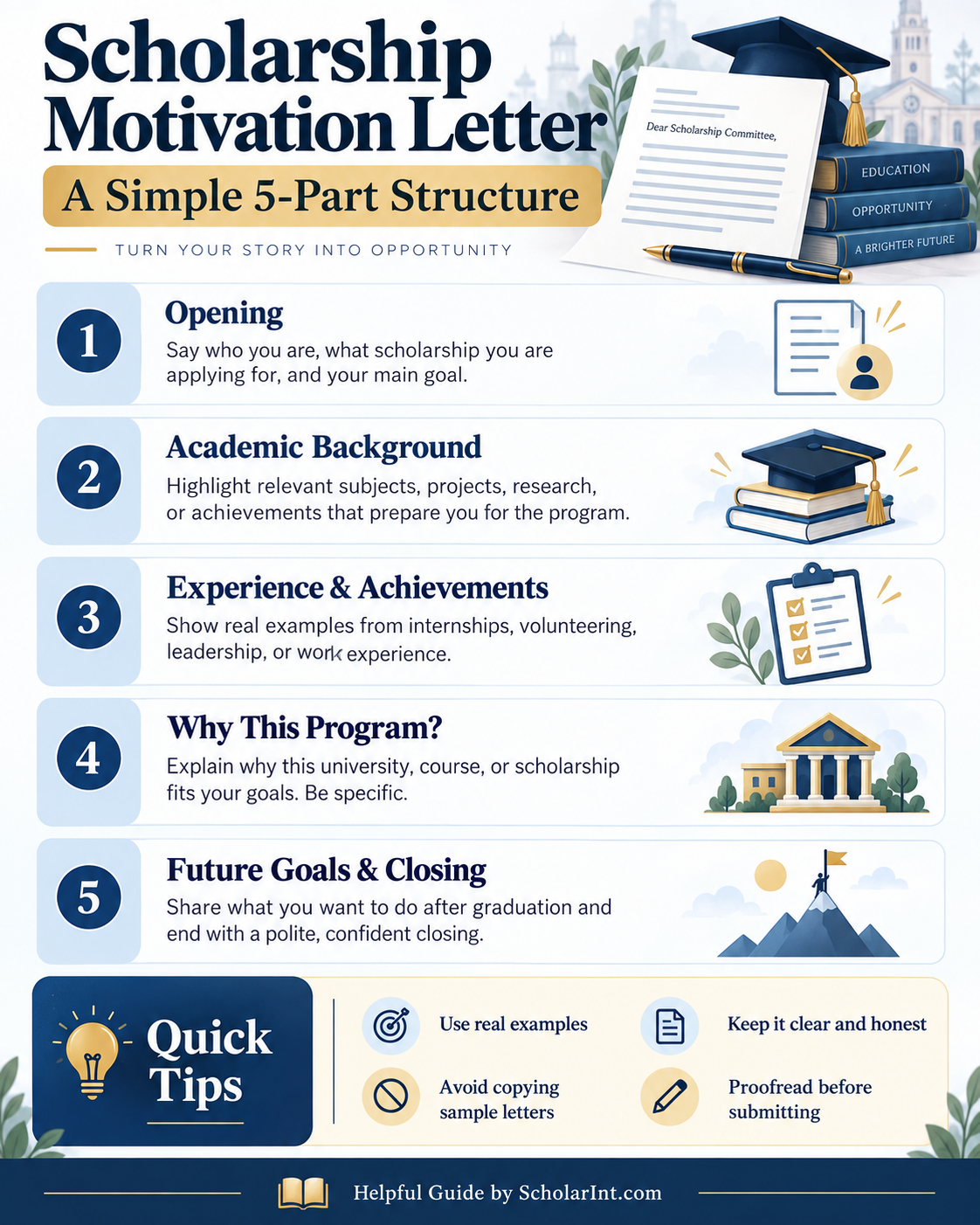
A simple five-part structure works well for most scholarships.
1. Opening: Who You Are and What You Are Applying For
Start clearly. Do not waste the first paragraph with long quotes or dramatic sentences.
A good opening tells the reader:
Your current academic or professional position
The scholarship or programme you are applying for
Your main reason for applying
Example:
I am a final-year Environmental Science student at [University Name], and I am applying for the [Scholarship Name] to pursue the Master’s programme in Environmental Management at [University Name]. My academic work and community experience have strengthened my interest in practical solutions for water and climate challenges.
2. Academic Background: Show Preparation
Explain the part of your education that is most relevant to the programme.
Do not repeat your full CV. Choose two or three strong points.
You can mention:
Relevant subjects
Research projects
Final-year thesis
High academic performance
Laboratory or technical skills
Academic awards
Weak: “I am a hardworking student with excellent academic skills.”
Better: “During my final-year project, I analysed groundwater samples from three districts and learned how field data can be used to support public-health decisions.”
3. Experience and Achievements: Prove Your Claims
This paragraph can include work, volunteering, leadership, internships, research, or community activities.
Use a simple pattern:
Situation → Action → Result → Lesson
For example:
While volunteering with a local education group, I noticed that many students were missing application deadlines because scholarship information was difficult to understand. I helped create a simple weekly information sheet and shared it through student groups. Within three months, more than 100 students were using the guide. This experience taught me how clear communication can improve access to opportunities.
4. Why This Programme and Scholarship?
This is where many letters become too generic.
Do not write:
Your university is one of the best universities in the world and I have always dreamed of studying there.
Instead, be specific.
Mention things like:
A course or module
A research area
A programme feature
A laboratory or centre
An internship or industry link
A scholarship value that matches your goals
Example:
I am particularly interested in the programme’s focus on urban sustainability and applied research. The combination of policy, environmental planning, and project-based learning matches my goal of working on climate-resilient city planning in my home country.
For some scholarships, your motivation letter can directly affect funding decisions. Roskilde University, for example, considers the motivation letter as part of the scholarship ranking process for eligible applicants. You can read our Roskilde University Scholarship 2027 guide for a real example of this type of application.
5. Future Goals and Closing
End by showing direction.
Explain:
What you want to do after graduation
How the scholarship will help
What kind of impact you hope to make
Keep the closing confident but not arrogant.
Example:
This scholarship would allow me to focus fully on my studies and gain the skills needed to work on evidence-based environmental policy. After graduation, I hope to return to my region and contribute to projects that improve water management and climate resilience. Thank you for considering my application.
Copy-Ready Scholarship Motivation Letter Template
You can copy the template below and replace the text in square brackets.
Dear Scholarship Selection Committee,
I am [your current position, for example: a final-year Bachelor’s student in Economics at XYZ University], and I am applying for the [Scholarship Name] to study [Programme Name] at [University Name]. My interest in [field] developed through [short reason or experience], and I now want to build the knowledge and skills needed to [main career or impact goal].
During my studies, I have focused on [relevant subjects, research, or skills]. One of the most important experiences for me was [project, thesis, internship, or achievement]. Through this experience, I learned [specific skill or lesson], and it confirmed my interest in [field or problem].
Outside the classroom, I have also been involved in [work, volunteering, leadership, student society, research, community project, etc.]. In this role, I [what you did]. As a result, [result or impact]. This experience helped me develop [skills such as teamwork, leadership, problem-solving, communication, or responsibility].
I am especially interested in [University/Programme Name] because of [specific course, research area, programme feature, faculty strength, or opportunity]. This fits closely with my goal of [future goal]. I believe the programme will help me strengthen my knowledge of [specific area] and prepare me to [future work or contribution].
The [Scholarship Name] would make this opportunity possible by [explain financial or academic benefit without sounding desperate]. More importantly, it would allow me to focus on my studies, take part in [research/community/professional opportunity], and build the skills needed to [long-term goal].
After completing the programme, I plan to [career plan]. In the longer term, I hope to [impact goal]. I would be grateful for the opportunity to join [University/Scholarship Community] and contribute through my academic work, experience, and commitment to [relevant field or community].
Thank you for considering my application.
Sincerely, [Your Full Name]
Full Sample Motivation Letter for a Master’s Scholarship
This example is fictional. Use it to understand the structure, not as a letter to submit unchanged.
Dear Scholarship Selection Committee,
I am completing a Bachelor’s degree in Environmental Sciences and am applying for the Green Futures Master’s Scholarship to study Environmental Policy and Management. My interest in this field began during my undergraduate studies, when I saw how water shortages and poor waste management affected communities close to my university. I want to build the technical and policy skills needed to help cities respond to these challenges in a practical way.
During my degree, I studied environmental chemistry, water management, statistics, and geographic information systems. My final-year project examined the quality of groundwater samples collected from three local areas. I was responsible for organising the data, reviewing the results, and presenting the findings to my department. The project taught me how scientific evidence can support better public decisions.
I also volunteered with a student environmental group that worked with local schools. I helped organise awareness sessions on plastic waste and water conservation. At first, attendance was low, so our team changed the sessions from long lectures to short activities and demonstrations. Participation improved, and the experience taught me that good environmental work requires communication as well as technical knowledge.
I am interested in the Master’s programme because it combines environmental science with policy, planning, and applied research. The module on climate adaptation is especially relevant to my goal of working on urban resilience. I also value the opportunity to complete a practical research project, because I want to learn how to turn data into realistic policy recommendations.
The scholarship would allow me to focus fully on the programme and take part in academic and community activities that would otherwise be difficult for me to afford. I see the scholarship not only as financial support but as an opportunity to become part of a network of students who want to use education to solve real problems.
After graduation, I plan to work with an environmental agency or development organisation on water and climate-resilience projects. In the long term, I hope to help design practical policies for cities facing water stress and rapid population growth. I believe this Master’s programme would give me the knowledge, research skills, and international perspective needed to move toward that goal.
Thank you for considering my application.
Sincerely, [Student Name]
Full Sample Motivation Letter for an Undergraduate Scholarship
Dear Scholarship Selection Committee,
I am applying for the International Undergraduate Merit Scholarship to study Computer Science at [University Name]. I became interested in technology during secondary school when I started learning basic programming through free online lessons. What began as curiosity became a serious academic goal when I created a simple attendance-tracking tool for a school project.
My strongest subjects are mathematics, computer science, and physics. I enjoy problems that require patience and logical thinking. During my final school year, I worked with two classmates to build a small website for our science club. I was responsible for organising the content and learning enough HTML and JavaScript to make the pages work properly. This experience showed me that I enjoy learning by building things.
I have also volunteered as a peer tutor for younger students in mathematics. Teaching others helped me become more patient and improved the way I explain difficult ideas. It also made me realise that technology is most useful when it solves a real problem for people.
I chose [University Name] because the Computer Science programme combines strong technical foundations with practical projects. I am particularly interested in learning more about software development and data science. My long-term goal is to work on digital tools that improve access to education and public services.
Receiving this scholarship would reduce the financial pressure of international tuition and allow me to focus more fully on my studies. I would also like to contribute to student societies, peer-support activities, and technology projects on campus.
I am ready to work hard, learn from others, and make the most of this opportunity. Thank you for considering my application.
Sincerely, [Student Name]
Full Sample Motivation Letter for a Research or PhD Scholarship
Dear Scholarship Selection Committee,
I am applying for the Doctoral Research Scholarship in Computational Biology at [University Name]. My academic background in molecular biology and bioinformatics has led me to a strong interest in using computational methods to understand disease mechanisms and improve biomedical research.
During my Master’s degree, I worked on a research project that analysed gene-expression data from publicly available cancer datasets. I learned to clean and organise large datasets, use statistical tools, and interpret biological results. More importantly, I learned how careful research design can prevent misleading conclusions.
After completing my degree, I worked as a research assistant in a molecular biology laboratory. My role included sample preparation, data management, literature review, and support for ongoing research projects. Working closely with both laboratory and computational researchers helped me understand the value of interdisciplinary research.
I am particularly interested in this doctoral project because it combines computational modelling with biological questions that have direct relevance to human health. The research group’s work on [specific topic] matches my previous experience and would allow me to develop stronger skills in [specific methods].
My long-term goal is to build a research career focused on data-driven approaches to biomedical science. I also hope to contribute to research training and scientific collaboration in my home region. This scholarship would give me the time, supervision, and research environment needed to develop as an independent researcher.
Thank you for considering my application.
Sincerely, [Student Name]
Useful Sentence Starters You Can Adapt
For the Opening
I am applying for the [Scholarship Name] to pursue…
My interest in [field] developed when…
I am currently completing…
I hope to build on my background in…
For Academic Experience
During my undergraduate studies, I developed a strong interest in…
My final-year project focused on…
A course that strongly influenced my goals was…
This experience helped me understand…
For Leadership or Community Work
Outside my academic work, I have been involved in…
In this role, I was responsible for…
One challenge I faced was…
This experience taught me…
For Programme Fit
I am particularly interested in this programme because…
The opportunity to study [specific topic] is important to me because…
This programme fits my goals by…
I am especially drawn to…
For Future Goals
After graduation, I plan to…
In the long term, I hope to…
I want to use this training to…
My goal is to contribute to…
How Long Should a Motivation Letter Be?
There is no universal length.
If the scholarship gives a word limit, follow it exactly.
If no limit is given, a practical target for many applications is around 500 to 800 words. Some programmes ask for shorter statements, while others may allow 1,000 words or more.
Do not make the letter longer just to sound impressive. A clear 600-word letter is better than a repetitive 1,200-word letter.
Motivation Letter vs Personal Statement
These two documents are often similar, but there can be a difference.
Motivation Letter
Personal Statement
Usually focuses more on why you want the programme or scholarship
Often gives more space to your personal journey and background
Explains academic and career goals
May discuss identity, experiences, challenges, and growth
Often more direct and professional
Can be more personal and reflective
May be addressed to a committee
Often written as an essay without a greeting
Always check the application instructions. If the form gives specific questions, answer those questions instead of forcing your letter into a general template.
10 Common Motivation Letter Mistakes
1. Starting With a Famous Quote
The committee wants to hear your story, not someone else’s quote.
2. Using the Same Letter for Every Scholarship
A generic letter usually sounds generic. Change the programme-fit section for every application.
3. Repeating Your CV
Do not list every activity. Explain why the most relevant experiences matter.
4. Making Claims Without Evidence
If you say you are a leader, give an example of leadership.
5. Writing Only About Financial Need
Financial need may be important, but most scholarships also want to understand your academic fit, goals, and potential.
6. Using Too Much Formal Language
Simple sentences are easier to trust than complicated phrases copied from formal templates.
7. Praising the University Too Much
Do not spend half the letter saying the university is prestigious. Explain why the programme fits you.
8. Writing a Life Story With No Direction
Your experiences should connect to the scholarship and your future goals.
9. Ignoring the Scholarship’s Values
If the scholarship focuses on leadership, community service, research, climate, or another theme, address that theme honestly.
10. Submitting AI-Generated Text Without Personalising It
AI can help you organise ideas or improve grammar, but it should not invent achievements or replace your real voice. A committee can learn much more from one specific, genuine example than from a page of polished but empty language.
A Simple Formula for Every Paragraph
If you get stuck, use this formula:
Claim → Example → Result → Connection
For example:
Claim: I developed strong teamwork skills during my internship. Example: I worked with four team members to prepare weekly project reports. Result: We reduced reporting delays and improved communication with the supervisor. Connection: This experience prepared me for collaborative work in the Master’s programme.
How to Make Your Letter Sound Human
You do not need dramatic writing. You need clear writing.
Try these simple rules:
Use short sentences.
Use real examples.
Write the way an educated person would speak.
Avoid words you would never normally use.
Do not repeat “I am passionate” in every paragraph.
Use numbers when they add useful detail.
Explain what you learned, not only what you did.
For example:
Generic: “I am extremely passionate about helping society and becoming a global leader.”
Human: “While volunteering at a weekend tutoring programme, I worked with students who were preparing for university entrance tests. Seeing how much a small amount of support could change their confidence made me want to stay involved in education.”
Final Scholarship Motivation Letter Checklist
Before you submit, check every item below.
Did I use the correct scholarship and university name?
Did I answer the actual application question?
Did I explain why I chose the programme?
Did I include real examples instead of general claims?
Did I connect my past experience to my future goals?
Did I explain how the scholarship will help?
Did I show what I hope to contribute later?
Did I remove repeated sentences?
Did I check grammar and spelling?
Did I stay within the word limit?
Does the letter sound like me?
Did I avoid copying a sample word for word?
Final Thoughts
A scholarship motivation letter does not need to sound perfect. It needs to sound clear, honest, and specific.
The strongest letters usually have three things: a clear goal, real evidence, and a strong connection between the student and the opportunity.
Start with your own story. Choose two or three experiences that matter. Explain what you learned. Then show how the scholarship can help you move from where you are now to where you want to go.
If you are applying for a highly competitive programme, you may also find our Rhodes Scholarship 2027 guide useful for seeing how major scholarships evaluate academic achievement, leadership, service, and future potential.
2 Comments