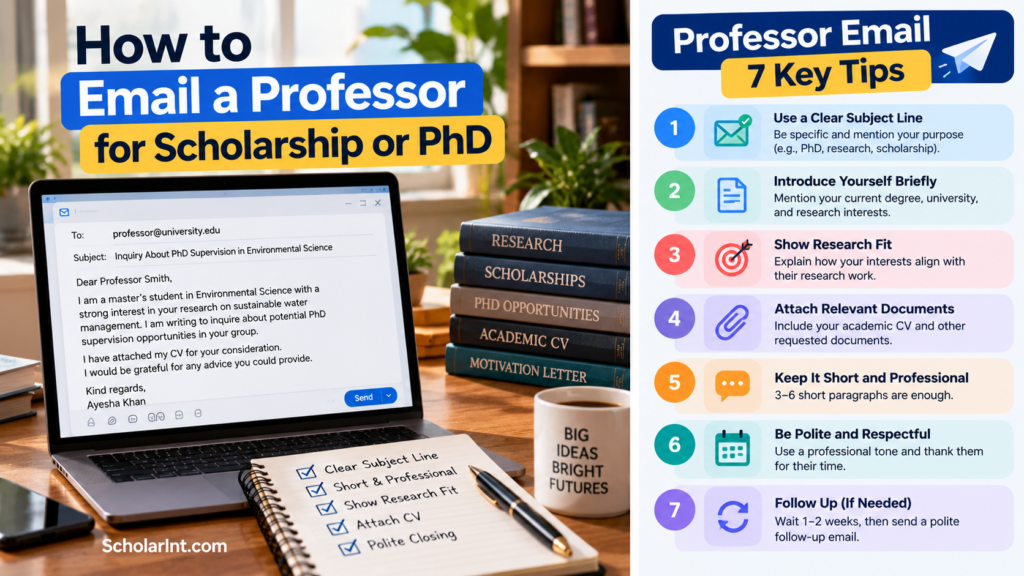
Emailing a professor can feel difficult, especially when you are asking about a research position, Master’s supervision, PhD funding, a recommendation, or a meeting. The good news is that a strong email does not need to be long or complicated.
A good professor email should be clear, respectful, specific, and easy to answer. It should show that you know who you are contacting and why your background may fit their work.
This guide explains how to email a professor step by step. You will also find ready-to-copy subject lines, first-contact templates, funding inquiry emails, follow-up emails, meeting requests, thank-you emails, and common mistakes to avoid.
Quick Rule: Do not send the same email to 50 professors. A short, personalised email sent to the right professor is usually better than a long generic message.
When Should You Email a Professor?
You may need to contact a professor when you want to:
- Ask about a funded PhD position
- Ask whether they are accepting new graduate students
- Discuss possible Master’s or PhD supervision
- Ask about joining a research group
- Request a short meeting
- Ask a specific academic question
- Follow up after an application or earlier conversation
- Thank them after an interview or meeting
Before emailing, always check whether the university or scholarship already gives clear instructions. If the website says “do not contact supervisors before applying,” follow that rule.
What Makes a Professor Reply?
Professors are busy. Your goal is not to impress them with long writing. Your goal is to make it easy for them to understand your message.
A strong email usually has five parts:
- A clear subject line
- A short introduction
- A specific reason for contacting them
- A brief explanation of why your background fits
- A simple question or next step
The Best Email Structure
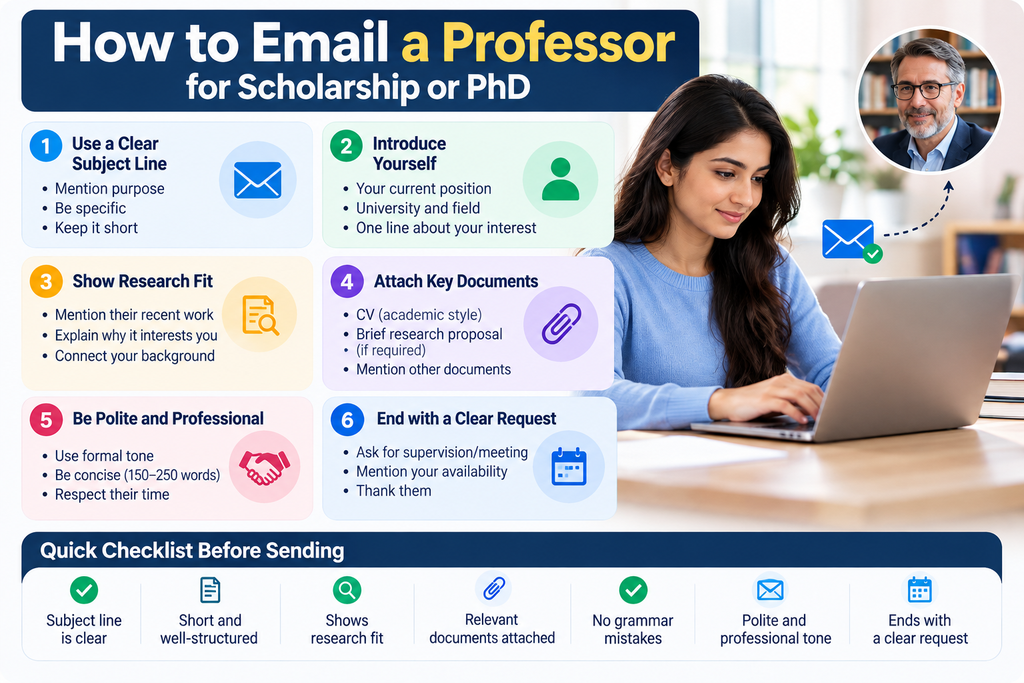
1. Use a Clear Subject Line
Your subject line should explain the purpose of the email in a few words.
Good examples:
- Prospective PhD Student – Machine Learning for Healthcare
- Research Supervision Inquiry – Environmental Engineering
- PhD Funding Inquiry for 2027 Entry
- Master’s Research Project Inquiry – Molecular Biology
- Request for a Short Research Meeting
Avoid vague subjects such as:
- Hello Sir
- Scholarship
- Urgent
- Need Help
- Admission
- Request
2. Address the Professor Correctly
Use:
Dear Professor [Last Name],
or, if you know they use “Dr”:
Dear Dr [Last Name],
Do not write:
- Dear Sir/Madam
- Hi Teacher
- Respected Sir
- Dear Mr Professor
If you are unsure about the title, check the university profile page.
3. Introduce Yourself in One or Two Sentences
Tell the professor who you are and what you are doing now.
Example:
I am completing an MSc in Bioinformatics at XYZ University, where my research focuses on transcriptomic analysis of cancer datasets.
That is stronger than:
My name is Ali and I am a very passionate and hardworking student who has always dreamed of studying abroad.
4. Show That You Know Their Research
This is the most important part of a research email.
Mention one specific topic, paper, project, or research area.
Example:
I was particularly interested in your group’s recent work on interpretable machine learning for clinical prediction, especially the way your team combines model performance with explainability.
Do not pretend you read a paper if you did not. One honest sentence is enough.
5. Explain Why You May Be a Good Fit
Connect your own background to the professor’s work.
You can mention:
- Your thesis
- Research methods
- Relevant coursework
- Programming skills
- Laboratory skills
- Publications
- Research assistant experience
Example:
My current project uses R and Python to analyse RNA-seq data, and I have experience with differential expression analysis, data visualisation, and reproducible workflows.
If your academic CV needs work first, use our Academic CV for Scholarships guide before contacting supervisors.
6. Ask One Clear Question
Do not ask five questions in one email.
A good question might be:
- Are you accepting PhD students for 2027 entry?
- Would my background be suitable for your research group?
- May I ask whether funded positions are expected in your lab?
- Would you be available for a short meeting to discuss possible supervision?
7. End Politely
A simple ending is enough:
Thank you for your time and consideration. I have attached my CV for reference and would be grateful for any guidance.
Best regards,
[Your Name]
Ready-to-Copy Email to a Professor for PhD Supervision
Use this when: You have identified a professor whose research matches your background and you want to ask about PhD supervision.
READY TO COPY — PhD SUPERVISION EMAIL
Subject: Prospective PhD Student – [Your Research Area]

Dear Professor [Last Name],

I am [your current position/degree] at [University Name], where I am working on [short research topic].

I am contacting you because I am very interested in your research on [specific research area]. I was particularly interested in [specific paper/project/topic] because [one short reason].

My background includes experience in [2–3 relevant methods, subjects, or skills]. In my current/previous research, I [one clear example of relevant work].

I am planning to apply for PhD study for [2027 entry / specific intake]. May I ask whether you expect to accept new PhD students in your research group?

I have attached my CV for reference. I would be grateful for any guidance you can share.

Thank you for your time.

Best regards,
[Full Name]
[Current University]
[Country]
[Email]
[LinkedIn/Google Scholar/ORCID if relevant]
Ready-to-Copy Email Asking About Funded PhD Positions
Use this when: You want to know whether the professor has a funded position or expects funding soon.
READY TO COPY — FUNDING INQUIRY
Subject: PhD Funding Inquiry – [Research Area] – [Year]

Dear Professor [Last Name],

I am [your current degree/role] at [University Name], with a background in [field].

I am interested in your research on [specific topic], especially [specific project/paper/research direction]. My experience in [relevant method/skill] is closely related to this area.

I am planning to apply for PhD study for [year/intake] and wanted to ask whether you currently have, or expect to have, any funded PhD opportunities in your group.

My recent work includes [one short research example]. I have attached my CV in case it is useful.

Thank you for your time. I would be grateful for any information about possible opportunities or the best way to apply.

Best regards,
[Full Name]
Ready-to-Copy Email for a Master’s Research Supervisor
READY TO COPY — MASTER’S SUPERVISION EMAIL
Subject: Master’s Research Supervision Inquiry – [Topic]

Dear Dr [Last Name],

I am applying to the [Master’s Programme Name] at [University Name] for [year/intake].

My academic background is in [field], and I am particularly interested in [research topic]. I came across your work on [specific research area/project], which is closely related to the direction I hope to explore during my Master’s research.

During my [Bachelor’s/current degree], I worked on [project/thesis], where I gained experience in [relevant skills].

May I ask whether you are available to supervise Master’s research students in this area for the upcoming intake?

I have attached my CV for reference.

Thank you very much for your time.

Kind regards,
[Full Name]
Ready-to-Copy Email for a Research Internship
READY TO COPY — RESEARCH INTERNSHIP EMAIL
Subject: Research Internship Inquiry – [Research Area]

Dear Professor [Last Name],

I am a [year/degree] student in [field] at [University Name].

I am interested in gaining research experience in [topic], and your group’s work on [specific area] strongly caught my attention.

My current skills include [relevant skills], and I have previously worked on [short project/example].

I wanted to ask whether your group accepts research interns or visiting students during [time period].

I would be happy to provide any additional information. My CV is attached for reference.

Thank you for considering my message.

Best regards,
[Full Name]
How to Write a Good Follow-Up Email
If a professor does not reply, it does not always mean they are not interested.
They may be:
- Travelling
- Teaching
- Reviewing papers or grants
- Receiving many emails
- On leave
A polite follow-up is reasonable.
A practical rule is to wait around 7 to 10 business days before sending one follow-up, unless the application deadline is very close.
Do not send daily reminders.
Ready-to-Copy Follow-Up Email
READY TO COPY — FOLLOW-UP EMAIL
Subject: Follow-Up: Prospective PhD Student – [Research Area]

Dear Professor [Last Name],

I hope you are well.

I wanted to follow up on my email from [date] regarding possible PhD supervision in [research area].

I understand you may be very busy, but I would be grateful if you could let me know whether you expect to accept new students for [year/intake].

I have attached my CV again for convenience.

Thank you for your time.

Best regards,
[Full Name]
Ready-to-Copy Email Requesting a Short Meeting
READY TO COPY — MEETING REQUEST
Subject: Request for a Short Meeting – [Topic]

Dear Professor [Last Name],

Thank you for your reply and for considering my interest in [research area/programme].

If convenient, would you be available for a short 15–20 minute online meeting to discuss [specific topic]?

I am available on [give 2–3 time options with time zone], but I am happy to adjust to a time that works for you.

Thank you again.

Best regards,
[Full Name]
Ready-to-Copy Thank-You Email After a Meeting
READY TO COPY — THANK-YOU EMAIL
Subject: Thank You for Your Time

Dear Professor [Last Name],

Thank you for speaking with me today about [research topic/programme].

I found your advice on [specific point] especially helpful, and our discussion increased my interest in [research group/programme].

I appreciate your time and guidance. I will follow the next steps we discussed and keep you updated.

Best regards,
[Full Name]
What Should You Attach?
For a first research email, a short academic CV is often useful.
Possible attachments include:
- Academic CV
- Research proposal, only if relevant or requested
- Transcript, only when useful or requested
- Writing sample, only if requested
Do not attach ten certificates.
A professor usually does not need:
- Passport scan
- National ID
- Every certificate you have received
- Large files
- Unrequested personal documents
A good file name is:
Ali_Khan_Academic_CV.pdf
Not:
cvfinalLATESTnew2.pdf
How Long Should the Email Be?
Short is usually better.
A first email can often fit within 150 to 250 words.
You do not need to explain your entire life story. Your CV can carry the details.
If the professor is interested, they can ask for more information.
Should You Mention Scholarships in the First Email?
Yes, if funding is important to your decision, but ask clearly and politely.
Good:
May I ask whether funded PhD positions are expected in your group for 2027 entry?
Less effective:
Sir please give me fully funded scholarship because I cannot afford tuition.
Focus first on research fit. Funding is important, but the professor also needs to understand why you are contacting their group specifically.
How Much Should You Personalise the Email?
You do not need to write a completely new email every time.
You can keep the same basic structure, but change:
- Professor’s name
- Research area
- Specific paper or project
- Your matching experience
- Your question
If the same email could be sent to any professor in the world without changing anything, it is too generic.
10 Common Mistakes When Emailing Professors
1. Sending a Mass Email
Do not put 20 professors in CC or BCC.
2. Writing a Very Long Email
Keep the first message focused.
3. Using the Wrong Professor’s Name
This immediately makes the email look copied.
4. Asking Questions Answered on the Website
Check the lab and programme pages first.
5. Saying “I Read Your Research” Without Being Specific
Mention one real topic, paper, method, or project.
6. Attaching Too Many Files
A CV is usually enough for first contact.
7. Using an Unprofessional Email Address
Use an address based on your real name.
8. Asking for a Scholarship Before Explaining Fit
Show why you belong in the research area first.
9. Sending Too Many Follow-Ups
One polite follow-up is usually enough.
10. Using AI to Invent Research Experience
AI can improve grammar and structure, but every project, skill, publication, and achievement in your email must be true.
Weak Email vs Better Email
Weak Version
Dear Sir,
I hope you are fine. I am very interested in your prestigious university and want to do PhD under your kind supervision. I have good academic background and passion for research. Please give me scholarship and acceptance letter.
I am waiting for your positive response.
Regards
Better Version
Dear Professor Ahmed,
I am completing an MSc in Electrical Engineering at XYZ University, where my thesis focuses on fault detection in power systems using machine learning.
I am contacting you because I am interested in your group’s work on data-driven grid monitoring, particularly your recent research on explainable fault classification. My current work uses Python and time-series data, which seems closely related to this area.
I plan to apply for PhD study for 2027 entry. May I ask whether you expect to accept new doctoral students in your group?
I have attached my academic CV for reference. Thank you for your time.
Best regards,
[Name]
Should You Write a Motivation Letter and an Email the Same Way?
No.
An email should be short and focused. A motivation letter gives you more space to explain your background, goals, and reasons for applying.
If your scholarship or programme also asks for a statement, use our Scholarship Motivation Letter guide to prepare that document separately.
A Simple Checklist Before You Press Send
- Did I spell the professor’s name correctly?
- Did I use the correct title?
- Is the subject line clear?
- Did I say who I am in the first paragraph?
- Did I mention a specific research topic?
- Did I explain why my background fits?
- Did I ask one clear question?
- Is the email under about 250 words?
- Did I attach the correct CV?
- Is the CV file name professional?
- Did I remove copied or generic sentences?
- Did I proofread before sending?
Frequently Asked Questions
How long should I wait before following up?
Around 7 to 10 business days is usually reasonable for a first follow-up, unless a deadline is very close.
Should I email multiple professors at the same university?
You can contact more than one professor when your interests genuinely match, but avoid sending identical mass emails. Some departments may have rules about supervisor contact, so check first.
Should I attach my transcript?
Usually not in the first email unless it is requested or clearly useful. Your CV is often enough for first contact.
Can I email a professor before applying?
Yes, in many research programmes. But some universities tell applicants not to contact supervisors before applying, so follow the programme instructions.
What if the professor says they have no funding?
Thank them for replying. You can ask whether they know of departmental scholarships or future funded openings, but do not pressure them.
What if I receive no reply after a follow-up?
Move on respectfully. The professor may be unavailable, not recruiting, or too busy to respond.
Should I use ChatGPT to write the email?
You can use AI to improve clarity and grammar, but personalise the message yourself. Never let AI invent research experience, publications, or a fake connection to the professor’s work.
Final Thoughts
A professor email does not need to sound impressive. It needs to make sense.
Introduce yourself quickly. Mention one specific part of the professor’s research. Show one or two ways your background fits. Then ask one clear question.
The best email is not the longest email. It is the email that makes it easy for the professor to understand who you are and why replying may be worth their time.
1 Comment