
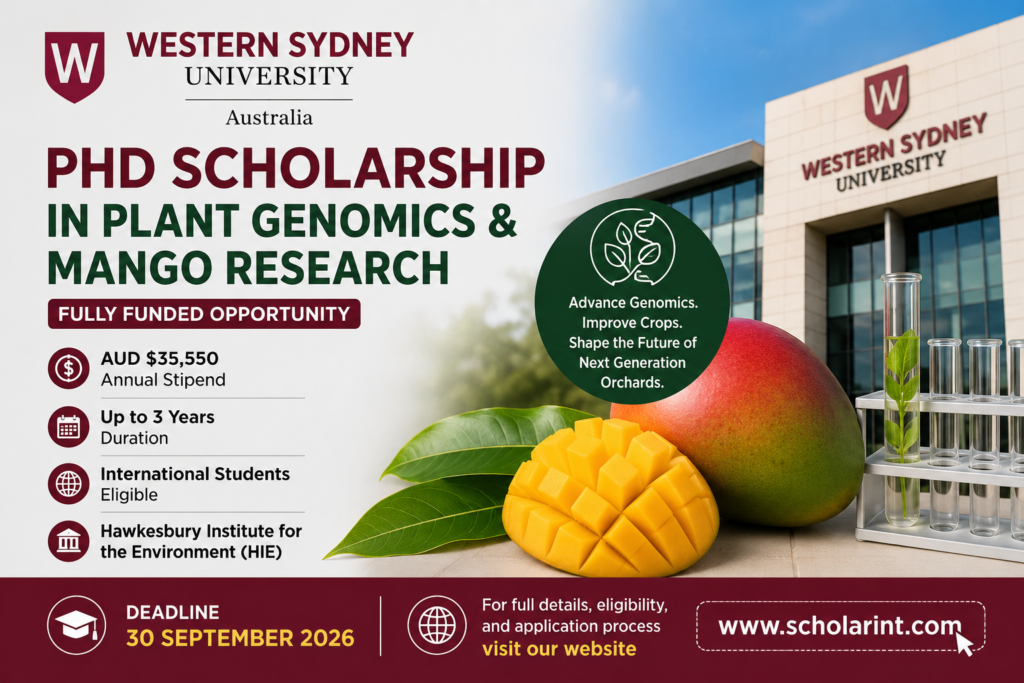
Western Sydney University is offering a postgraduate research scholarship for a PhD project investigating the genomics of mango fruit colour and quality at the Hawkesbury Institute for the Environment (HIE) in Australia.
The research project is ideal for candidates interested in plant molecular biology, genomics, biochemistry, plant physiology, horticulture, agriculture, and molecular breeding.
The scholarship provides a tax-free stipend of AUD $35,550 per year for up to three years. International candidates can also apply and may be eligible for a tuition fee waiver if they have a strong research track record.
🎓 Degree: PhD
🇦🇺 Country: Australia
🏛️ University: Western Sydney University
🔬 Institute: Hawkesbury Institute for the Environment (HIE)
💰 Stipend: AUD $35,550 per year
⏳ Duration: Up to 3 years
🌍 International Students: Eligible
📅 Deadline: 30 September 2026
🔖 Scholarship Reference: PS2026_076_CS0930016_HIE
About the Western Sydney University PhD Scholarship
The Hawkesbury Institute for the Environment at Western Sydney University is offering a postgraduate research scholarship for a PhD project focused on the genomics of mango fruit colour and quality.
The project aims to understand the genetic and molecular mechanisms that influence important mango characteristics and how these traits interact with environmental conditions at the crop level.
The research is connected with Horticulture Innovation’s industry-led Genetics for Next Generation Orchards project.
The successful candidate will investigate gene functions, regulatory mechanisms and genetic variability in mango. The research may ultimately help develop molecular marker tools that can support breeders, growers and scientists in selecting improved crop varieties.
What Will the PhD Research Focus On?
The successful PhD candidate will work on several areas of modern plant science and genomics.
The research may involve:
- Genomics and gene annotation
- Functional genomics
- Molecular biology
- Biochemistry
- Plant physiology
- Genetic variability
- Gene regulation
- Bioinformatics
- Genetic engineering
- Molecular marker development
- Plant breeding
The overall aim is to improve understanding of valuable mango traits and contribute to the development of molecular tools that can be used in crop breeding programs.
What Does the Scholarship Provide?
💰 AUD $35,550 Annual Stipend
The scholarship provides a tax-free stipend of AUD $35,550 per year for up to three years to support the student’s living expenses.
Domestic candidates are supported through the Research Training Program (RTP) Fee Offset.
🌍 Tuition Fee Support for International Students
International candidates can apply for the scholarship.
Candidates with a strong research track record may be eligible for a tuition fee waiver.
This is an important distinction for international applicants. The tuition fee waiver should not be assumed to be automatically available to every international candidate.
🔬 Research Support
The scholarship information also provides support for approved research-related expenses, which may include:
- Conference attendance
- Fieldwork
- Additional research costs
Such support is subject to the applicable university or institute conditions.
🏥 Overseas Student Health Cover
International students are required to hold Overseas Student Health Cover (OSHC) during their studies in Australia.
Applicants should budget for OSHC separately because it is not covered by the scholarship.
⚠️ Important: The AUD $35,550 stipend should not be interpreted as covering every expense associated with studying and living in Australia. International applicants should carefully calculate their expected living, insurance and other costs.
Who Can Apply?
The project welcomes applicants from different academic backgrounds who have a strong interest in plant science, genomics, horticulture and next-generation crop research.
The project is particularly suitable for candidates interested in understanding how plant traits are controlled at the:
- Molecular level
- Genetic level
- Epigenetic level
- Biochemical level
- Physiological level
Applicants should also be interested in applying this knowledge to molecular marker development and crop breeding.
Eligibility Criteria
Applicants should hold qualifications and experience equivalent to one of the following:
- An Australian First Class Bachelor (Honours) degree
- A coursework Master’s degree with at least 25% research component
- A Research Master’s degree
- An equivalent overseas qualification
Applicants should also demonstrate strong academic performance in relevant subjects.
Relevant Academic Background
The project is particularly suitable for candidates with academic or research backgrounds in:
- Plant molecular biology
- Genomics
- Biochemistry
- Plant physiology
- Agriculture
- Horticulture
- Related biological sciences
Research Interest
Applicants should demonstrate a strong interest in:
- Plant molecular biology
- Functional genomics
- Molecular marker development
- Gene regulation
- Plant breeding
- Crop improvement
Bioinformatics
Applicants should be willing to learn bioinformatics techniques relevant to plant genomics.
You do not necessarily need to be an advanced bioinformatics researcher, but you should demonstrate an ability and willingness to learn computational approaches relevant to the project.
Communication and Data Analysis
The successful candidate should have:
- Excellent written communication skills
- Strong verbal communication skills
- Creativity
- Proven data-analysis experience
- Ability to work independently and as part of a multidisciplinary research team
English Language Requirement
International applicants must demonstrate English-language proficiency according to Western Sydney University’s applicable requirements.
Is This PhD Scholarship Open to International Students?
Yes.
International candidates are eligible to apply for this PhD project.
The scholarship provides the stated AUD $35,550 annual stipend, while international candidates with a strong research track record may also be eligible for a tuition fee waiver.
International applicants should separately check the university’s requirements for:
- PhD admission
- English language proficiency
- Tuition fees
- Student visa
- Overseas Student Health Cover
Who Is a Good Fit for This PhD Project?
This PhD opportunity may be a good fit for graduates who want to develop a research career in:
Plant Genomics → Molecular Biology → Plant Biotechnology → Crop Breeding → Agricultural Research
Candidates with previous research experience in plant biology, molecular biology, genomics, biochemistry, physiology or related areas may find the project particularly relevant.
However, having a relevant degree is only one part of a competitive application.
Your application should clearly explain how your previous research experience connects with this specific PhD project.
💡 ScholarInt Tip: When contacting the supervisor, don’t simply write that you are interested in the project. Briefly explain your academic background, research experience, relevant laboratory or analytical skills, publications if applicable, and why this particular project matches your research interests.
Documents to Prepare
Applicants should prepare the academic and supporting documents required for the university’s research-degree and scholarship application.
These may include:
- Academic certificates
- Academic transcripts
- Curriculum vitae (CV)
- Evidence of research experience
- Research publications, if applicable
- English-language evidence where required
- Research project information
- Eligibility statement
- Other supporting documents requested by Western Sydney University
Always follow the latest instructions in the official application portal.
How to Apply for the Western Sydney University PhD Scholarship
The application process involves contacting the lead researcher and submitting an Expression of Interest before completing the full application.
Step 1: Review the Eligibility Criteria
Carefully read the project requirements and determine whether your academic qualifications and research experience match the project.
Step 2: Prepare Your Eligibility Statement
Prepare a document explaining how you satisfy the project’s eligibility requirements.
Try to address the requirements one by one rather than submitting a generic statement.
Step 3: Contact the Lead Researcher
The lead researcher listed for the project is:
Associate Professor Chris Cazzonelli
📧 Email: c.cazzonelli@westernsydney.edu.au
Your email should briefly include:
- Your academic background
- Your research experience
- Relevant technical skills
- Your interest in the project
- Why you believe your background matches the research
Step 4: Submit an Expression of Interest
Submit an Expression of Interest (EOI) through the Western Sydney University online portal.
Step 5: Wait for the EOI Outcome
If your EOI is approved, proceed to the next stage of the application.
Step 6: Submit the Complete Application
Log into the online portal and submit your completed application before the scholarship deadline.
Step 7: Check Your Application Carefully
Make sure all required information and supporting documents have been submitted correctly.
Incomplete applications or applications that do not meet the project requirements may not be considered.
Application Deadline
📅 Application Deadline: 30 September 2026
🔖 Scholarship Reference: PS2026_076_CS0930016_HIE
Applicants should start the process early because contacting the supervisor and preparing an Expression of Interest can take time.
Do not wait until the final day to begin contacting the researcher.
How to Make Your Application Stronger
1. Connect Your Experience With the Research Project
Explain how your previous education, research or laboratory experience relates to plant genomics, molecular biology, biochemistry, physiology or horticulture.
2. Highlight Your Research Skills
If you have experience with molecular biology, genomic analysis, biochemical assays, plant physiology or related laboratory techniques, explain what you actually did.
Simply listing techniques is less useful than demonstrating how you applied them.
3. Show Your Data Analysis Experience
The project specifically mentions proven data-analysis experience.
Mention relevant statistical, computational or data-analysis work from your previous research.
4. Demonstrate Your Interest in Plant Genomics
Explain why you are interested in understanding genes, gene regulation and desirable plant characteristics.
5. Show Your Willingness to Learn
The project involves bioinformatics, so demonstrating your willingness to develop computational and genomic-analysis skills can strengthen your application.
6. Write a Personalized Email to the Supervisor
Avoid sending a generic email that could be sent to any university.
Show that you have read the research project and understand what the PhD will investigate.
Is This a Fully Funded PhD Scholarship?
The scholarship provides a tax-free stipend of AUD $35,550 per year for up to three years.
For international candidates, the current information states that candidates with a strong track record will be eligible for a tuition fee waiver.
Therefore, applicants should not assume that every international candidate automatically receives a complete tuition-free package.
For this reason, ScholarInt recommends describing this opportunity as a funded PhD scholarship with potential tuition fee support for strong international candidates, rather than promising full funding to every applicant.
Frequently Asked Questions
Is Western Sydney University offering a PhD scholarship in mango genomics?
Yes. The project focuses on the genomics of mango fruit colour and quality and is based at the Hawkesbury Institute for the Environment at Western Sydney University.
How much is the Western Sydney University PhD scholarship?
The scholarship provides a tax-free stipend of AUD $35,550 per year for up to three years.
Can international students apply?
Yes. International candidates are eligible to apply for the project.
Does the scholarship cover tuition fees for international students?
International candidates with a strong research track record may be eligible for a tuition fee waiver. Applicants should confirm their individual tuition arrangements with Western Sydney University.
What is the research topic?
The PhD focuses on the genomics of mango fruit colour and quality, including gene functions, regulatory mechanisms, genetic variability and molecular marker development.
What academic background is suitable?
Relevant backgrounds include plant molecular biology, genomics, biochemistry, plant physiology, agriculture and horticulture.
Do I need previous bioinformatics experience?
The project states that candidates should be willing to learn bioinformatics techniques applicable to plant genomics. Applicants should therefore demonstrate their willingness and ability to develop these skills.
Who is the lead researcher?
The lead researcher is Associate Professor Chris Cazzonelli.
What is the scholarship reference code?
The scholarship reference code is:
PS2026_076_CS0930016_HIE
What is the application deadline?
The current deadline is:
30 September 2026
Does the scholarship cover OSHC?
International candidates are required to hold Overseas Student Health Cover (OSHC), and applicants should budget for this separately.
Final Thoughts
The Western Sydney University PhD Scholarship in Plant Genomics and Mango Research is an interesting opportunity for graduates who want to work at the intersection of plant genomics, molecular biology, horticulture and crop improvement.
The research project connects fundamental genomic research with practical applications in crop breeding and next-generation orchard systems.
The scholarship provides a tax-free AUD $35,550 annual stipend for up to three years, while eligible international candidates with a strong research track record may also receive tuition fee support.
If your academic background matches the project, focus your application on your research experience, technical skills, data-analysis ability and genuine interest in plant genomics.
Most importantly, start early. The application deadline is 30 September 2026, and applicants need to contact the lead researcher and complete the Expression of Interest process before submitting the full application.