
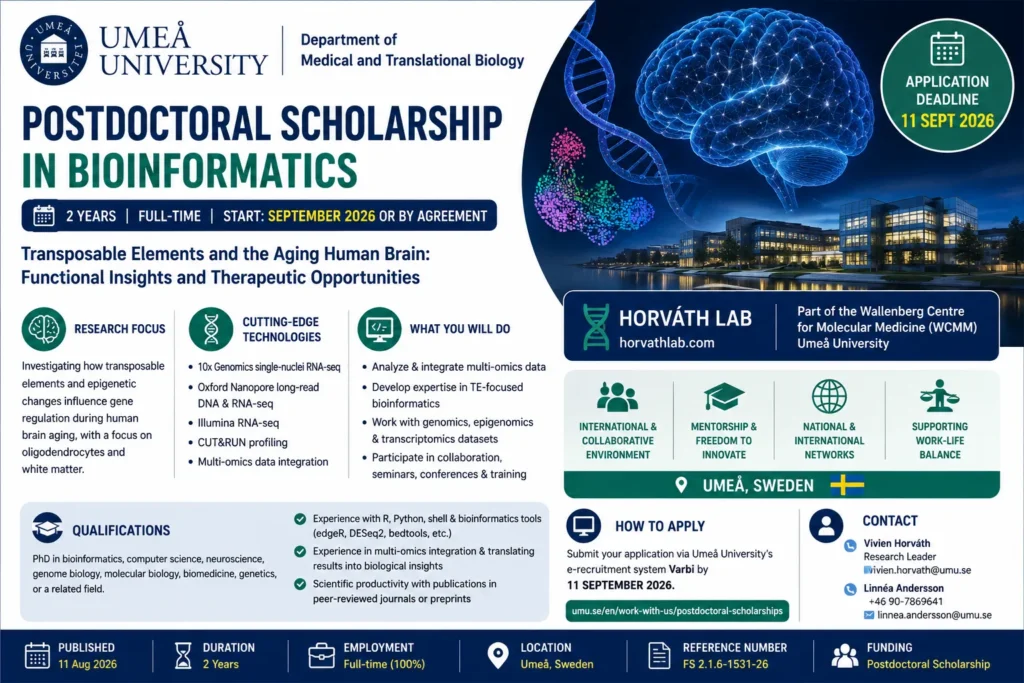
Apply for a 2-year Postdoctoral Scholarship in Bioinformatics at Umeå University, Sweden. Research brain aging, transposable elements and multi-omics. Deadline: September 11, 2026.
Postdoctoral Scholarship in Bioinformatics at Umeå University, Sweden – 2026
Umeå University in Sweden is inviting applications for a 2-year Postdoctoral Scholarship in Bioinformatics within the research project “Transposable Elements and the Aging Human Brain: Functional Insights and Therapeutic Opportunities.”
The position is based in the Horváth Lab, Department of Medical and Translational Biology, Umeå University. The project focuses on understanding how transposable elements (TEs), epigenetic regulation, and gene expression change during human brain aging.
The successful postdoctoral researcher will work with advanced multi-omics, single-cell, long-read sequencing, epigenomics, transcriptomics, and computational genomics approaches using post-mortem human brain samples.
The scholarship is full-time for two years, with the start date in September 2026 or by agreement. The application deadline is September 11, 2026.
Postdoctoral Scholarship in Bioinformatics – Quick Details
| Job Detail | Information |
|---|---|
| Position | Postdoctoral Scholarship in Bioinformatics |
| Employer | Umeå University |
| Department | Medical and Translational Biology |
| Research Group | Horváth Lab |
| Location | Umeå, Sweden |
| Country | Sweden |
| Duration | 2 years |
| Workload | 100% / Full-time |
| Start Date | September 2026 or by agreement |
| Funding Type | Postdoctoral scholarship |
| Published | August 11, 2026 |
| Application Deadline | September 11, 2026 |
| Reference Number | FS 2.1.6-1531-26 |
| Application Language | English or Swedish |
| Application System | Umeå University Varbi |
| Main Fields | Bioinformatics, Neuroscience, Molecular Biology, Genetics, Cell Biology |
About the Research Project
The postdoctoral position is part of the project:
“Transposable Elements and the Aging Human Brain: Functional Insights and Therapeutic Opportunities.”
Human brain aging is a major risk factor for the development of neurodegenerative disorders. Understanding the molecular mechanisms associated with healthy brain aging is therefore an important area of biomedical research.
The Horváth Lab investigates brain aging from the perspective of transposable elements (TEs).
Transposable elements occupy approximately half of the human genome and can strongly influence gene regulation. In adult tissues, their activity is normally controlled by epigenetic mechanisms, including DNA methylation.
Previous research from the Horváth Lab has identified mechanisms through which transposable elements influence gene expression in the human brain, including interactions with epigenetic repressors.
The current project investigates how age-related changes in epigenetic repression affect the activity and regulatory impact of transposable elements in the aging human brain.
Research Focus: Aging Brain and Oligodendrocytes
The project will focus particularly on white matter, a brain region that is significantly affected during aging.
Researchers will investigate oligodendrocytes, the major cell type associated with white matter.
Using post-mortem human brain samples, the research team will generate an integrated multi-omics dataset to investigate changes in:
- DNA methylation
- Chromatin regulation
- Transposable element activity
- Gene expression
- Cellular states
- Age-associated molecular changes
The project combines large-scale bulk and single-cell approaches with advanced computational analysis.
Advanced Bioinformatics and Sequencing Technologies
The postdoctoral researcher will work with data generated using several cutting-edge technologies, including:
- 10x Genomics single-nuclei RNA sequencing
- Oxford Nanopore long-read DNA sequencing
- Oxford Nanopore long-read RNA sequencing
- Illumina RNA sequencing
- CUT&RUN profiling
- High-throughput sequencing
- Single-cell and single-nucleus analysis
- Multi-omics data integration
These datasets will be integrated using TE-tailored bioinformatics approaches to develop a comprehensive understanding of molecular changes associated with brain aging.
What Will the Postdoctoral Researcher Do?
The successful candidate will have the opportunity to:
- Analyze and integrate data from multiple sequencing technologies.
- Develop advanced expertise in multi-omics data integration.
- Work specifically with transposable element-focused computational approaches.
- Investigate neuroscience, epigenetics, genome regulation, and computational genomics.
- Analyze genomic, epigenomic, and transcriptomic datasets.
- Participate in laboratory meetings and scientific discussions.
- Attend journal clubs, seminars, conferences, and workshops.
- Participate in interdisciplinary collaborations.
- Develop scientific writing and communication skills.
- Strengthen project management skills.
- Develop research leadership capabilities.
- Build an international professional research network.
About the Horváth Lab
The research will be conducted in the Horváth Lab at Umeå University, an international and multidisciplinary research environment focused on advanced biomedical and molecular research.
The lab promotes:
- Scientific excellence
- Curiosity-driven research
- Collaboration
- Inclusion
- Interdisciplinary research
- International cooperation
- Professional development
- Healthy work-life balance
The successful postdoctoral researcher will receive dedicated mentorship while also having the freedom to develop and pursue innovative research ideas.
Wallenberg Centre for Molecular Medicine
The Horváth Lab is part of the Wallenberg Centre for Molecular Medicine (WCMM) at Umeå University.
WCMM is a national initiative funded by the Knut and Alice Wallenberg Foundation to strengthen molecular life science research in Sweden.
Research programs at WCMM Umeå span areas including:
- Neuroscience
- Cancer
- Infection biology
- Metabolic disease
- Molecular medicine
WCMM promotes close collaboration between basic scientists and clinicians and works with Region Västerbotten and other WCMM centers in Sweden.
The postdoctoral researcher will therefore become part of a broad national and international research network.
Umeå Postdoc Society
Postdoctoral researchers can also benefit from the Umeå Postdoc Society, which provides opportunities for:
- Skills-development workshops
- Professional courses
- Networking
- Social activities
- Interaction with other postdoctoral researchers
This provides an additional platform for career development and building professional connections.
Qualifications
Applicants must have completed a doctoral degree or a foreign qualification considered equivalent to a doctoral degree.
The doctoral qualification must be completed no later than the time the scholarship recipient is selected.
Priority is generally given to candidates who completed their doctoral degree within the previous three years.
Candidates who completed their PhD earlier may still be eligible when special circumstances apply, such as:
- Illness
- Parental leave
- Certain positions of trust
- Military service
- Clinical practice
- Other relevant professional appointments or assignments
Eligible PhD Backgrounds
The doctoral degree should preferably be in:
- Bioinformatics
- Computer Science
- Neuroscience
- Genome Biology
- Molecular Biology
- Biomedicine
- Genetics
- A related scientific field
Required Bioinformatics Experience
The project is particularly seeking candidates with documented experience in analyzing:
- Genomics datasets
- Epigenomics datasets
- Transcriptomics datasets
Applicants should have practical programming experience using:
- R
- Python
- Shell
Bioinformatics Tools and Software
Experience with high-throughput sequencing data analysis and bioinformatics tools is required.
Relevant experience includes tools and packages such as:
- edgeR
- DESeq2
- bedtools
- Related genomic analysis software
Candidates should be able to process and analyze complex sequencing datasets and interpret computational results in a biological context.
Multi-Omics Experience
Experience integrating complex omics datasets is highly relevant to this project.
Applicants should ideally be able to:
- Integrate multiple molecular datasets.
- Analyze high-throughput sequencing data.
- Translate computational findings into biological insights.
- Work with complex genomic datasets.
- Communicate computational results to interdisciplinary research teams.
Scientific Productivity
Applicants should demonstrate scientific productivity through publications in:
- International peer-reviewed journals; and/or
- Preprint publications.
A strong publication record relevant to bioinformatics, genomics, neuroscience, epigenetics, or computational biology can strengthen an application.
Desirable Skills
The following skills are considered advantageous:
Supercomputing
Experience working with high-performance computing or supercomputing clusters.
Single-Cell Analysis
Experience analyzing single-cell or single-nucleus sequencing datasets.
Long-Read Sequencing
Experience with long-read sequencing technologies and analysis.
Epigenetics
Knowledge or research experience in epigenetics and genome regulation.
Transposable Elements
Experience studying transposable element biology is particularly relevant.
Genome Assembly and Organization
Experience with:
- Genome assembly
- Genome organization
- Genome regulation
- Computational genomics
is also desirable.
Language Requirements
Excellent written and verbal English communication skills are essential because the position involves close collaboration with members of the research group and external research partners.
Applications may be submitted in English or Swedish.
Personal Qualities
The research group is seeking candidates who are:
- Highly motivated
- Curious
- Organized
- Independent
- Collaborative
- Proactive
- Strong problem-solvers
- Interested in interdisciplinary research
Candidates should demonstrate the ability to take initiative and organize and drive their research project forward.
What Umeå University Offers
The Horváth Lab promotes a supportive research culture based on:
- Scientific excellence
- Collaboration
- Inclusion
- Mentorship
- Research independence
- International collaboration
- Professional development
- Work-life balance
The successful candidate will also have opportunities to attend national and international conferences, workshops, and specialized training courses.
Application Deadline
The application deadline for this Postdoctoral Scholarship in Bioinformatics at Umeå University is:
September 11, 2026
Applications should be submitted before the deadline through the university’s Varbi e-recruitment system.
Required Application Documents
A complete application should include:
1. Cover Letter
The cover letter should clearly explain:
- Your research experience
- Your motivation for applying
- Your relevant technical expertise
- How your experience matches the project requirements
2. Curriculum Vitae
A CV of maximum two pages should be included.
3. Publication List
A publication list of maximum five pages should be provided.
4. Doctoral Degree Documentation
Applicants should provide:
- A verified copy of their doctoral degree certificate; or
- Documentation explaining when the doctoral degree is expected to be completed.
5. Doctoral Thesis
A copy of the doctoral thesis should be provided if available.
6. References
Provide contact information for two referees.
How to Apply
Applications must be submitted through Umeå University’s Varbi e-recruitment system.
The application should be written in English or Swedish, with supporting documents submitted in Word or PDF format.
Application Portal
Applicants should submit their application through the official Umeå University recruitment system.
The application deadline is:
September 11, 2026
Contact Information
Research Questions
Vivien Horváth
Research Leader / Horváth Lab
Email: vivien.horvath@umu.se
Additional Contact
Linnéa Andersson
Telephone: 090-7869641
Email: linnea.andersson@umu.se
Research Group Information
For additional information about the research group:
Information about postdoctoral scholarships at Umeå University is available through the university’s official website:
Umeå University Postdoctoral Scholarships
Who Should Apply?
This postdoctoral opportunity may be particularly suitable for researchers with backgrounds in:
- Bioinformatics
- Computational biology
- Neuroscience
- Genomics
- Epigenomics
- Transcriptomics
- Molecular biology
- Genetics
- Biomedical sciences
- Computational genomics
Candidates with experience in R, Python, shell scripting, high-throughput sequencing, multi-omics integration, single-cell analysis, long-read sequencing, epigenetics, or transposable element biology may be particularly well suited to the project.
Frequently Asked Questions
What is the duration of the postdoctoral scholarship?
The scholarship is offered for two years on a full-time basis.
Where is the postdoctoral position located?
The position is based at Umeå University in Umeå, Sweden.
When does the position start?
The position is expected to start in September 2026 or by agreement.
What is the research topic?
The project investigates transposable elements and the aging human brain, focusing on their relationship with epigenetic regulation, gene expression, and molecular changes in oligodendrocytes.
What programming languages are required?
Applicants should have documented experience using R, Python, and shell for genomics, epigenomics, and/or transcriptomics analysis.
Which bioinformatics tools are relevant?
Experience with tools such as edgeR, DESeq2, bedtools, and related genomic analysis software is required.
Is single-cell experience required?
Single-cell or single-nucleus analysis experience is listed as a desirable skill rather than the primary mandatory qualification.
Is long-read sequencing experience required?
Experience with long-read datasets is desirable for this project.
Can international researchers apply?
The position is based at Umeå University in Sweden and is part of an international research environment. Applicants should review the official eligibility and scholarship requirements before applying.
What is the application deadline?
The deadline is September 11, 2026.
How many references are required?
Applicants should provide contact information for two references.
How long should the CV be?
The CV should be a maximum of two pages.
How long can the publication list be?
The publication list should be a maximum of five pages.
Job Details
- Job Title: Postdoctoral Scholarship in Bioinformatics
- Employer: Umeå University
- Department: Medical and Translational Biology
- Research Group: Horváth Lab
- Project: Transposable Elements and the Aging Human Brain
- Location: Umeå, Sweden
- Country: Sweden
- Duration: 2 years
- Workload: 100% / Full-time
- Start: September 2026 or by agreement
- Funding: Postdoctoral scholarship
- Reference Number: FS 2.1.6-1531-26
- Published: August 11, 2026
- Application Deadline: September 11, 2026
- Application Language: English or Swedish
- Application System: Varbi
- Fields: Bioinformatics, Neuroscience, Molecular Biology, Genetics, Cell Biology
Final Takeaway
The Postdoctoral Scholarship in Bioinformatics at Umeå University offers a two-year research opportunity for scientists interested in brain aging, transposable elements, epigenetics, genomics, and computational biology.
The project provides exposure to advanced technologies including 10x Genomics single-nuclei RNA sequencing, Oxford Nanopore long-read sequencing, Illumina RNA sequencing, CUT&RUN, and multi-omics data integration.
Researchers with strong experience in R, Python, shell, high-throughput sequencing analysis, genomics, epigenomics, transcriptomics, and computational biology should consider applying.
The application deadline is September 11, 2026. Applicants should prepare their CV, cover letter, publication list, doctoral documentation, thesis, and two references before submitting the application through Umeå University’s recruitment system.