
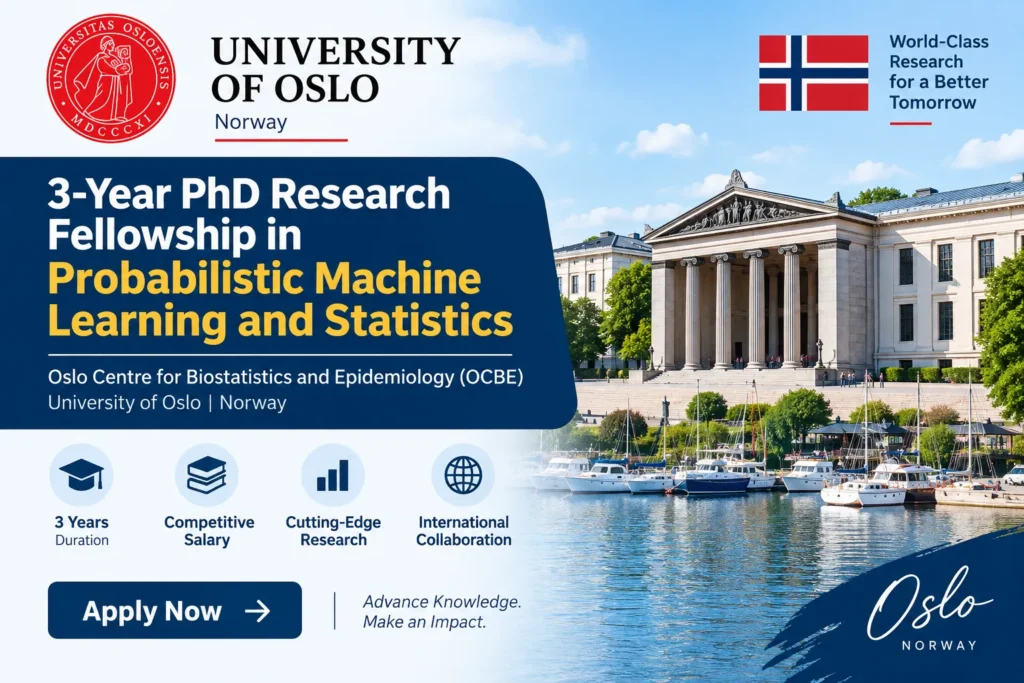
Apply for a 3-year PhD Research Fellowship in Probabilistic Machine Learning and Statistics at the University of Oslo, Norway.
Applications are invited for a 3-year PhD Research Fellowship in Probabilistic Machine Learning and Statistics at the University of Oslo (UiO), Norway. The position is hosted by the Oslo Centre for Biostatistics and Epidemiology (OCBE), Department of Biostatistics, Institute of Basic Medical Sciences.
The research project focuses on developing probabilistic latent-variable methods for large and structured biological datasets, with applications in genomics, spatial transcriptomics, and fluorescence imaging.
The preferred starting date is as soon as possible and will be agreed upon with the successful candidate. The position is based at the Department of Biostatistics, OCBE, at the Gaustad UiO campus in Oslo.
Scholarship Overview PhD Research Fellowship in Probabilistic Machine Learning and Statistics
| Category | Details |
|---|---|
| University | University of Oslo (UiO) |
| Country | Norway |
| Research Centre | Oslo Centre for Biostatistics and Epidemiology (OCBE) |
| Department | Department of Biostatistics |
| Position | PhD Research Fellow |
| Duration | 3 years |
| Research Area | Probabilistic Machine Learning and Statistics |
| Location | Oslo, Norway |
| Starting Date | As soon as possible, by agreement |
| Salary | NOK 550,800–595,000, depending on competence and experience |
| Application System | Jobbnorge |
| Working Language | English |
The fellowship is designed as research training leading toward completion of a PhD degree.
Research Project PhD Research Fellowship in Probabilistic Machine Learning and Statistics
The project addresses challenges associated with analysing increasingly complex biological datasets. These datasets can be large, heterogeneous and contain complicated spatial and functional relationships.
The PhD Research Fellowship in Probabilistic Machine Learning and Statistics researcher will work on a unified and scalable framework for probabilistic unsupervised learning of structured biological data.
Key research activities include:
- Developing probabilistic factor models.
- Creating scalable inference algorithms for high-dimensional, multi-view biological data.
- Incorporating domain-specific information into latent-variable models.
- Studying computation, identifiability, uncertainty quantification and interpretation.
- Accounting for spatial relationships, physical constraints, imaging data and clinical covariates.
- Applying developed methods to spatial transcriptomics and fluorescence imaging.
The project is particularly relevant to candidates interested in probabilistic modelling, latent-variable methods and structured unsupervised learning.
Research Environment and Collaboration
The successful candidate will work at the intersection of probabilistic machine learning, computational statistics and biostatistics. The work combines methodological development, inference algorithms and scalable computational implementation.
The researcher will join the statistical models for high-dimensional and functional data research group led by Professor Valeria Vitelli at OCBE and collaborate with the MolMed Imaging Platform at the Institute of Basic Medical Sciences.
The position is also connected to the FunGen-AD consortium, described in the vacancy as the world’s largest research initiative studying the genetic underpinnings of Alzheimer’s disease. There may also be an opportunity for a 3–6 month research stay at Columbia University in New York, USA.
Candidates are encouraged to publish their research in leading venues in machine learning, statistics and computational biology, including conferences such as NeurIPS and ICML.
Funding and Benefits
The PhD Research Fellowship in Probabilistic Machine Learning and Statistics Research Fellowship provides a salaried position.
The stated salary is:
NOK 550,800–595,000 per year, depending on competence and experience. A 2% statutory contribution is deducted from the salary for the State Pension Fund.
Other benefits mentioned by the University of Oslo include:
- International and professionally stimulating research environment.
- Support for international relocation.
- Career and professional development opportunities.
- Access to national and international research collaborators.
- Welfare schemes.
- Public health services through membership of the National Insurance Scheme.
- Pension arrangements through the State Pension Fund.
- Access to exercise facilities and training opportunities during working hours.
- Family-friendly surroundings in Oslo.
An extension of up to 12 months may be considered for compulsory career-enhancing duties such as teaching or advising, depending on qualifications and departmental needs.
Eligibility Criteria
Academic Qualifications
Applicants should normally hold a Master’s degree or equivalent in one of the following areas:
- Statistics
- Machine learning
- Mathematics
- Computer science
- Physics
- A closely related quantitative discipline
For applicants with a foreign completed degree at MSc level, the qualification must correspond to a minimum of four years in the Norwegian educational system.
The Master’s project should address methodological questions using mathematical, statistical or computational tools. Applicants are expected to demonstrate a strong interest in methodological development.
Required Technical Skills
Applicants must demonstrate competence in:
- Probability
- Linear algebra
- Statistical modelling
- Probabilistic modelling
- Latent-variable methods or Bayesian methodology
- Programming and computational methods
Strong programming skills in Python, PyTorch/JAX or similar technologies are specifically required.
Grade Requirements
The stated academic grade norms are:
- Bachelor’s courses: average grade of C or better in the Norwegian system.
- Master’s courses: average grade of B or better.
- Master’s thesis: B or better.
Applicants without a completed Master’s degree have until December 31 to complete the final examination.
Additional Qualifications
Experience in the following areas is considered advantageous:
- Bayesian computation
- Probabilistic machine learning
- Latent-variable models
- Unsupervised learning
- Matrix and tensor factorisation
- Computational analysis of large or high-dimensional datasets
- Biomedical applications
- Interdisciplinary collaboration
Eligible Countries
The supplied vacancy does not specify a list of eligible countries.
Therefore, applicants should consult the University of Oslo’s official requirements concerning international applicants, particularly the English-language requirements and degree documentation requirements.
Eligible countries: Not specified.
Available Research Areas
The PhD Research Fellowship in Probabilistic Machine Learning and Statistics project is centred on methodological research in:
- Probabilistic machine learning
- Computational statistics
- Biostatistics
- Latent-variable modelling
- Probabilistic factor models
- Bayesian methodology
- Structured unsupervised learning
- High-dimensional biological data
- Genomics
- Spatial transcriptomics
- Fluorescence imaging
- Computational biology
The project is particularly suited to candidates who want to develop new statistical and computational methodology rather than primarily conduct experimental biomedical research.
English Language Requirements
English is the working language of the research group and OCBE, and excellent written and oral English communication skills are required. The vacancy also refers applicants to the University of Oslo’s regulations for specific English requirements and possible exemptions for applicants from outside the EU/EEA.
The supplied information does not state that IELTS is universally required.
Therefore:
IELTS requirement: Not specified in the supplied vacancy.
Applicants should check the official UiO regulations before applying.
Required Documents
The application must include:
- Cover letter explaining motivation and research interests.
- CV containing education, employment positions and academic work/publications.
- Bachelor’s and Master’s degree diplomas.
- Academic transcripts.
- English-language proficiency documentation, where applicable.
- List of publications and academic work to be considered.
- Master’s thesis or at least a completed chapter.
- Contact information for 2–3 references, including their name, relationship to the applicant, email and telephone number.
Foreign applicants should also provide an official explanation of their university grading system.
Application documents should be in English or a Scandinavian language. Applicants are encouraged to retrieve education results through Vitnemålsportalen where available.
Application Deadline
Application deadline: Not specified in the supplied scholarship data.
Because the vacancy states that the preferred starting date is as soon as possible, applicants should verify the current deadline directly on the official University of Oslo/Jobbnorge vacancy before preparing their submission.
How to Apply
Applications must be submitted through the Jobbnorge recruitment system.
Applicants should:
- Prepare the motivation letter and research-interest statement.
- Update their academic CV.
- Collect Bachelor’s and Master’s transcripts and diplomas.
- Prepare the Master’s thesis or a completed chapter.
- Prepare the publication/academic-work list.
- Add contact details for 2–3 references.
- Provide English proficiency documentation if applicable.
- Upload an explanation of the grading system if applying with a foreign degree.
- Submit the complete application through the Jobbnorge application system.
Selection Process
The University of Oslo states that the best qualified candidates will be invited for interviews. Selection is based on a comprehensive assessment of the applicable qualification requirements, including skills and personal suitability.
Candidates are expected to demonstrate:
- Analytical ability and intellectual curiosity.
- Motivation for theory-driven foundational research.
- Persistence and creativity when solving technically difficult problems.
- Ability to work independently.
- Effective interdisciplinary collaboration.
- Interest in an academic or research-oriented career.
- Good communication skills.
- Ability to work in a structured manner and adapt to new tasks.
Applicants and projects will also undergo checks relating to national export, sanctions and security regulations.
Important Tips for Applicants
This PhD Research Fellowship in Probabilistic Machine Learning and Statistics Research Fellowship is highly quantitative. Applicants should therefore make the connection between their previous academic work and the project’s methodological requirements very clear.
When preparing an application, consider highlighting:
- Mathematical and statistical training.
- Probability and linear algebra knowledge.
- Experience with statistical modelling.
- Python or other relevant programming experience.
- Machine learning or Bayesian modelling projects.
- Experience handling high-dimensional datasets.
- Relevant computational or biomedical research.
- Your Master’s thesis methodology.
- Publications or research outputs related to statistics, machine learning or computational biology.
Applicants should also explain why they are interested in methodological research, rather than simply describing a general interest in machine learning or biomedical research.
Frequently Asked Questions
Who can apply for this PhD Research Fellowship in Probabilistic Machine Learning and Statistics position?
Applicants should have a Master’s degree or equivalent in statistics, machine learning, mathematics, computer science, physics or a closely related quantitative discipline.
Is this a funded PhD Research Fellowship in Probabilistic Machine Learning and Statistics?
Yes. The position is a salaried PhD Research Fellowship in Probabilistic Machine Learning and Statistics Research Fellowship with a stated salary range of NOK 550,800–595,000, depending on competence and experience.
What is the duration of the fellowship?
The PhD Research Fellowship in Probabilistic Machine Learning and Statistics Research Fellowship is for three years. An extension of up to 12 months may be considered for certain compulsory work duties, depending on qualifications and departmental needs.
Does the position require IELTS?
The vacancy requires excellent English communication skills and refers international applicants to UiO’s English-language requirements and exemptions. However, a specific IELTS score is not stated in the supplied information.
What programming skills are required?
Strong programming and computational skills are required. The vacancy gives Python, PyTorch/JAX or similar technologies as examples.
What documents are required?
The application requires a cover letter, CV, Bachelor’s and Master’s documentation, English proficiency documentation where applicable, publication/academic-work list, Master’s thesis or completed chapter, and details for 2–3 references.
Can international students apply?
The supplied vacancy provides requirements for foreign applicants, including degree-equivalence and grading-system documentation. It does not provide a separate nationality restriction.
Where will the PhD Research Fellowship in Probabilistic Machine Learning and Statistics researcher work?
The position is based at the Department of Biostatistics, Oslo Centre for Biostatistics and Epidemiology, at the Gaustad UiO campus in Oslo, Norway.
Is there an opportunity to conduct research abroad?
The position provides possibilities for arranging a 3–6 month research stay at Columbia University in New York, USA.
What is the application deadline?
The deadline is not specified in the supplied scholarship information. Applicants should verify the current deadline on the official vacancy/application page before submitting an application.
Conclusion
The 3-Year PhD Research Fellowship in Probabilistic Machine Learning and Statistics at the University of Oslo is a research position focused on probabilistic modelling, computational statistics and machine learning for complex biological data.
The project combines theoretical methodological development with applications in areas such as genomics, spatial transcriptomics and fluorescence imaging. Applicants should have a strong quantitative background, programming skills and a clear interest in probabilistic and statistical methodology.
Before applying, carefully check the official vacancy for the latest deadline, documentation requirements and English-language rules.