
a
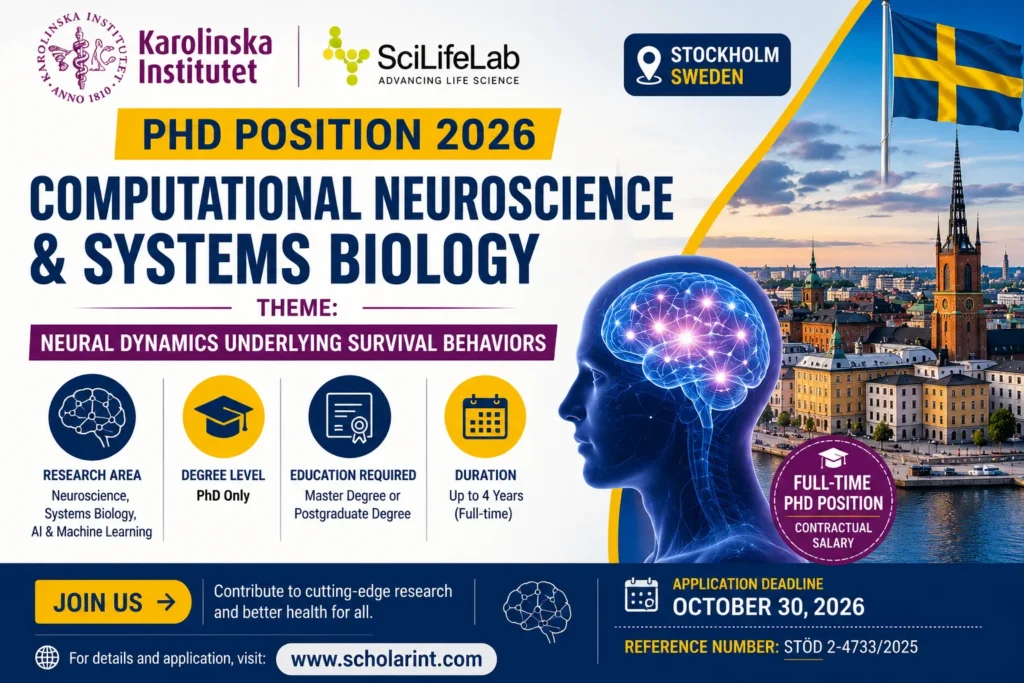
PhD Position in Computational Neuroscience and Systems Biology: Neural Dynamics Underlying Survival Behaviors
Are you interested in understanding how brain-wide neural activity generates behavior? Karolinska Institutet (KI) in Stockholm, Sweden, is offering a PhD position in Computational Neuroscience and Systems Biology focused on understanding the neural dynamics underlying survival behaviors.
The PhD position is based in the Stagkourakis Lab at Karolinska Institutet and SciLifeLab, within the Department of Neuroscience at Biomedicum. The research combines computational neuroscience, systems biology, network theory, dynamical systems, and machine learning to investigate how distributed neural circuits control instinctive and homeostatic behaviors.
PhD Position Overview
| Scholarship Detail | Information |
|---|---|
| University | Karolinska Institutet |
| Research Group | Stagkourakis Lab |
| Department | Department of Neuroscience |
| Research Area | Computational Neuroscience & Systems Biology |
| PhD Subject | Neural Dynamics Underlying Survival Behaviors |
| Location | Stockholm, Sweden |
| Degree Level | PhD |
| Education Required | Master’s degree or equivalent |
| Position Type | PhD placement |
| Study Mode | Full-time |
| Duration | Maximum 4 years |
| Number of Positions | 1 |
| Salary | Monthly doctoral salary |
| English Requirement | English equivalent to Swedish English B/English 6 |
| Reference Number | STÖD 2-4733/2025 |
| Published | November 28, 2025 |
| Application Deadline | October 30, 2026 |
About the PhD Research
The Stagkourakis Lab investigates the neural and neurohormonal mechanisms that regulate instinctual and homeostatic behaviors, including aggression, fear, feeding, and social interactions.
The PhD project focuses on understanding how brain-wide neural dynamics generate survival-related behaviors. The research involves analyzing large-scale neural population recordings obtained from freely moving animals during naturalistic behaviors.
The project combines several computational approaches, including:
- Computational neuroscience
- Systems biology
- Graph theory
- Dynamical systems
- Machine learning
- Neural population analysis
- Statistical modeling
- Time-series analysis
- Network science
The overall goal is to understand how distributed neural ensembles represent internal states and contribute to the generation of survival behaviors.
PhD Project and Responsibilities
The selected doctoral student will contribute to the analysis and computational modeling of large-scale neural population recordings collected during naturalistic behaviors in freely moving animals.
The project integrates graph-theoretic, dynamical-systems, and machine-learning approaches to investigate how distributed neural populations encode internal states and influence survival behaviors.
Main Research Activities
The doctoral researcher may work on:
- Analysis of large-scale neural recordings.
- Computational modeling of neural population activity.
- Neural dynamics and network analysis.
- Graph-theoretic modeling of brain activity.
- Dynamical systems approaches to neuroscience.
- Machine-learning-based analysis.
- Linking neural activity with behavior.
- Analysis of multimodal datasets.
- Development of analytical tools and computational models.
- Integration of theoretical and experimental neuroscience.
What Does Karolinska Institutet Offer?
Karolinska Institutet is one of the world’s leading medical universities and provides a creative, collaborative, and research-intensive environment.
As a doctoral student, you will receive:
- An individual research project.
- Supervision from experienced researchers.
- Access to advanced research infrastructure.
- Training in computational neuroscience and data science.
- Access to Karolinska Institutet and SciLifeLab infrastructure.
- Opportunities for interdisciplinary collaboration.
- Opportunities to work with researchers generating large-scale experimental datasets.
- Participation in research projects with potential relevance to neuropsychiatric disorders.
- Opportunities for international academic collaboration.
- A contractual doctoral salary.
- Access to employee benefits, including the university’s modern gym and medical-care reimbursements.
Eligibility Requirements
Applicants must meet both the general eligibility requirement and the specific English-language requirement for doctoral education by the application deadline.
General Eligibility
Applicants are eligible for doctoral education if they meet one of the following conditions:
- Hold a second-cycle/advanced Master’s degree; or
- Have completed courses equivalent to at least 240 higher-education credits, including at least 60 credits at advanced/Master’s level; or
- Have acquired substantially equivalent knowledge through another route in Sweden or abroad.
Applicants claiming equivalent knowledge must follow Karolinska Institutet’s requirements for assessing equivalent qualifications.
English Language Requirement
Applicants must demonstrate English proficiency equivalent to English B/English 6 at Swedish upper secondary school level.
Applicants are responsible for providing documentation confirming their eligibility.
Karolinska Institutet also verifies the authenticity of submitted documents. False or fraudulent documents may result in withdrawal of admission and may have legal consequences.
Required Qualifications
The ideal candidate should have a strong quantitative background and a genuine interest in neural computation, brain dynamics, and behavior.
Applicants should have:
- A degree in Computational Neuroscience, Physics, Applied Mathematics, Computer Science, Bioengineering, or a related field.
- Strong programming and data-analysis skills.
- Experience with Python, MATLAB, or Julia.
- Experience with large-scale data analysis, signal processing, or statistical modeling.
- Ability to work independently.
- Ability to work effectively within an interdisciplinary research team.
- Strong interest in understanding neural mechanisms underlying behavior.
Desirable Skills and Experience
The following experience is considered advantageous:
- Knowledge of dynamical systems.
- Knowledge of network science.
- Experience with machine learning applied to neuroscience.
- Experience with neural population analysis.
- Knowledge of methods such as PCA, UMAP, GLMs, HMMs, or graph models.
- Experience with time-series analysis.
- Knowledge of state-space modeling.
- Familiarity with causal inference methods.
- Interest in connecting neural activity with behavior.
- Experience working with multimodal datasets.
- Basic knowledge of Git and version control.
- Experience developing reproducible data-analysis pipelines.
Who Should Apply?
This PhD opportunity may be particularly suitable for candidates interested in the intersection of:
Computational Neuroscience + Systems Biology + Artificial Intelligence + Neural Dynamics + Machine Learning + Behavioral Neuroscience
Candidates who enjoy developing mathematical or computational models from experimental data and connecting theoretical approaches with biological observations are encouraged to consider this opportunity.
Duration and Employment
The successful candidate will be employed as a doctoral student for a maximum of four years on a full-time basis.
| Employment Detail | Information |
|---|---|
| Employment Type | PhD placement |
| Contract | Full-time |
| Duration | Maximum 4 years |
| Positions Available | 1 |
| Full-Time Equivalent | 100% |
| Salary | Monthly salary |
| Start Date | Flexible during 2026 |
Location
The research activities are based at Karolinska Institutet and SciLifeLab in Solna, Stockholm.
Karolinska Institutet – Biomedicum
Department of Neuroscience
Biomedicum D8
Karolinska Institutet
Solnavägen 9, Solna, Sweden
SciLifeLab
SciLifeLab Gamma 5
Tomtebodavägen 23A
Solna, Sweden
Application Process
Applications must be submitted through the Varbi recruitment system.
Applicants are encouraged to submit their applications as early as possible.
Required Documents
Your application should include:
- Personal letter/motivation letter.
- Curriculum vitae (CV).
- Degree projects.
- Previous publications, if applicable.
- Documentation demonstrating relevant skills and experience.
- Documents proving general doctoral eligibility.
- Documents proving specific eligibility, including English proficiency.
The application should preferably be written in English, although applications may also be submitted in Swedish.
Selection Process
Karolinska Institutet will select candidates based on their eligibility and ability to benefit from doctoral education.
The selection will consider:
- Relevant subject knowledge.
- Analytical skills.
- Research experience.
- Other documented knowledge or experience relevant to doctoral studies.
All applicants will be informed once the recruitment process has been completed.
Important Dates
| Date | Information |
|---|---|
| Published | November 28, 2025 |
| Application Deadline | October 30, 2026 |
| Expected Start | Flexible during 2026 |
PhD Position Summary
This PhD position in Computational Neuroscience and Systems Biology at Karolinska Institutet provides an opportunity to investigate how large-scale neural dynamics contribute to instinctive and survival-related behaviors.
The project combines neural population recordings, computational modeling, graph theory, dynamical systems, machine learning, and behavioral analysis.
Candidates with a Master’s degree or equivalent background in computational neuroscience, physics, mathematics, computer science, bioengineering, or related disciplines, together with strong programming and quantitative skills, may be well suited to this research opportunity.
Frequently Asked Questions
What is the subject of this PhD position?
The research focuses on Computational Neuroscience and Systems Biology, with a particular emphasis on neural dynamics underlying survival behaviors.
What degree level is offered?
This is a PhD/doctoral position.
What educational qualification is required?
Applicants generally need a second-cycle/advanced Master’s degree or equivalent qualification that satisfies Karolinska Institutet’s doctoral eligibility requirements.
Where is the PhD position located?
The position is based in Stockholm/Solna, Sweden, at Karolinska Institutet and SciLifeLab.
How long is the PhD position?
The doctoral studentship is offered for a maximum of four years of full-time study/employment.
What programming languages are useful?
The position specifically mentions Python, MATLAB, or Julia.
What research methods may be used?
The project may involve graph theory, dynamical systems, machine learning, neural population analysis, signal processing, statistical modeling, and multimodal data analysis.
What is the application deadline?
The last application date is October 30, 2026.