
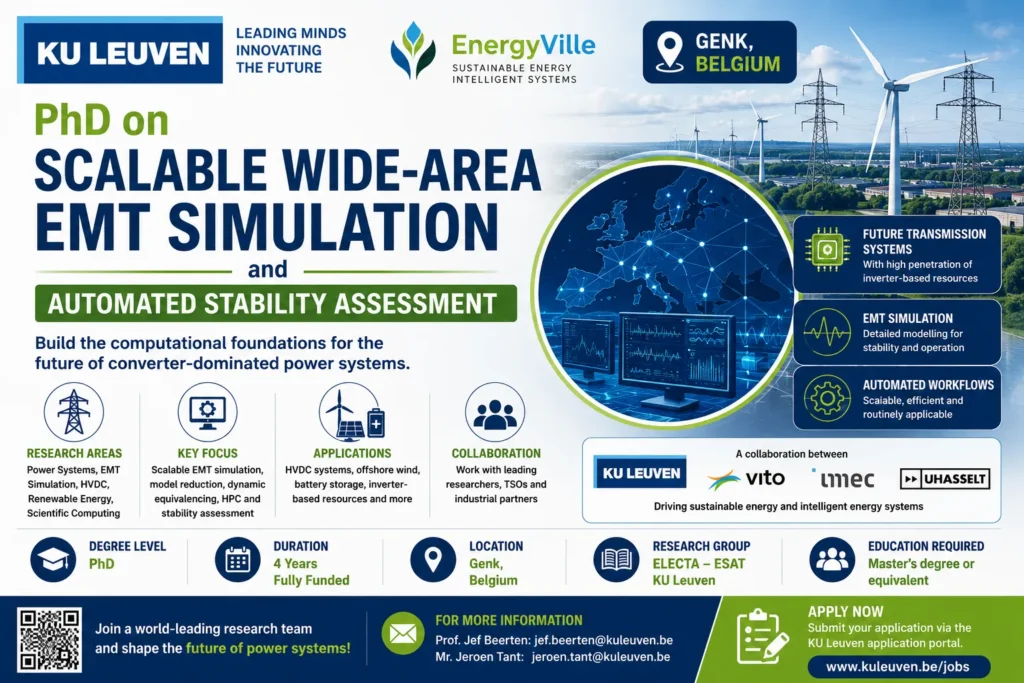
KU Leuven and EnergyVille are offering a fully funded 4-year PhD position focused on scalable electromagnetic-transient (EMT) simulation and automated stability assessment of future converter-dominated transmission systems.
The project combines power systems engineering, numerical methods, scientific computing, high-performance computing, and software development to address the growing challenges created by inverter-based resources such as offshore wind, battery storage, HVDC systems, and other power-electronic technologies.
The successful PhD candidate will develop computational methods that can make EMT-based stability assessment more scalable, automated, and practical for large national and regional transmission networks.
PhD Position Overview
| Detail | Information |
|---|---|
| University | KU Leuven |
| Research Group | ELECTA, Department of Electrical Engineering (ESAT) |
| Research Partner | EnergyVille |
| Research Area | Power Systems, EMT Simulation & Stability Assessment |
| PhD Topic | Scalable Wide-Area EMT Simulation and Automated Stability Assessment |
| Degree Level | PhD |
| Education Required | Master’s degree or equivalent |
| Funding | Fully Funded |
| Duration | 4 years |
| Location | Genk, Belgium |
| Research Focus | Power Systems, HVDC, Renewable Energy, Scientific Computing |
| Programming | Python, Julia, MATLAB, C/C++ or related languages |
| Application | KU Leuven application portal |
About KU Leuven
KU Leuven is one of Belgium’s leading research universities, with a long tradition of education and fundamental research.
The university conducts both fundamental and applied research across a wide range of academic disciplines and maintains a strong international research orientation.
The Department of Electrical Engineering (ESAT) includes the ELECTA research group, which conducts research covering the generation, transmission, distribution, and efficient use of electrical energy.
Research areas within the group include:
- Smart grids
- Reliable power systems
- Renewable energy integration
- HVDC systems
- LVDC systems
- Energy markets
- Transmission networks
- Distribution networks
- Converter-dominated power systems
The ELECTA research group is led by seven professors and includes senior researchers, postdoctoral researchers, and approximately 50 PhD students.
About EnergyVille
EnergyVille is a collaboration between KU Leuven, VITO, imec, and UHasselt focused on sustainable energy and intelligent energy systems.
The PhD project will be carried out within the KU Leuven ELECTA division and EnergyVille-Etch, providing access to a research environment focused on future energy technologies and advanced power-system research.
About the Research Team
The research team led by Prof. Jef Beerten is internationally recognized for research in areas including:
- HVDC systems
- Converter modeling
- Dynamic interactions
- Grid-forming control
- Impedance-based stability assessment
- Future AC/DC transmission networks
The group combines fundamental research with practical industrial applications and contributes to the development of future converter-dominated transmission systems.
About the PhD Project
Future electrical transmission systems are expected to contain increasing numbers of inverter-based resources, including offshore wind farms, battery storage systems, HVDC networks, and other converter-connected technologies.
These technologies introduce increasingly important electromagnetic-transient (EMT) phenomena that can affect power-system stability and operation.
Although EMT simulation provides detailed modeling capabilities, current approaches do not scale efficiently to the size of national and regional transmission systems.
Research Vision
The goal of this PhD project is to make EMT-based stability assessment for future transmission systems more systematic, scalable, and routinely applicable, similar to the way RMS-based studies are currently used.
The research will combine:
Power Systems + Numerical Methods + Scientific Computing + Software Development
Main Research Objectives
The successful PhD researcher will work on developing computational foundations for large-scale and automated EMT-based stability assessment.
1. Scalable EMT Simulation
Develop new methodologies that allow EMT simulations to be performed efficiently on large transmission systems.
2. Model Reduction
Investigate model-reduction techniques that can decrease computational complexity while retaining the important dynamic characteristics of the system.
3. Dynamic Equivalencing
Study dynamic equivalencing methods for representing parts of large transmission networks more efficiently.
4. Network Partitioning
Develop network-partitioning approaches that can improve the scalability and computational performance of EMT simulations.
5. High-Performance Computing
Investigate parallel computing and high-performance computing approaches for large-scale EMT simulation.
6. Automated Stability Assessment
Develop automated workflows for:
- Large-scale stability assessment
- Contingency screening
- Automated simulation
- Analysis of stability phenomena
- Evaluation of multiple transmission-system scenarios
7. Converter-Driven Stability
Identify and analyze stability phenomena associated with:
- HVDC systems
- Renewable energy generation
- Battery energy storage
- Inverter-based resources
- Converter-dominated transmission networks
8. Utility-Scale Validation
Validate the developed computational methods using realistic utility-scale transmission-system models.
Ideal Candidate Profile
KU Leuven is looking for a highly motivated candidate with a strong academic background and an interest in computational power-system research.
Required Qualifications
Applicants should have:
- A Master’s degree in Electrical Engineering, Applied Mathematics, Scientific Computing, Computer Engineering, or a related discipline.
- Excellent academic results.
- A strong background in power systems.
- An interest in power-system dynamics and stability.
- An affinity for numerical simulation.
- Interest or experience in algorithm development.
- Interest in scientific programming.
- Excellent English communication skills.
Desirable Skills
The following qualifications are considered an advantage:
- Knowledge of power electronics.
- Understanding of HVDC systems.
- Knowledge of inverter-based resources.
- Experience with PSCAD.
- Experience with EMTP.
- Experience with RTDS.
- Experience with OPAL-RT.
- Experience with PowerFactory.
- Experience with MATLAB/Simulink.
- Programming experience in Python.
- Programming experience in Julia.
- Programming experience in MATLAB.
- Programming experience in C/C++.
- Interest in high-performance computing.
- Knowledge or interest in parallel algorithms.
What Does the PhD Position Offer?
This is a fully funded 4-year PhD position at KU Leuven and EnergyVille.
The successful candidate will have the opportunity to:
- Work on cutting-edge research in future power systems.
- Investigate converter-dominated transmission networks.
- Develop advanced EMT simulation methodologies.
- Work with state-of-the-art simulation infrastructure.
- Use realistic utility-scale transmission-system models.
- Collaborate with leading academic researchers.
- Work with transmission system operators (TSOs).
- Collaborate with industrial partners.
- Attend international conferences.
- Publish research in high-impact scientific journals.
- Develop expertise in scientific computing and high-performance computing.
Research Location
The PhD position will be based in:
EnergyVille
Genk, Belgium
The research is conducted through collaboration between the KU Leuven ELECTA research division and EnergyVille.
Application Requirements
Interested candidates should submit their application through the KU Leuven application portal.
The application should include:
- Curriculum Vitae (CV)
- Academic transcripts
- Motivation letter
- Technical statement
Technical Statement
Applicants must also provide a brief technical statement of maximum half an A4 page addressing:
- Why are you interested in applying for this PhD position?
- What are the main computational challenges associated with wide-area EMT simulation and automated stability assessment?
Applicants should keep this statement concise and demonstrate both their motivation and understanding of the computational challenges associated with the project.
Contact Information
For further information about the PhD project, applicants can contact:
Prof. Dr. Jef Beerten
Email: jef.beerten@kuleuven.be
Jeroen Tant
Email: jeroen.tant@kuleuven.be
Diversity and Inclusion
KU Leuven states that it is committed to providing an inclusive, respectful, and socially safe research and working environment.
The university considers diversity an asset and supports an environment where open dialogue and different perspectives contribute to research and education.
Why Apply for This PhD?
This PhD position is particularly suitable for candidates interested in the future of electrical power systems, renewable energy integration, HVDC, power electronics, numerical simulation, and high-performance computing.
The project addresses an important challenge in modern energy infrastructure: how to efficiently assess the stability of increasingly complex transmission systems containing large numbers of inverter-based resources.
For candidates with a strong background in electrical engineering and computational methods, this PhD offers the opportunity to work at the intersection of power-system engineering, advanced simulation, numerical algorithms, and scientific software development.
PhD Opportunity Summary
| Category | Details |
|---|---|
| Position | PhD on Scalable Wide-Area EMT Simulation and Automated Stability Assessment |
| University | KU Leuven |
| Research Group | ELECTA |
| Partner | EnergyVille |
| Location | Genk, Belgium |
| Degree Level | PhD |
| Education Required | Master’s degree |
| Funding | Fully Funded |
| Duration | 4 years |
| Research Area | Electrical Engineering / Power Systems |
| Key Topics | EMT Simulation, Stability Assessment, HVDC, Renewable Energy, Scientific Computing |
| Programming | Python, Julia, MATLAB, C/C++ |
| Application | KU Leuven Application Portal |
Frequently Asked Questions
What is the topic of this PhD?
The PhD focuses on scalable wide-area electromagnetic-transient (EMT) simulation and automated stability assessment for future converter-dominated transmission systems.
Which university is offering this PhD?
The position is offered through KU Leuven, in collaboration with EnergyVille.
Where is the PhD located?
The working location is Genk, Belgium, at EnergyVille.
Is this a fully funded PhD?
Yes. The position is described as a fully funded 4-year PhD position at KU Leuven and EnergyVille.
What degree is required?
Applicants should have a Master’s degree in Electrical Engineering, Applied Mathematics, Scientific Computing, Computer Engineering, or a related discipline.
What programming skills are useful?
Programming experience in Python, Julia, MATLAB, C/C++, or related languages is considered valuable.
Is experience with power-system software required?
The source lists experience with tools such as PSCAD, EMTP, RTDS, OPAL-RT, PowerFactory, and MATLAB/Simulink as desirable skills.
What is the duration of the PhD?
The position is funded for four years.
What documents are required?
Applicants should submit a CV, academic transcripts, motivation letter, and a technical statement of no more than half an A4 page.