
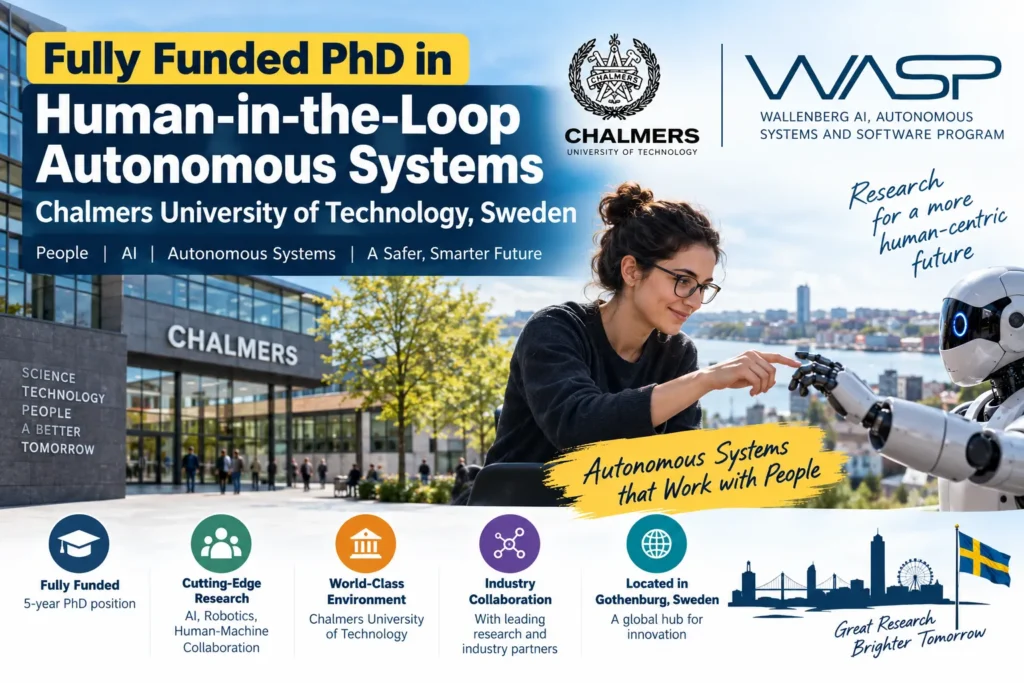
Fully Funded PhD in Human-in-the-Loop Autonomous Systems
Chalmers University of Technology in Gothenburg, Sweden, is recruiting doctoral students to work on human-in-the-loop (HITL) autonomous systems, with research spanning autonomous robots, software engineering, self-adaptive systems, human-machine coordination, formal methods and cybersecurity.
The opportunity is particularly relevant to applicants with a background in Computer Science, Software Engineering, Applied Mathematics or a closely related field who want to conduct research at the intersection of humans, artificial intelligence, autonomous systems and software engineering.
The positions are described as fully funded from the start, with doctoral employment at Chalmers. The supplied vacancy states a five-year appointment that includes 20% teaching or other departmental duties, with a starting salary of SEK 35,725 per month, increasing by SEK 5,000 per month after two years.
Important deadline note: The supplied vacancy states an application deadline of October 15, 2026, but the current WASP listing for this specific Chalmers position gives July 13, 2026. Applicants should therefore verify the live Chalmers/WASP application page before relying on either date.
Quick Overview
| Detail | Information |
|---|---|
| University | Chalmers University of Technology |
| Location | Gothenburg, Sweden |
| Research area | Human-in-the-loop autonomous systems |
| Positions | 5 doctoral student positions |
| Funding | Fully funded from the start |
| Duration | 5 years |
| Department | Department of Computer Science and Engineering |
| Research division | Interaction Design and Software Engineering |
| Main fields | AI, autonomous systems, software engineering, formal methods, human-machine collaboration |
| Salary | SEK 35,725/month initially, according to the supplied vacancy |
| Salary increase | SEK 5,000/month after 2 years |
| Teaching/departmental duties | 20% of working time |
| Degree background | Computer Science or related field |
| Language | English |
| Study mode | Physical presence required in Sweden |
| Application language | English |
| Supervisor | Associate Professor Rebekka Wohlrab |
| Funding/program connections | VR, SSF and WASP |
| Application deadline | Verify current deadline on the official vacancy |
What Is a Human-in-the-Loop Autonomous System?
Human-in-the-loop autonomous systems are systems designed to operate autonomously while incorporating human expectations, decisions, interaction, supervision or collaboration into their operation.
Instead of treating autonomy as complete independence from people, HITL research investigates how autonomous systems can work effectively and safely with humans. This can include robots collaborating with workers, autonomous systems adapting to changing human teams, or software that reasons about what users expect from an autonomous system.
This research is increasingly important because autonomous technologies are being introduced into complex environments where technical performance alone is not enough. Systems may also need to be understandable, adaptable, secure and aligned with human goals.
Why This PhD in Human-in-the-Loop Autonomous Systems Opportunity Is Significant
The research at Chalmers focuses on an important challenge: how can autonomous systems become better at working with humans in real-world environments?
The research can have applications in areas such as:
- Healthcare
- Transportation
- Robotics
- Industrial automation
- Autonomous networks
- Human-machine teaming
- Software-intensive systems
- Cybersecurity
- Intelligent infrastructure
The broader research environment combines computer science, software engineering, artificial intelligence and autonomous systems. The Department of Computer Science and Engineering is jointly associated with Chalmers University of Technology and the University of Gothenburg.
PhD Research Projects in Human-in-the-Loop Autonomous Systems
The recruitment covers two principal research projects: Expectations and Self-adaptation.
1. Expectations Project
The Expectations project investigates how autonomous systems can become aware of what their human users expect.
A major challenge with autonomous systems is that they may perform technically valid actions that nevertheless surprise or confuse their users. Understanding human expectations could help autonomous systems behave in ways that better align with users or provide meaningful explanations when unexpected behavior occurs.
The project plans to investigate:
- Representation of human expectations
- Formal modelling of expectations
- Runtime reasoning about human expectations
- Autonomous system behavior
- Explanations for unexpected system behavior
- Simulation-based evaluation
- Experiments using physical robots
The project requires applicants to be comfortable with mathematics and to hold a degree in Computer Science, Applied Mathematics or a related field. Experience with probability theory, reinforcement learning or Markov Decision Processes is advantageous. Coursework or project experience in multi-agent systems, reinforcement learning and probability theory can further strengthen an application.
Who is a good fit for the Expectations project?
This project may be particularly suitable for applicants interested in:
- Formal methods
- Reinforcement learning
- Probability
- Markov Decision Processes
- Multi-agent systems
- Human-AI interaction
- Robot reasoning
- Explainable autonomous behavior
2. Self-Adaptation Project
The Self-adaptation project focuses on adaptive coordination between teams of humans and autonomous systems.
Many existing systems rely on predefined coordination rules. However, real-world environments can change rapidly. The number of humans or autonomous systems involved may change, communication structures may vary, and teams may need different levels of centralized or decentralized control.
The project therefore investigates methods for enabling autonomous systems to adapt their coordination mechanisms at runtime.
Research activities may include:
- Designing software architectures for adaptive coordination
- Developing software prototypes
- Runtime models
- Behavior trees
- State machines
- Human-machine teaming
- Multi-human and multi-autonomous-system coordination
- Experimental evaluation
- Cybersecurity in human-machine teams
One possible research direction involves cybersecurity: for example, determining how a human-autonomous team should respond when an autonomous system behaves suspiciously or may have been compromised.
Applicants for this project should be comfortable with self-adaptive systems and software architecture and should normally have a degree in Computer Science, Software Engineering or a related field.
What Will the PhD in Human-in-the-Loop Autonomous Systems Student Do?
Successful applicants will conduct research across theoretical development, software engineering and experimental evaluation.
The main responsibilities include:
- Developing theoretical foundations, methods, models and tools for human-in-the-loop autonomous systems.
- Evaluating research contributions using rigorous empirical methods.
- Conducting laboratory experiments and potentially industrial evaluations.
- Developing software and research prototypes.
- Publishing research papers.
- Presenting research at relevant scientific venues.
- Completing advanced doctoral-level courses.
- Teaching at undergraduate level or performing other departmental duties equivalent to 20% of working time.
The research may also involve collaboration with industrial partners, including Volvo Group and Ericsson, according to the supplied position description.
Funding and Salary
One of the strongest features of this opportunity is that the doctoral positions are described as fully funded from the beginning.
The supplied vacancy states:
- Five-year fixed-term doctoral appointment
- 20% teaching or other departmental duties
- Starting salary: SEK 35,725 per month
- Salary increase of SEK 5,000 per month after two years
- Employment benefits available to Chalmers doctoral employees
The stated salary is the amount in the supplied vacancy and should not be interpreted as a net or after-tax salary.
Does the PhD include teaching?
Yes. The position is structured around 20% teaching or other departmental duties. The remaining working time is devoted to doctoral research, courses and related academic activities.
WASP and the Chalmers Research Environment
The positions are connected to the Wallenberg AI, Autonomous Systems and Software Program (WASP), one of Sweden’s major research initiatives in artificial intelligence, autonomous systems and software.
WASP’s Graduate School provides PhD in Human-in-the-Loop Autonomous Systems students with interdisciplinary training, research networking, international opportunities and interaction with Swedish industry. The current WASP Graduate School reports hundreds of active doctoral students and a broad course portfolio.
The WASP Graduate School also provides courses covering areas such as:
- Autonomous systems
- Artificial intelligence and machine learning
- Cybersecurity
- Human-robot interaction
- Interaction and collaboration
- Software engineering
- Cloud computing
- Statistics and optimization
This broader training can be valuable for doctoral researchers whose projects cross traditional disciplinary boundaries.
Who Can Apply?
The position is aimed primarily at applicants with a strong academic background in computer science or a closely related discipline.
Mandatory qualifications
According to the supplied vacancy, applicants should have:
- A Master’s degree of 120 credits or a Master’s degree of 60 credits in Computer Science or a related field
- A documented research record or demonstrated research interests in software engineering, formal methods or a related area
- Strong motivation and independence
- Well-developed analytical and problem-solving abilities
- Strong written and spoken English communication skills
The vacancy also states that substantially equivalent knowledge acquired through another educational route may qualify. A four-year Bachelor’s degree is given as an example.
What Can Strengthen an Application?
A strong applicant may have experience in one or more of the following areas:
- Software engineering
- Formal methods
- Self-adaptive systems
- Software architecture
- Artificial intelligence
- Reinforcement learning
- Probability theory
- Markov Decision Processes
- Multi-agent systems
- Autonomous systems
- Robotics
- Human-AI interaction
- Cybersecurity
- Runtime models
- Behavior trees
- State machines
Peer-reviewed publications can also strengthen an application. The supplied vacancy specifically identifies publications in conferences, journals or workshops as advantageous.
Is This PhD in Human-in-the-Loop Autonomous Systems Suitable for International Students?
The position can be relevant to international applicants who meet the academic requirements. However, doctoral study requires physical presence in Sweden throughout the study period, according to the supplied vacancy.
A valid residence permit must be available by the study start date; otherwise, admission may be withdrawn.
Applicants should separately verify the current Swedish immigration and residence-permit requirements with the appropriate Swedish authorities before making travel or financial commitments.
Application Requirements
Applications must be submitted in English and as PDF files. The supplied vacancy lists the following documents:
1. CV
Your CV should clearly demonstrate:
- Academic background
- Research experience
- Thesis work
- Programming or technical skills
- Publications
- Relevant projects
- Research interests
2. Personal Letter
The personal letter is limited to one page.
It should cover:
- Who you are
- Your relevant academic and research experience
- Your thesis or previous research
- Other relevant research activities
- Your future research goals
- Your intended research focus
3. Bachelor’s and Master’s Thesis
Applicants should provide their Bachelor’s thesis and, where available, Master’s thesis together with academic transcripts.
The application system does not support ZIP files, and the supplied vacancy states a maximum file size of 40 MB for each file.
Incomplete applications and applications submitted by email will not be considered. Reference contact details are requested after the interview stage.
How to Make Your Application Stronger
Because these are research-intensive doctoral positions, applicants should avoid treating the application as a generic PhD in Human-in-the-Loop Autonomous Systems application.
A stronger application should establish a clear connection between your previous research and the proposed project.
For example:
- Identify the project you are applying for.
Explain why the Expectations or Self-adaptation project matches your interests. - Show relevant technical preparation.
Highlight experience with formal methods, software architecture, reinforcement learning, probability, autonomous systems or related areas where applicable. - Explain your research experience.
Your thesis, publications, research projects and experimental work are particularly important. - Demonstrate methodological thinking.
Explain how you have approached research questions rather than simply listing technical skills. - Connect your future goals to the project.
The personal letter specifically asks applicants to describe their future goals and research focus. - Keep the letter focused.
Because the personal letter is limited to one page, every paragraph should contribute evidence of research fit.
Advantages of This PhD in Human-in-the-Loop Autonomous Systems
The position offers several attractive features for candidates pursuing careers in AI, robotics, autonomous systems or software engineering.
Fully funded doctoral employment
The position is described as fully funded from the start rather than requiring the student to independently secure tuition or research funding.
Strong interdisciplinary research
The projects combine human-centered software engineering, autonomous systems, formal reasoning, software architecture and artificial intelligence.
Industrial collaboration
The research can involve industrial contexts and collaborators such as Volvo Group and Ericsson.
WASP Graduate School
WASP provides a national research and training environment connecting doctoral researchers across AI, autonomous systems and software.
International research environment
The program supports interaction among researchers, doctoral students and industry and includes international opportunities through the Graduate School.
Potential Challenges Applicants Should Consider
A strong opportunity does not necessarily mean every applicant will be a good fit.
Consider the following before applying:
- The academic requirements are strongly oriented toward Computer Science and related technical disciplines.
- The research involves substantial analytical and technical work.
- Applicants need sufficient mathematical preparation for the Expectations project.
- Software architecture and self-adaptive systems knowledge is important for the Self-adaptation project.
- The position requires physical presence in Sweden.
- The doctoral appointment includes 20% teaching or other departmental duties.
- Applicants should be prepared for research publication and conference participation.
The key question is therefore not simply “Is this a funded PhD?” but rather “Does my academic and research background match the research problem?”
Chalmers PhD in Human-in-the-Loop Autonomous Systems: Key Takeaways
- Chalmers University of Technology is recruiting doctoral students in human-in-the-loop autonomous systems.
- The research covers human expectations, adaptive coordination, autonomous systems and software engineering.
- Two major research directions are Expectations and Self-adaptation.
- Applicants generally need a Master’s-level background in Computer Science or a related discipline.
- Experience with formal methods, reinforcement learning, probability, software architecture or self-adaptive systems can strengthen an application.
- The supplied vacancy describes the positions as fully funded, with a five-year appointment and 20% teaching or departmental duties.
- The stated starting salary is SEK 35,725 per month, with a SEK 5,000 monthly increase after two years.
- The opportunity is connected to the WASP research and graduate-school environment.
- Applicants must submit a CV, one-page personal letter, thesis documents and transcripts.
- Applicants should verify the current deadline on the official vacancy because the supplied text and the current WASP listing show different dates.
Frequently Asked Questions
What is the Human-in-the-Loop PhD at Chalmers?
It is a doctoral research opportunity focused on developing autonomous systems that can work effectively with humans. The research includes human expectations, adaptive coordination, software engineering, formal methods, robotics and potentially cybersecurity.
Is the Chalmers Human-in-the-Loop PhD fully funded?
Yes. The supplied position description states that the doctoral positions are fully funded from the start and are offered as fixed-term doctoral employment.
How much does a Chalmers PhD in Human-in-the-Loop Autonomous Systems student earn?
The supplied vacancy states a starting salary of SEK 35,725 per month, valid from May 1, 2026, with an increase of SEK 5,000 per month after two years.
What degree do I need for this PhD in Human-in-the-Loop Autonomous Systems ?
Applicants are expected to have a Master’s degree in Computer Science or a related field. The vacancy also indicates that substantially equivalent knowledge may qualify in some circumstances.
Can I apply if I have experience in reinforcement learning?
Yes, particularly for the Expectations project. The vacancy identifies probability theory, reinforcement learning and Markov Decision Processes as advantageous areas of experience.
Can I apply for the Self-adaptation project with a Software Engineering background?
Yes. Software Engineering is specifically identified as an appropriate degree background for the Self-adaptation project, where knowledge of self-adaptive systems and software architecture is important.
Does the PhD in Human-in-the-Loop Autonomous Systems require teaching?
Yes. The supplied vacancy states that doctoral students will teach at undergraduate level or perform other departmental duties corresponding to 20% of working hours.
Is physical presence in Sweden required?
Yes. The supplied position states that doctoral studies require physical presence throughout the study period and that a valid residence permit must be presented by the study start date.
What is the application deadline?
The supplied vacancy states October 15, 2026, but the current WASP listing for the Chalmers Human-in-the-Loop position lists July 13, 2026. Because these dates conflict, applicants should check the live official application page before submitting an application.