
Introduction
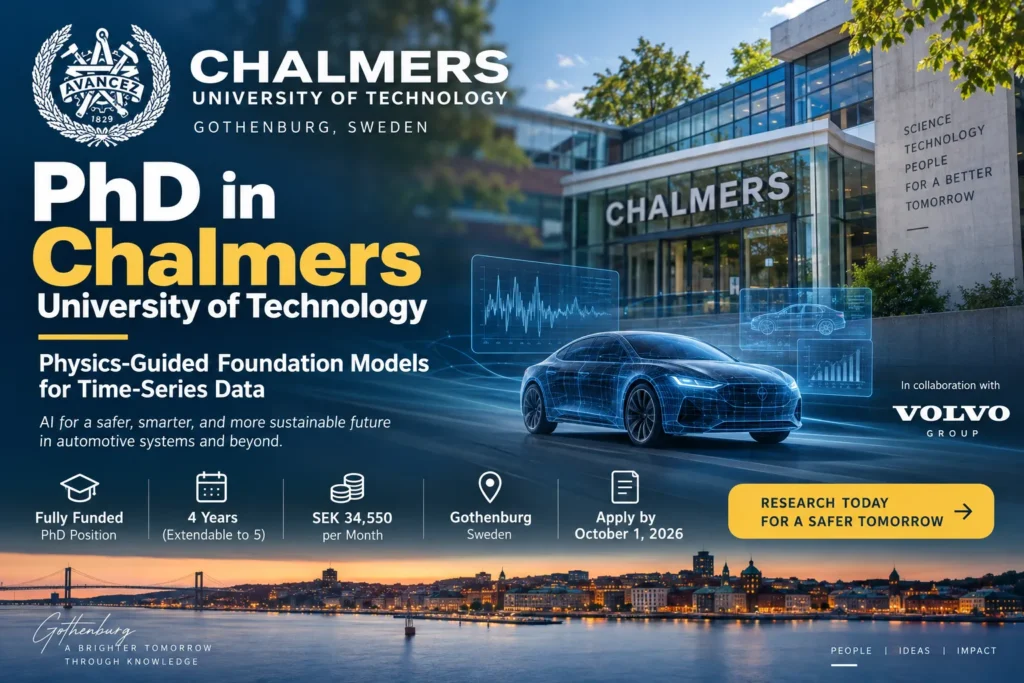
Apply for a fully funded PhD at Chalmers University of Technology in Sweden on physics-guided foundation models for safety-critical time-series data.
The PhD in Chalmers University of Technology offers an opportunity to conduct research on physics-guided foundation models for multivariate time-series data, with a primary application in automotive systems. The doctoral project combines machine learning, time-series modeling, physics-aware modeling, simulation, and safety-critical AI in collaboration with Volvo Group.
The position is based at the Department of Computer Science and Engineering, a joint department of Chalmers University of Technology and the University of Gothenburg. The research will be conducted within AIXLab@Chalmers, with access to industrial datasets, simulation environments, and real-world validation workflows.
The application deadline is October 1, 2026. The position is fully funded, and the advertised starting salary is SEK 34,550 per month, according to the vacancy information supplied for this position.
PhD in Chalmers University of Technology Position at Chalmers: Key Details
| Category | Details |
|---|---|
| University | Chalmers University of Technology |
| Location | Gothenburg, Sweden |
| Department | Department of Computer Science and Engineering |
| Research environment | AIXLab@Chalmers |
| Industry partner | Volvo Group |
| PhD field | Artificial Intelligence, Computer Science, Time-Series Modeling |
| Research focus | Physics-guided foundation models for time-series data |
| Funding | Fully funded |
| Standard position length | 4 years |
| Possible extension | Up to 5 years with up to 20% departmental duties |
| Advertised starting salary | SEK 34,550/month |
| Language | English |
| Location | Gothenburg, Sweden |
| Application deadline | October 1, 2026, 23:59 CET |
| Position type | Doctoral/PhD position |
The vacancy states that the position requires physical presence throughout the study period and that an appropriate residence permit must be available by the study start date.
What Is This PhD in Chalmers University of Technology Project About?
This PhD in Chalmers University of Technology project investigates how physics-guided foundation models can be developed for complex multivariate time-series data.
In this context, foundation models are reusable pretrained models that can potentially be adapted to different vehicles, operating conditions, and tasks rather than being designed for only one narrowly defined application.
The main research application is the automotive sector. The project aims to use AI models to:
- Predict vehicle behavior
- Simulate rare and safety-critical scenarios
- Generate realistic test cases
- Improve validation of automated systems
- Reduce dependence on physical testing
- Identify potential failure modes
- Improve the reliability and efficiency of automated systems
The underlying techniques may also have applications beyond automotive engineering, including other safety-critical fields such as healthcare.
What Does “Physics-Guided” Machine Learning Mean?
Physics-guided machine learning combines data-driven AI models with knowledge about how a physical system behaves.
Instead of allowing a neural network to learn entirely from data, physical principles can be incorporated into the modeling process. Depending on the research approach, this may involve:
- Physical constraints
- Conservation laws
- System dynamics
- Physics-based inductive biases
- Hybrid simulation and machine-learning approaches
- Physics-consistent loss functions
For this project, the models will work with vehicle-related time-series data, including CAN signals, sensor streams, and simulated state trajectories.
This makes the research particularly relevant to safety-critical applications, where a model must not only perform well statistically but also behave reliably under unusual or previously unseen conditions.
What Research Will the PhD in Chalmers University of Technology Student Conduct?
The research will combine several areas of modern artificial intelligence and engineering.
1. Multivariate Time-Series Modeling
The project will work with multiple signals changing over time. Automotive systems can generate large numbers of interconnected signals from sensors, vehicle-control systems, and simulations.
The research will investigate how these signals can be represented and modeled effectively.
2. Foundation Models
The PhD in Chalmers University of Technology researcher will investigate reusable models that can be pretrained and subsequently adapted to different tasks.
Potential tasks include forecasting, representation learning, and scenario generation.
3. Physics-Guided AI
The project will investigate ways to introduce physical knowledge into large neural architectures rather than relying solely on statistical patterns in the training data.
4. Scenario Generation
One important application is generating rare or difficult scenarios that may be expensive or dangerous to reproduce using physical vehicles.
Synthetic or simulated scenarios can potentially help researchers and engineers evaluate automated systems against a broader range of conditions.
5. Safety and Reliability
Because the project focuses on safety-critical systems, model performance must be considered alongside reliability, physical consistency, and the ability to handle edge cases.
The intended research outcomes include safer automation, more efficient testing, fewer failure modes, and potentially reduced energy use.
Why Is Time-Series AI Important for Automotive Systems?
Modern vehicles generate substantial quantities of time-dependent information from sensors, electronic control systems, simulations, and communication networks.
Traditional machine-learning models may perform well on common situations but can encounter difficulties when presented with unusual combinations of conditions.
Foundation models for time-series data could potentially provide a reusable framework for:
- Vehicle behavior prediction
- Anomaly and failure analysis
- Simulation
- Test-case generation
- Representation learning
- Forecasting
- Automated-system validation
The addition of physical constraints is particularly relevant where incorrect predictions could have safety implications.
Who Is Eligible to Apply?
The vacancy specifies several mandatory qualifications.
Academic Requirements
Applicants must have either:
- A 120-credit Master’s degree, or
- A 60-credit Master’s degree
in Computer Science, Electrical Engineering, or an equivalent field.
For applicants whose education was completed outside Sweden, the vacancy states that a four-year Bachelor’s degree is accepted.
Chalmers’ general doctoral-study information similarly states that doctoral applicants normally need a second-cycle degree equivalent to a Swedish Master’s degree, with subject-specific requirements determined by the relevant graduate school.
English Language Skills
Applicants need strong written and verbal communication skills in English.
Machine Learning Knowledge
The position requires strong fundamentals in machine learning, particularly:
- Probability
- Statistics
- Optimization
- Time-series modeling
- Physics-guided machine learning
Programming Skills
Applicants are expected to have proficiency in:
- Python
- Modern deep-learning frameworks
- PyTorch or comparable tools
Engineering and Research Skills
The position also emphasizes engineering maturity, including experience with:
- Large-scale GPU training
- Cluster-based training
- Reproducible experiments
- Version-controlled datasets
- Systematic model evaluation
- Large-scale empirical research
Applicants should also be capable of formulating research questions and conducting empirical studies at scale.
Which Additional Experience Can Strengthen an Application?
The following experience is not listed as mandatory, but may strengthen an applicant’s profile:
- Physics-informed or physics-guided machine learning
- Foundation models for time-series data
- Forecasting
- Representation learning
- Safety-critical systems
- Scenario generation
- Edge-case testing
- Academic research
- Peer-reviewed publications
What Will the PhD Student Do?
The doctoral researcher will combine advanced coursework with independent scientific research.
Key responsibilities include:
- Taking advanced courses within the Graduate School of Computer Science and Engineering.
- Developing original scientific concepts.
- Designing and conducting research studies.
- Evaluating machine-learning models systematically.
- Communicating research results in written and oral form.
- Working with industrial researchers and engineers.
- Developing reusable modeling frameworks for safety-critical time-series data.
- Publishing research findings in relevant machine-learning and applied-AI venues.
The advertised project specifically expects the research to contribute to industrial validation workflows as well as academic research.
Collaboration With Volvo Group
A major feature of this PhD in Chalmers University is the collaboration between AIXLab@Chalmers and Volvo Group.
This means the research is closely connected to industrial applications rather than being limited to theoretical model development.
According to the vacancy, the doctoral researcher will have access to:
- Industrial datasets
- Simulation environments
- Real validation workflows
- Engineers and researchers at Volvo Group
For applicants interested in pursuing careers in industrial AI, autonomous systems, machine learning engineering, or applied research, this industry connection is an important feature of the position.
Is the Chalmers PhD Fully Funded?
Yes. The advertised doctoral position is fully funded from the start. The vacancy describes it as a doctoral employment position rather than an unfunded student place.
Chalmers’ general doctoral-study information confirms that doctoral students are employed by Chalmers and receive a monthly salary, while doctoral studies do not incur tuition fees.
How Long Is the PhD?
The advertised position is limited to four years, with the possibility of extension to five years when the doctoral student undertakes departmental duties of up to 20%.
Chalmers’ current rules similarly describe four years of full-time doctoral employment, with departmental duties of up to 20% potentially extending the employment period.
What Is the PhD Salary at Chalmers?
The vacancy lists a starting salary of SEK 34,550 per month, valid from May 25, 2025.
Because doctoral students at Chalmers are employees, salary and employment conditions are distinct from a traditional tuition-paying PhD in Chalmers University of Technology model. Chalmers also states that doctoral salaries have defined levels and are revised annually.
Applicants should therefore distinguish between the advertised starting salary for this vacancy and any later salary adjustments.
Where Is thePhD in Chalmers University of Technology Located?
The position is based in Gothenburg, Sweden.
The job listing identifies the location as:
Maskingränd 2, Gothenburg, Sweden.
Gothenburg is home to Chalmers’ research and education activities and has a strong industrial and engineering ecosystem.
What Benefits Does Chalmers Offer?
As a doctoral employee, the successful candidate receives employee benefits in addition to the doctoral salary.
The vacancy highlights:
- Employee status at Chalmers
- A research-oriented international environment
- A position in Gothenburg
- Parental-leave and childcare information for international employees
- Support for equality and inclusion
- Swedish-language courses for non-native Swedish speakers
Chalmers also describes doctoral education as combining research, courses, and teaching, with generic and transferable-skills development available to doctoral students.
What Documents Are Required?
The application must be submitted in English and attached as PDF files. The vacancy specifically states that the application system does not support ZIP files.
The application should include:
1. CV
Your CV should clearly present your:
- Academic qualifications
- Research experience
- Programming skills
- Machine-learning experience
- Publications
- Relevant projects
- Industry experience
2. Personal Letter
The personal letter should include:
- A brief introduction
- Your motivation for applying
- Your interest in the research project
3. Bachelor’s and Master’s Thesis
Applicants should provide their Bachelor’s thesis and, where available, Master’s thesis.
4. Academic Transcripts
Academic transcripts should accompany the degree/thesis documentation.
References are requested later in the recruitment process, after the interview stage.
How to Make Your Application Stronger
Because this project sits at the intersection of AI, engineering, and safety-critical systems, a strong application should demonstrate more than general interest in artificial intelligence.
Highlight relevant technical skills
If you have experience with:
- Python
- PyTorch
- TensorFlow
- GPU computing
- Linux clusters
- CUDA
- Time-series analysis
- Deep learning
- Transformers
- Foundation models
- Probabilistic modeling
- Optimization
make those skills easy to find in your CV.
Connect your research experience to the project
Do not simply list publications or projects. Explain how your previous work demonstrates your ability to:
- Formulate research questions
- Work with real datasets
- Design experiments
- Analyze results
- Reproduce experiments
- Communicate scientific findings
Demonstrate interest in physics-guided AI
If your previous research involves physical systems, simulation, mathematical modeling, differential equations, control systems, or scientific machine learning, explain the connection explicitly.
Address safety-critical applications
Experience with automotive systems is useful, but the project description also emphasizes broader safety-critical applications.
Therefore, experience involving reliability, validation, simulation, anomaly detection, uncertainty, edge cases, or safety constraints can be relevant.
Important Eligibility Consideration for International Applicants
International applicants should pay particular attention to the degree-equivalence requirement.
The position specifically requests a Master’s qualification in Computer Science, Electrical Engineering, or an equivalent discipline, while Chalmers’ general doctoral rules also require the applicant’s previous education to be sufficiently related to the doctoral subject.
Therefore, having a Master’s degree alone does not automatically mean that an applicant qualifies. The academic background must also match the research area and graduate-school requirements.
Application Deadline
The deadline for this doctoral position is:
October 1, 2026, at 23:59 CET / Europe-Stockholm time.
Applicants should submit a complete application before the deadline. The vacancy states that incomplete applications and applications submitted by email will not be considered.
Who Should Apply?
This PhD in Chalmers University of Technology is particularly suitable for applicants with a strong background in:
- Computer Science
- Artificial Intelligence
- Machine Learning
- Electrical Engineering
- Systems Engineering
- Control
- Signal Processing
- Time-Series Analysis
- Scientific Machine Learning
- Vehicle Dynamics
It is especially relevant for candidates who want to work at the intersection of AI research, physical systems, large-scale machine learning, and safety-critical applications.
Key Takeaways
- Chalmers University of Technology is offering a fully funded PhD in Chalmers University of Technology position in Gothenburg, Sweden.
- The project focuses on physics-guided foundation models for multivariate time-series data.
- The primary application is automotive systems, in collaboration with Volvo Group.
- Applicants need a relevant Master’s degree or equivalent qualification and strong machine-learning skills.
- Python and modern deep-learning frameworks such as PyTorch are required.
- Experience with physics-informed ML, time-series foundation models, safety-critical systems, or research publications can strengthen an application.
- The advertised starting salary is SEK 34,550 per month.
- The standard doctoral employment period is four years, with possible extension through departmental duties.
- The application deadline is October 1, 2026.
Frequently Asked Questions
What is the PhD in Chalmers University of Technology of Technology about?
The PhD in Chalmers University focuses on developing physics-guided foundation models for multivariate time-series data. The main application is automotive systems, where the models will be investigated for vehicle prediction, simulation, scenario generation, and safety validation.
Is this Chalmers PhD fully funded?
Yes. The vacancy states that the doctoral position is fully funded from the start. Chalmers’ general doctoral information also states that doctoral students are employed and receive a monthly salary, with doctoral studies free from tuition fees.
What is the salary for this Chalmers PhD?
The advertised starting salary is SEK 34,550 per month, with the vacancy specifying that this salary level is valid from May 25, 2025.
What degree is required for this PhD?
The vacancy requires a 120-credit Master’s degree or a 60-credit Master’s degree in Computer Science, Electrical Engineering, or an equivalent field. For education obtained outside Sweden, a four-year Bachelor’s degree is accepted according to the advertisement.
Do I need experience with physics-informed machine learning?
Physics-informed or physics-guided machine-learning experience is listed as an advantage rather than a mandatory requirement. The mandatory requirements instead emphasize machine-learning fundamentals, time-series modeling, Python, deep-learning frameworks, and large-scale research engineering.
Where is the PhD in Chalmers University located?
The position is located in Gothenburg, Sweden, at Chalmers University of Technology. The job listing gives the location as Maskingränd 2, Gothenburg.
What is the application deadline?
The application deadline is October 1, 2026, at 23:59 CET / Europe-Stockholm time.
What documents are required?
Applicants should submit an English-language application containing a CV, personal letter, Bachelor’s and Master’s thesis where available, and academic transcripts. Applications should be submitted through the application system rather than by email.