
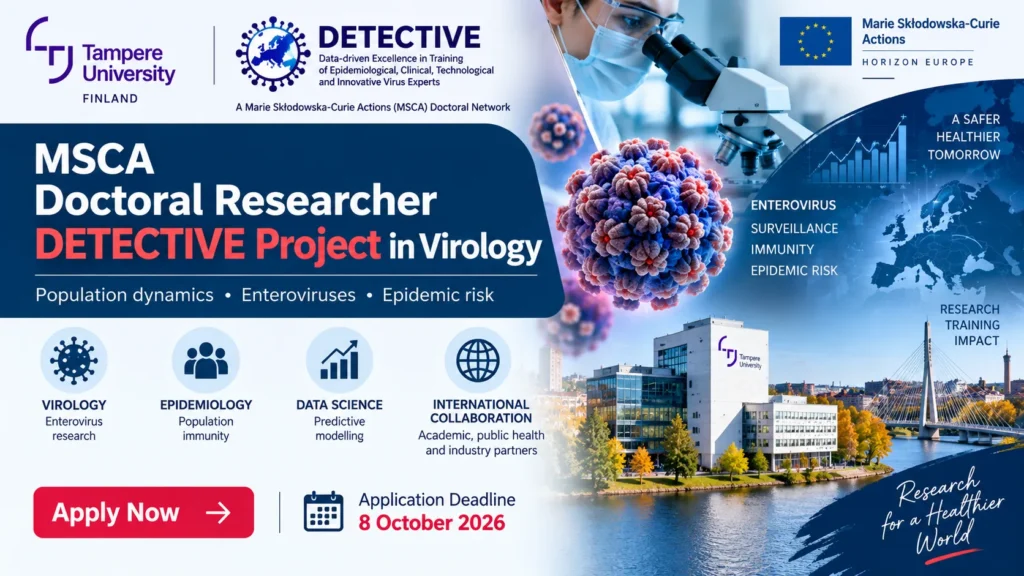
Apply for the MSCA Doctoral Researcher DETECTIVE Project Virology at Tampere University, Finland. Research enteroviruses, immunity and epidemic risk.
MSCA Doctoral Researcher DETECTIVE Project Virology at Tampere University
The MSCA Doctoral Researcher DETECTIVE Project in Virology offers an opportunity for doctoral research at Tampere University, Finland, as part of the Horizon Europe Marie Skłodowska-Curie Actions (MSCA) Doctoral Network DETECTIVE.
The project focuses on enterovirus circulation, population immunity and emerging epidemic risk. The doctoral researcher will combine laboratory-based virology and serology with epidemiological analysis and predictive modelling using long-term biological and surveillance data.
The project is based within an international and multidisciplinary research network involving academic institutions, public health organisations, regulatory bodies and industry partners across Europe.
Scholarship Overview
| Category | Details |
|---|---|
| University | Tampere University |
| Country | Finland |
| Project | DETECTIVE |
| Network | MSCA Doctoral Network |
| Position | Doctoral Candidate 8 |
| Research Area | Virology, Epidemiology and Population Immunity |
| Specific Topic | Population dynamics and emerging epidemics |
| Duration | 3 years |
| Target Degree | PhD from Tampere University |
| Location | Tampere, Finland |
| Funding | EU-funded MSCA Doctoral Network |
| Salary | Set according to MSCA rates |
| Application Deadline | 8 October 2026 |
| Application | DETECTIVE application form |
| Starting Date | Not specified |
The successful candidate will join Work Package 2 of the DETECTIVE network and conduct doctoral research on enterovirus population dynamics and epidemic emergence.
About the DETECTIVE Project
DETECTIVE stands for Data-driven Excellence in Training of Epidemiological, Clinical, Technological and Innovative Virus Experts.
It is a Horizon Europe Marie Skłodowska-Curie Actions Doctoral Network designed to train researchers in areas including:
- Epidemic intelligence
- Emerging virus surveillance
- Pandemic preparedness
- Risk assessment
- Public health decision-making
- Virology
- Epidemiology
- Data-driven research
The network brings together academic, public health, clinical and industrial partners across Europe. Its broader objective is to improve early detection of emerging pathogens and strengthen evidence-based responses to infectious disease threats.
MSCA Doctoral Researcher DETECTIVE Project Virology Research
The specific doctoral project investigates why some enterovirus types remain in limited circulation while others become epidemic or re-emerge.
Enteroviruses are common human pathogens that can cause conditions ranging from mild or asymptomatic infections to severe neurological, cardiac and systemic disease.
A major focus of the project is population immunity. Previous infections can produce type-specific neutralising antibodies, while new susceptible individuals continuously enter the population. Consequently, immunity can vary between age groups, birth cohorts and different calendar periods.
The project will investigate whether these changing immunity patterns can help explain and potentially predict the emergence of enterovirus epidemics.
Research Objectives
As Doctoral Candidate 8, the researcher will work on several interconnected objectives.
Characterising Enterovirus Immunity
The project will examine type-specific enterovirus immunity across:
- Different age groups
- Birth cohorts
- Calendar periods
This will involve longitudinal serum samples and neutralising antibody analyses.
Studying Long-Term Enterovirus Circulation
The researcher will investigate enterovirus circulation in the background population and integrate findings with:
- Healthcare surveillance
- Wastewater monitoring
- Historical epidemic information
Identifying Population Susceptibility
Another objective is to identify population-level patterns of susceptibility and immunity associated with increased enterovirus circulation and epidemic emergence.
Developing Predictive Models
The project will develop and validate predictive models for enterovirus epidemic risk by integrating:
- Immunological data
- Virological data
- Epidemiological information
- Surveillance datasets
The work will use unique longitudinal resources from the Finnish DIPP study, which contains biological samples collected from children since 1994.
Research Environment
The doctoral researcher will work in a multidisciplinary international environment involving specialists in:
- Virology
- Immunology
- Epidemiology
- Bioinformatics
- Public health
- Epidemic modelling
The supervisory team includes Adjunct Professor Sami Oikarinen and Dr. Jutta Laiho. Additional scientific mentoring and collaboration will be provided by Professor Heikki Hyöty at Tampere University, Dr. Sarah Kempster at the UK Medicines and Healthcare products Regulatory Agency (MHRA), and Professor Nicholas Grassly at Imperial College London.
International Secondments
The doctoral researcher will have international secondment opportunities within the DETECTIVE network.
Planned secondments include:
MHRA – United Kingdom
The researcher will receive training related to antibody standards at the Medicines and Healthcare products Regulatory Agency.
Imperial College London – United Kingdom
A secondment at Imperial College London will provide training in population immunity and epidemic-risk modelling.
These placements are intended to provide experience across academic and industrial research environments while developing scientific and transferable skills.
Eligibility Criteria
Applicants should have a relevant Master’s degree in a field such as:
- Biomedical sciences
- Bioinformatics
- Microbiology
- Virology
- Immunology
- Epidemiology
- A related discipline
The Master’s degree must be completed before the starting date of employment.
Additional Skills
Experience with molecular technologies and bioinformatics is considered an advantage.
The successful candidate should also be motivated to develop expertise in data science, including:
- Machine learning
- Artificial intelligence
- Biomedical data analysis
- Epidemiological data analysis
Good written and spoken English communication skills and the ability to work in a multidisciplinary research environment are expected.
MSCA Doctoral Researcher DETECTIVE Project Virology Mobility Requirement
Because this is an MSCA Doctoral Network position, applicants must meet the applicable mobility requirement.
Applicants must not have resided or carried out their main activity, such as work or studies, in Finland for more than 12 months during the 36 months immediately preceding 1 March 2027.
Short stays such as holidays and certain other excluded periods are not counted under the stated rule.
Applicants should carefully assess their personal mobility history against the official MSCA rules before applying.
Funding and Benefits
The position is a three-year Doctoral Candidate position at Tampere University within the EU-funded MSCA Doctoral Network DETECTIVE.
The salary will be determined according to MSCA rates.
A six-month trial period applies to new employees. The target degree is a MSCA Doctoral Researcher DETECTIVE Project Virology from Tampere University.
The position also offers access to:
- Unique longitudinal biological samples and epidemiological datasets
- International DETECTIVE research and training networks
- Interdisciplinary training schools
- Career development planning
- Personal empowerment programmes
- Campus Sport Services
- Occupational healthcare
- Flexible working hours
- Staff benefits at campus restaurants and cafés
Eligible Countries
The supplied vacancy does not provide a specific list of eligible countries.
International applicants should instead assess their eligibility against the academic requirements and, importantly, the MSCA Doctoral Researcher DETECTIVE Project Virology mobility rule.
Eligible countries: Not specified.
Required Documents
Applicants must complete the DETECTIVE application form and provide:
- Curriculum Vitae – maximum 2 pages.
- Motivation Letter – maximum 1 page.
- Details for two references.
The application must be submitted using the designated DETECTIVE application form.
English Language Requirements
The vacancy states that applicants should have excellent oral and written communication skills in English.
However, the supplied information does not specify an IELTS, TOEFL or other minimum English-language test score.
IELTS requirement: Not specified.
Applicants should check the official Tampere University and DETECTIVE requirements if formal English-language documentation is relevant to their application.
Application Deadline
The application deadline is:
8 October 2026
Applicants should submit the completed application and required documents before the closing date.
How to Apply
Applicants should follow these steps:
Step 1: Check your academic eligibility
Make sure you have a relevant Master’s degree in biomedical sciences, virology, microbiology, immunology, epidemiology, bioinformatics or a related discipline.
Step 2: Check the MSCA Doctoral Researcher DETECTIVE Project Virology mobility rule
Review your residence and main-activity history in Finland during the 36 months preceding 1 March 2027.
Step 3: Prepare your CV
The CV should be no longer than two pages.
Highlight relevant:
- Research experience
- Laboratory skills
- Virology or microbiology experience
- Bioinformatics
- Epidemiology
- Data analysis
- Publications
Step 4: Prepare your motivation letter
The motivation letter must be a maximum of one page.
Explain your interest in the DETECTIVE project and demonstrate how your academic and research background relates to the doctoral project.
Step 5: Add two references
Provide details for two references as required by the application.
Step 6: Submit the DETECTIVE application
The application should be submitted through the designated DETECTIVE online application form.
The official application link supplied in the vacancy is:
Research Facilities at Tampere University
Tampere University provides research infrastructure relevant to virology, metagenomics and environmental research.
The available facilities include:
- Metagenomics core facilities
- Environmental wastewater sample and data bank
- Biosafety Level 2 and Level 3 laboratories
- Dedicated PCR and cell-culture areas
- University-wide research core facilities
- Collections of wild-type enteroviruses isolated from different countries and continents
The virus laboratory also participates in international quality-control programmes, including QCMD. Researchers have access to high-performance computing resources through CSC – IT Center for Science for large-scale sequencing, bioinformatics and metagenomics research.
Important Tips for Applicants
Applicants should tailor their application specifically to the population dynamics and emerging epidemics research theme.
Relevant experience to highlight may include:
- Virology
- Serology
- Immunology
- Molecular biology
- Epidemiology
- Bioinformatics
- Statistical analysis
- Machine learning
- Public health research
- Infectious disease surveillance
Candidates without extensive machine-learning experience may still find the project relevant if they demonstrate a strong willingness to develop data-science skills, because the vacancy specifically highlights the expectation that the successful candidate will develop expertise in machine learning and artificial intelligence for biomedical and epidemiological data.
Applicants should also pay particular attention to the MSCA Doctoral Researcher DETECTIVE Project Virology mobility requirement because failure to meet this condition can affect eligibility.
Frequently Asked Questions
What is the DETECTIVE Doctoral Network?
DETECTIVE is a Horizon Europe Marie Skłodowska-Curie Actions Doctoral Network focused on training researchers in epidemic intelligence, emerging virus surveillance and pandemic preparedness.
What is the research topic of this MSCA Doctoral Researcher DETECTIVE Project Virology?
The project investigates enterovirus circulation, population immunity and the factors associated with epidemic emergence. It will also develop predictive models for enterovirus epidemic risk.
Where is the MSCA Doctoral Researcher DETECTIVE Project Virology position located?
The Doctoral Candidate 8 position is based at Tampere University in Finland.
How long is the position?
The position is for three years.
What Master’s degrees are relevant?
Relevant fields include biomedical sciences, bioinformatics, microbiology, virology, immunology, epidemiology and related disciplines.
Is bioinformatics experience mandatory?
The vacancy states that experience with molecular technologies and bioinformatics is an advantage, rather than explicitly stating it as a mandatory requirement.
Does the project involve machine learning?
Yes. The successful candidate is expected to develop expertise in data science, including machine learning and artificial intelligence, and apply these approaches to biomedical and epidemiological data.
Is IELTS required?
No specific IELTS score is stated in the supplied vacancy.
IELTS requirement: Not specified.
What is the MSCA Doctoral Researcher DETECTIVE Project Virology mobility requirement?
Applicants must not have resided or carried out their main activity in Finland for more than 12 months during the 36 months immediately preceding 1 March 2027, subject to the applicable MSCA Doctoral Researcher DETECTIVE Project Virology rules and exclusions.
What documents are required?
A CV of up to two pages, a motivation letter of up to one page and details for two references are required.
What is the application deadline?
The closing date is 8 October 2026.
Are international secondments available?
Yes. Planned secondments include the UK MHRA for antibody-standard training and Imperial College London for population immunity and epidemic-risk modelling.
Conclusion
The MSCA Doctoral Researcher DETECTIVE Project in Virology at Tampere University offers doctoral research in enterovirus epidemiology, population immunity, virology and epidemic-risk modelling.
The project combines longitudinal biological samples with healthcare surveillance, wastewater monitoring and historical epidemic data to investigate patterns associated with enterovirus emergence. It also provides interdisciplinary training and international secondments through the DETECTIVE network.
Applicants should have a relevant Master’s degree, strong interest in biomedical and epidemiological research, good English communication skills and willingness to develop data-science expertise. The MSCA Doctoral Researcher DETECTIVE Project Virology mobility requirement should also be checked carefully before applying.
The application deadline is 8 October 2026, and applicants are required to submit a CV, one-page motivation letter and details for two references through the DETECTIVE application system.