
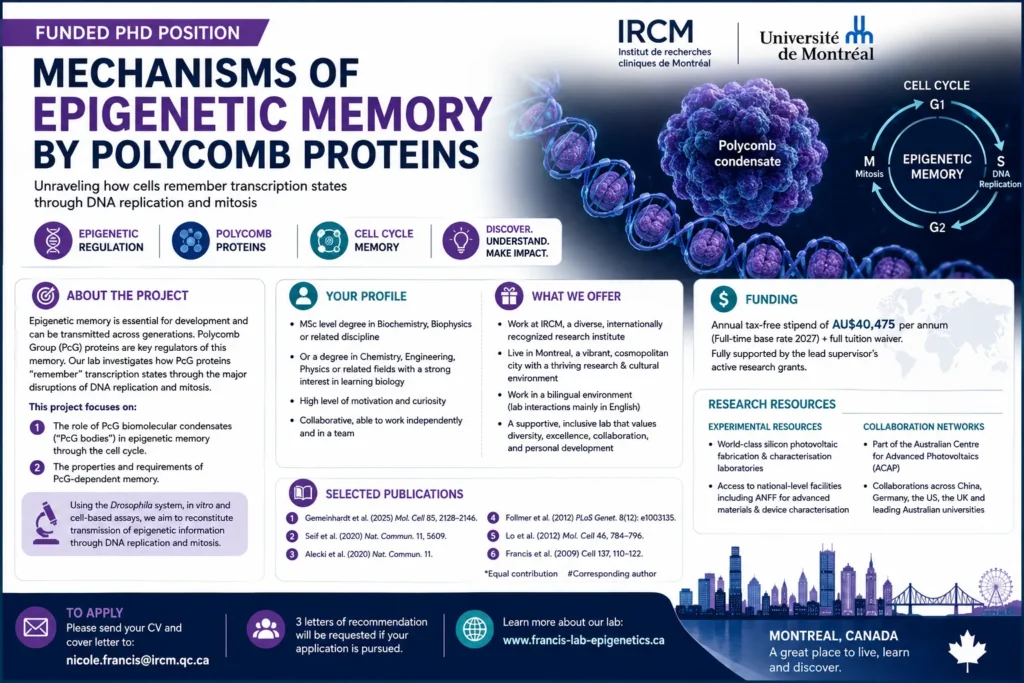
About the PhD Project
A funded PhD position is available for a highly motivated student interested in biochemistry, biophysics, epigenetic regulation, and transcriptional memory.
The project will investigate how Polycomb Group (PcG) proteins preserve epigenetic information and maintain transcriptional states as cells undergo DNA replication and mitosis.
Epigenetic memory plays a fundamental role in development and can also contribute to the transmission of biological information across generations. Although chromatin-based models have provided important insights into how Polycomb proteins contribute to epigenetic memory, the molecular mechanisms that allow transcriptional states to persist through the major disruptions associated with DNA replication and mitosis are not yet fully understood.
This PhD project aims to address these fundamental questions using a combination of biochemical, biophysical, in vitro, and cell-based approaches.
Research Focus
The research will use the simpler Drosophila system, where Polycomb Group proteins were originally discovered, to investigate the mechanisms responsible for maintaining epigenetic information.
The long-term goal of the research program is to reconstitute the transmission of epigenetic information through DNA replication and mitosis using controlled in vitro and cellular assays.
The current PhD project focuses on two major questions:
1. Role of Polycomb Biomolecular Condensates
The project will investigate the role of Polycomb Group biomolecular condensates, also known as “PcG bodies,” in maintaining epigenetic memory throughout the cell cycle.
Particular attention will be given to understanding how these condensates contribute to the organization and persistence of Polycomb-mediated transcriptional states.
2. Requirements for Polycomb-Dependent Memory
The second focus is to determine the properties and molecular requirements of Polycomb-dependent transcriptional memory.
The project builds on recent work from the research team investigating:
- Biomolecular condensate formation by a key component of Polycomb Repressive Complex 1 (PRC1)
- The molecular mechanisms regulating Polycomb protein phase separation
- A recently established synthetic reporter-based system for studying transcriptional memory
Research Approach
The project will integrate approaches from biochemistry, biophysics, molecular biology, and cell biology.
The precise training and research direction can be adapted according to the student’s existing experience and scientific interests.
Potential approaches will involve understanding:
- Polycomb protein interactions
- Biomolecular condensates
- Phase separation
- Chromatin-associated memory
- Transcriptional regulation
- DNA replication
- Mitosis
- Protein oligomerization
- In vitro biochemical systems
- Cell-based transcriptional memory assays
The research will provide an opportunity to investigate fundamental mechanisms of epigenetic regulation at molecular and cellular levels.
Ideal Candidate
The laboratory welcomes candidates with different academic and technical backgrounds and is prepared to adapt training and research activities to the student’s experience.
Applicants should have:
- A Master’s-level degree in biochemistry, biophysics, or a related discipline.
- Alternatively, a degree in chemistry, engineering, physics, or another relevant field, combined with a strong interest in learning biology.
- A high level of motivation and scientific curiosity.
- The ability to work independently.
- A collaborative attitude and willingness to work effectively as part of a research team.
The position may be particularly suitable for candidates interested in combining quantitative or physical-science approaches with modern molecular and cellular biology.
What the Research Environment Offers
The successful candidate will have the opportunity to work at the IRCM, an internationally recognized research institute affiliated with the University of Montreal.
The position offers an opportunity to:
- Conduct research in epigenetics and transcriptional memory.
- Work in an internationally recognized research environment.
- Develop interdisciplinary expertise in biochemistry and biophysics.
- Study Polycomb proteins and chromatin-based mechanisms.
- Work with in vitro and cell-based experimental systems.
- Develop technical and scientific research skills.
- Collaborate with researchers from diverse scientific backgrounds.
Life and Research in Montreal
The PhD position is based in Montreal, Canada, a diverse and cosmopolitan city with a strong academic, research, and cultural environment.
The research institute operates in a bilingual environment. While the institute is French-speaking, interactions within the Francis Lab are primarily conducted in English.
Diversity, Equity and Inclusion
The Francis Lab and IRCM are committed to equity, diversity, and inclusion as important components of scientific excellence.
The laboratory values:
- Diversity
- Technical expertise
- Intellectual engagement
- Collaboration
- Scientific curiosity
- Personal and professional development
The research environment is designed to support the development of all laboratory members while promoting high standards of scientific research.
About the Francis Lab
The Francis Lab studies fundamental mechanisms of epigenetic regulation, with a particular focus on transcriptional memory and the transmission of chromatin-based information through the cell cycle.
The laboratory investigates how Polycomb proteins and associated molecular mechanisms enable cells to preserve transcriptional states during processes such as DNA replication and mitosis.
More information about the laboratory and its research can be found on the lab website:
https://www.francis-lab-epigenetics.ca
Selected Research Publications
The research program builds on a substantial body of work investigating Polycomb proteins, biomolecular condensates, chromatin binding, and epigenetic memory.
Selected publications relevant to the project include:
- Gemeinhardt et al. (2025) – A disordered linker in the Polycomb protein Polyhomeotic tunes phase separation and oligomerization. Molecular Cell, 85, 2128–2146.
- Seif et al. (2020) – Phase separation by the Sterile Alpha Motif of Polyhomeotic compartmentalizes Polycomb Group proteins and enhances their activity. Nature Communications, 11, 5609.
- Alecki et al. (2020) – RNA-DNA strand exchange by the Drosophila Polycomb complex PRC2. Nature Communications, 11.
- Follmer, Wani & Francis (2012) – Polycomb Group proteins are retained at specific sites on chromatin in mitosis. PLoS Genetics, 8(12), e1003135.
- Lo et al. (2012) – A Bridging model for persistence of a Polycomb Group protein complex through DNA replication. Molecular Cell, 46, 784–796.
- Francis et al. (2009) – Polycomb proteins remain bound to chromatin and DNA during replication in vitro. Cell, 137, 110–122.
These studies provide scientific context for the proposed research on Polycomb-mediated epigenetic memory and the molecular mechanisms underlying its persistence through the cell cycle.
Application Process
Interested candidates should submit their application directly to the research group.
Required Documents
Applicants should send:
- Curriculum vitae (CV)
- Cover letter
Applications should be sent to:
Nicole Francis
Email: nicole.francis@ircm.qc.ca
If the application progresses further, three letters of recommendation will be requested.
Prospective applicants should use the cover letter to explain their scientific background, research interests, motivation for joining the Francis Lab, and interest in the proposed PhD project.
PhD Opportunity at a Glance
| Detail | Information |
|---|---|
| Position | Funded PhD Position |
| Project | Mechanisms of Epigenetic Memory by Polycomb Proteins |
| Research Area | Epigenetics, Biochemistry & Biophysics |
| Key Topic | Polycomb-mediated transcriptional memory |
| Model System | Drosophila |
| Degree Requirement | MSc or equivalent |
| Preferred Background | Biochemistry, Biophysics, Chemistry, Engineering or Physics |
| Research Methods | Biochemical, biophysical, in vitro and cell-based approaches |
| Host Institute | IRCM |
| University Affiliation | University of Montreal |
| Location | Montreal, Canada |
| Working Language in Lab | Mainly English |
| Funding | Funded PhD position |
| Application Documents | CV + Cover Letter |
| Recommendation Letters | 3 letters if application progresses |
| Application Email | nicole.francis@ircm.qc.ca |
| Lab Website | francis-lab-epigenetics.ca |
Why Apply?
This PhD provides an opportunity to investigate a fundamental question in modern molecular biology: how cells preserve transcriptional information through the major structural changes associated with DNA replication and mitosis.
The project combines epigenetics, Polycomb biology, biomolecular condensates, biophysics, and transcriptional regulation, making it particularly attractive for researchers interested in interdisciplinary approaches to molecular mechanisms.
The successful candidate will join an internationally recognized research environment at IRCM and contribute to research aimed at understanding how Polycomb proteins maintain epigenetic memory across the cell cycle.