
About the PhD Project
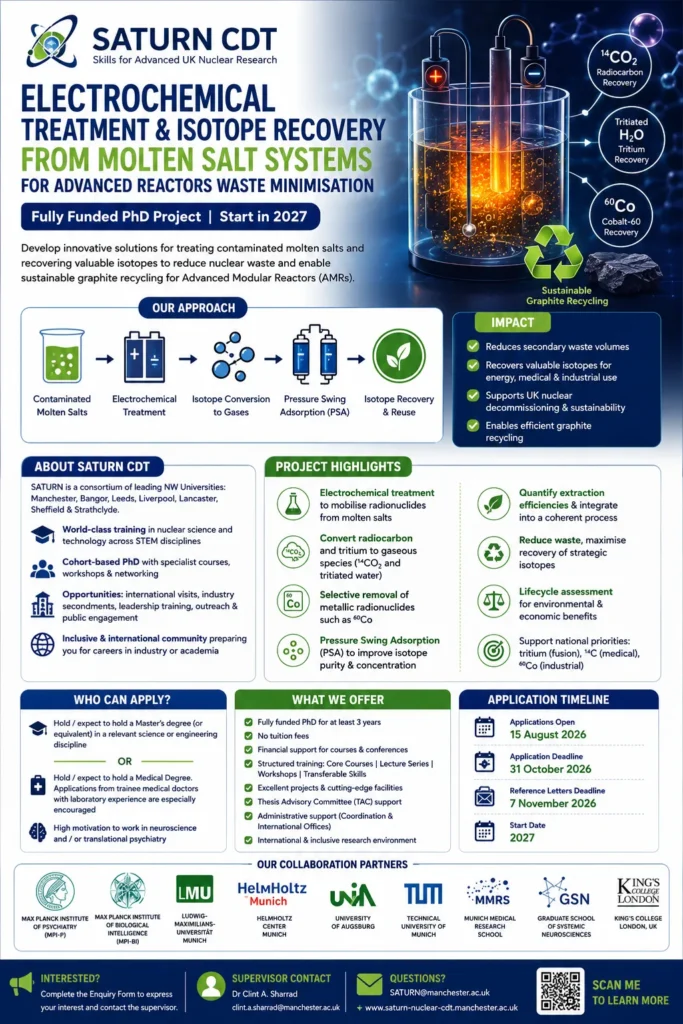
The SATURN Centre for Doctoral Training (CDT) is offering a PhD research opportunity focused on developing advanced technologies for the treatment of radioactive molten salts and recovery of valuable isotopes from advanced reactor waste streams.
The project, titled “Electrochemical Treatment and Isotope Recovery from Molten Salt Systems for Advanced Reactors Waste Minimisation,” addresses an important challenge associated with the management and recycling of irradiated graphite.
The research will investigate how electrochemical treatment can be used to remove, separate, recover, and potentially reuse radionuclides contained within molten salts generated during graphite decontamination and recycling.
Currently, there is no clearly defined waste route for these contaminated salts, creating an important technical challenge for the deployment and eventual decommissioning of Advanced Modular Reactors (AMRs).
Research Aim
The primary aim of the PhD is to develop an integrated molten salt treatment strategy capable of efficiently removing and recovering important radionuclides from irradiated molten salt systems and associated graphite wastes.
The research seeks to reduce secondary radioactive waste while simultaneously recovering isotopes that may have strategic value.
The project will explore the hypothesis that electrochemical processes within molten salts can mobilise radionuclides into forms that are easier to separate, recover, and purify.
Key Research Areas
The project will combine electrochemistry, isotope separation, nuclear waste management, and process development.
Major areas of investigation include:
- Molten salt electrochemistry
- Radioactive waste treatment
- Irradiated graphite management
- Radionuclide separation
- Isotope recovery and purification
- Advanced Modular Reactor waste
- Pressure swing adsorption
- Nuclear decommissioning
- Graphite recycling
- Waste minimisation
- Lifecycle assessment
Electrochemical Recovery of Radionuclides
A major component of the project involves developing electrochemical techniques for selective radionuclide removal.
The proposed approach will investigate the conversion of radiocarbon and tritium into gaseous chemical species, including:
- Radiocarbon → ¹⁴CO₂
- Tritium → tritiated water
The project will also investigate the selective electrochemical cycling and removal of metallic radionuclides such as:
- Cobalt-60 (⁶⁰Co)
Transforming radionuclides into separable forms could enable their subsequent recovery and purification rather than treating the entire contaminated salt stream as waste.
Pressure Swing Adsorption
Following electrochemical treatment, gaseous isotope-containing products will be further processed using Pressure Swing Adsorption (PSA).
PSA will be investigated as a method for improving:
- Isotope purity
- Isotope concentration
- Gas separation efficiency
- Potential recovery and reuse
Combining electrochemical treatment with downstream separation technologies could provide a more integrated approach to managing advanced nuclear reactor waste.
Research Objectives
The PhD research is expected to focus on several major objectives:
- Develop electrochemical approaches for treating contaminated molten salts.
- Investigate mobilisation of radionuclides into separable chemical forms.
- Quantify isotope extraction efficiencies.
- Develop methods for recovering radiocarbon and tritium.
- Investigate selective removal of metallic radionuclides such as cobalt-60.
- Integrate electrochemical treatment with pressure swing adsorption.
- Improve the purity and concentration of recovered isotopes.
- Reduce secondary radioactive waste volumes.
- Investigate opportunities for graphite recycling.
- Evaluate the environmental and economic performance of the proposed treatment strategy.
Strategic Importance of Recovered Isotopes
An important aspect of the project is that several radionuclides targeted for recovery have potential strategic applications.
Tritium
Recovered tritium may have potential importance for fusion energy technologies.
Radiocarbon
Radiocarbon (carbon-14) can have applications in medical and scientific fields.
Cobalt-60
Cobalt-60 is widely associated with industrial applications.
Rather than treating these radionuclides exclusively as waste, the research explores whether they can be efficiently separated and recovered for potential reuse.
Lifecycle Assessment
The project will include a lifecycle assessment to evaluate the wider environmental and economic implications of the proposed treatment technology.
Particular attention will be given to:
- Environmental benefits
- Economic feasibility
- Secondary waste reduction
- Graphite recycling
- Resource recovery
- Nuclear decommissioning
- Sustainability of waste treatment
This analysis will help determine whether the proposed technology could contribute to future UK nuclear waste management and decommissioning strategies.
About the SATURN Centre for Doctoral Training
The PhD is based within the SATURN Centre for Doctoral Training, a collaborative nuclear research training initiative involving universities across the UK.
The SATURN consortium includes:
- University of Manchester
- Bangor University
- University of Leeds
- University of Liverpool
- Lancaster University
- University of Sheffield
- University of Strathclyde
SATURN recruits researchers from across STEM disciplines and provides specialist training designed to develop future experts for the nuclear sector.
Graduates may pursue careers in either:
- Nuclear industry
- Academia
- Research organisations
- Nuclear technology development
Students join a cohort of researchers working on different aspects of nuclear science and engineering.
SATURN Training Program
The CDT provides training beyond the student’s individual PhD research project.
Students may have opportunities to participate in:
- Nuclear science and technology training
- Specialist technical courses
- Visits to internationally relevant facilities
- Industry secondments
- Leadership training
- Outreach activities
- Public engagement
- Cohort-based research activities
The objective is to develop both specialist nuclear expertise and broader professional skills.
Nuclear Boot Camp
During Months 1–3, students participate in the SATURN Nuclear Boot Camp.
The Boot Camp is based in Manchester and provides an introduction to the nuclear sector and relevant technical concepts.
For SATURN students based at partner universities, the CDT can provide accommodation in Manchester and cover the associated cost during this period.
Eligibility Requirements
Applicants should hold, or expect to obtain, at least:
A UK 2:1 honours degree or a Master’s degree
or an equivalent international qualification.
The degree should be in a relevant science or engineering discipline.
The project may therefore be particularly relevant to applicants with suitable backgrounds related to science, engineering, electrochemistry, materials, chemistry, nuclear science, or other disciplines relevant to the proposed research.
Contacting the Supervisor
Prospective candidates are strongly encouraged to contact the project supervisor before submitting an application.
For informal enquiries, applicants can contact:
Dr Clint A. Sharrad
Email: clint.a.sharrad@manchester.ac.uk
Discussing the project with the supervisor can help prospective candidates understand the research requirements and assess their suitability before applying.
How to Apply
Applicants should first complete the SATURN Enquiry Form to express their interest in the project.
After completing the form, applicants are strongly encouraged to contact the project supervisor to discuss their suitability.
If an applicant’s qualifications satisfy the standard entry requirements, the CDT Admissions Team will forward the enquiry form and CV to the relevant project supervisor for consideration.
Questions regarding the SATURN application process can be directed to:
Funding Status
Applicants should note that the advertised project is subject to funding confirmation.
Candidates should therefore check the latest funding details and eligibility conditions during the application process.
Equality, Diversity and Inclusion
The University of Manchester emphasizes equality, diversity, and inclusion across its research and educational activities.
Applications are encouraged from people with diverse backgrounds and career paths.
The university also welcomes applications from individuals returning after a career break or transitioning from other professional roles.
Depending on the project and funding arrangements, flexible study options may be considered.
Potential part-time arrangements include:
- 50%
- 60%
- 80%
Availability depends on the specific project and funder requirements.
PhD Opportunity at a Glance
| Detail | Information |
|---|---|
| Project | Electrochemical Treatment and Isotope Recovery from Molten Salt Systems for Advanced Reactors Waste Minimisation |
| Program | SATURN Centre for Doctoral Training |
| Research Area | Nuclear Waste Treatment & Isotope Recovery |
| Host Network | SATURN CDT |
| Primary Training Location | Manchester, UK |
| Degree Level | PhD |
| Minimum Qualification | 2:1 Honours Degree, Master’s, or International Equivalent |
| Academic Background | Relevant Science or Engineering Discipline |
| Key Techniques | Electrochemistry, Molten Salt Treatment, PSA, Isotope Separation |
| Target Isotopes | Tritium, Carbon-14 and Cobalt-60 |
| Application Route | SATURN Enquiry Form |
| Supervisor Contact | Dr Clint A. Sharrad |
| Funding | Subject to funding confirmation |
| Flexible Study | May be available depending on project/funder |
Why Consider This PhD?
This project offers an opportunity to work at the intersection of nuclear science, electrochemistry, isotope recovery, environmental sustainability, and advanced reactor technology.
The research could contribute to solving an important challenge for future nuclear technologies: how to safely and sustainably manage contaminated molten salts and irradiated graphite while minimising radioactive waste.
Through the SATURN CDT, the successful candidate will also gain access to cohort-based nuclear training, industry exposure, specialist facilities, leadership development, and interdisciplinary collaboration.
The combination of fundamental research and potential industrial impact makes this PhD particularly relevant for researchers interested in developing technologies for a more sustainable nuclear energy sector.