
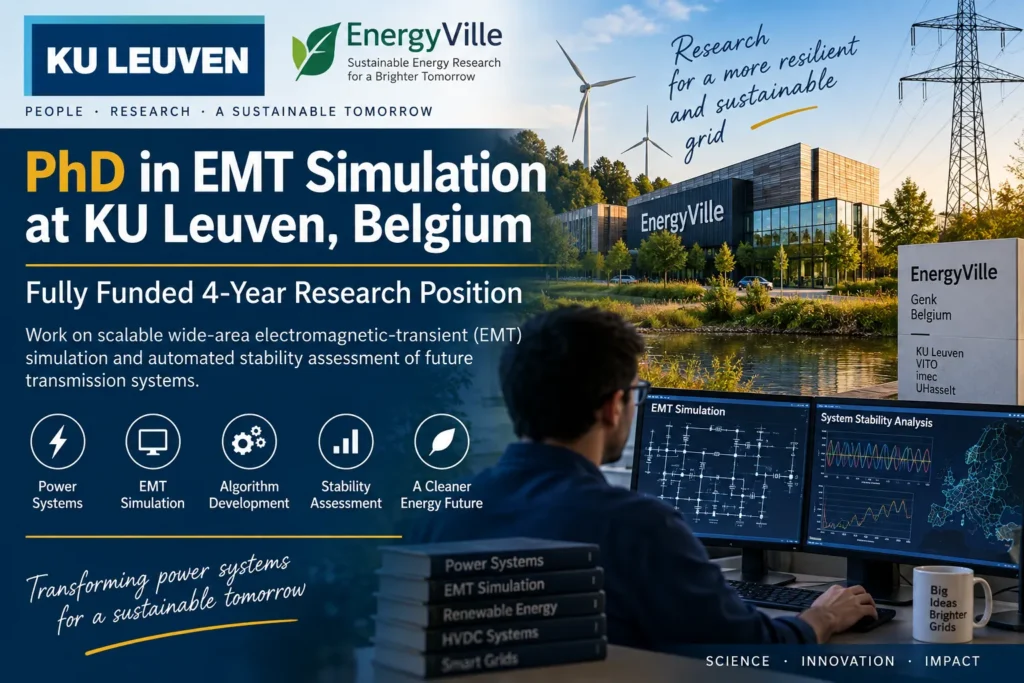
KU Leuven and EnergyVille are offering a Fully Funded PhD in EMT Simulation focused on scalable wide-area electromagnetic-transient (EMT) simulation and automated stability assessment of future transmission systems in Belgium. The project targets a major challenge in modern power-system engineering: making detailed EMT-based stability studies practical for large regional and national transmission networks.
The PhD research combines power-system dynamics, numerical simulation, scientific computing, algorithm development, and software engineering. The successful candidate will investigate methods such as model reduction, dynamic equivalencing, network partitioning, parallel computing, and automated contingency screening.
The position is based at EnergyVille in Genk, Belgium, within the KU Leuven ELECTA research environment.
PhD in EMT Simulation: What Is This Research About?
Electromagnetic-transient (EMT) simulation is a detailed approach to modelling the fast electrical dynamics of power systems. It becomes increasingly important as transmission networks incorporate more inverter-based technologies, including offshore wind farms, battery energy storage, HVDC systems, and other power-electronic converters.
The central research question of this PhD is:
How can EMT-based stability assessment be made scalable and automated enough for large transmission systems?
Traditional large-scale power-system studies often rely on reduced-order approaches such as RMS simulations. However, the increasing penetration of converter-connected resources means that electromagnetic-transient phenomena can have a greater influence on system stability.
The project’s vision is to make EMT-based stability assessment systematic, scalable, and routinely applicable, in a way comparable to established RMS-based studies.
About the KU Leuven ELECTA Research Group
The research will take place within ELECTA, the research group of KU Leuven’s Department of Electrical Engineering (ESAT).
ELECTA conducts research across areas including:
- Smart grids
- Reliable power systems
- Renewable-energy integration
- HVDC and LVDC systems
- Energy markets
- Transmission and distribution networks
- Converter-dominated power systems
The group is led by seven professors and works with senior researchers, postdoctoral researchers, and PhD students.
The project is also connected with EnergyVille, a collaboration involving KU Leuven, VITO, imec, and UHasselt that focuses on sustainable energy and intelligent energy systems.
Research Focus of the Fully Funded PhD in EMT Simulation
The Fully Funded PhD in EMT Simulation will develop computational methods for performing EMT-based stability studies on increasingly large and complex transmission networks.
The main research areas include:
1. Scalable EMT Simulation
The candidate will investigate methods for extending EMT simulation to large transmission systems.
The objective is to overcome the computational challenges that arise when detailed electromagnetic models are applied to wide-area networks.
2. Model Reduction and Dynamic Equivalencing
Large power-system models can become computationally expensive. The project therefore includes research into:
- Model reduction
- Dynamic equivalencing
- Network partitioning
These techniques can help reduce computational requirements while retaining the system behaviour needed for stability analysis.
3. High-Performance and Parallel Computing
The research will explore parallel and high-performance computing approaches for EMT simulation.
This makes scientific programming and computational performance important parts of the PhD rather than secondary skills.
4. Automated Stability Assessment
Another major component is the development of automated workflows for:
- Large-scale stability assessment
- Contingency screening
- Systematic analysis of different operating conditions
The goal is to reduce the manual effort involved in analysing complex transmission-system scenarios.
5. Converter-Driven Stability Phenomena
The Fully Funded PhD in EMT Simulation will investigate stability phenomena associated with modern converter-dominated grids, particularly those involving:
- HVDC systems
- Renewable generation
- Battery energy storage
- Inverter-based resources
These technologies are changing the dynamic behaviour of transmission networks and create new challenges for power-system stability analysis.
6. Validation Using Utility-Scale Models
The methods developed during the Fully Funded PhD in EMT Simulation will be tested using realistic utility-scale transmission-system models.
This provides an important practical dimension to the research because the objective is not simply to develop theoretical algorithms but to assess their usefulness in realistic power-system applications.
What Skills and Qualifications Are Required?
The ideal candidate should have a Master’s degree in one of the following areas:
- Electrical Engineering
- Applied Mathematics
- Scientific Computing
- Computer Engineering
- A related discipline
Excellent academic performance is also expected.
Technical Background
Applicants should have a strong foundation in power systems and an interest in:
- Power-system dynamics
- Stability analysis
- Numerical simulation
- Algorithm development
- Scientific programming
The position is particularly suitable for candidates who enjoy solving engineering problems through computational and mathematical methods.
Which Technical Skills Are an Advantage?
The following skills are listed as assets for the position:
| Skill or Experience | Relevance |
|---|---|
| Power electronics | Understanding converter-based systems |
| HVDC systems | Relevant to modern transmission networks |
| Inverter-based resources | Important for converter-dominated grids |
| PSCAD | EMT simulation experience |
| EMTP | Electromagnetic-transient modelling |
| RTDS | Real-time power-system simulation |
| OPAL-RT | Real-time simulation platforms |
| PowerFactory | Power-system modelling and analysis |
| MATLAB/Simulink | Numerical modelling and simulation |
| Python | Scientific programming and automation |
| Julia | Numerical and scientific computing |
| C/C++ | High-performance computational development |
| Parallel algorithms | Large-scale simulation and HPC |
Experience with these tools is considered an advantage rather than a universal requirement stated for every applicant.
Is Programming Important for This PhD?
Yes. Programming and computational skills are particularly relevant to this Fully Funded PhD in EMT Simulation because the research involves algorithm development, scientific computing, simulation automation, and high-performance computing.
The advertised position specifically identifies programming experience in Python, Julia, MATLAB, C/C++, or related languages as an asset.
Applicants interested in this position should therefore be prepared to demonstrate not only theoretical power-system knowledge but also their ability to develop or work with computational models and simulation tools.
What Is the Funding and Duration?
The position is advertised as a fully funded four-year Fully Funded PhD in EMT Simulation position at KU Leuven and EnergyVille.
The opportunity includes:
- A 4-year fully funded Fully Funded PhD in EMT Simulation position
- Research on future converter-dominated power systems
- Access to advanced simulation infrastructure
- Work with realistic utility-scale transmission-system models
- Collaboration with researchers, transmission system operators (TSOs), and industrial partners
- Opportunities to participate in international conferences
- Opportunities to produce high-impact research publications
The stated working location is Genk, Belgium, at EnergyVille.
Important: The supplied opportunity description identifies the position as fully funded but does not specify a salary amount, net monthly income, tuition arrangement, or detailed benefits. Applicants should verify those conditions directly through the official KU Leuven application information before applying.
Why Is Wide-Area EMT Simulation Important?
Modern transmission systems are becoming increasingly dependent on power-electronic technologies.
Offshore wind, battery storage, HVDC transmission, and other inverter-based resources can introduce dynamic behaviours that may not be adequately captured by simplified approaches in every situation.
EMT simulation provides a detailed representation of fast electrical phenomena. The challenge is computational scale: applying highly detailed simulation to a large national or regional network can require substantial computational resources.
This Fully Funded PhD in EMT Simulation addresses that gap by bringing together EMT modelling, model reduction, network decomposition, high-performance computing, and automated stability assessment.
Advantages of This Fully Funded PhD in EMT Simulation Opportunity
This position may be particularly attractive to researchers who want to work at the intersection of electrical engineering and computational science.
Strong interdisciplinary research
The project combines:
- Power-system engineering
- Numerical methods
- Scientific computing
- Software development
- High-performance computing
- Stability analysis
Industry-relevant applications
The research is directed toward realistic transmission-system challenges and includes validation using utility-scale models.
Exposure to modern power-system technologies
The project covers technologies that are increasingly important in future grids, including HVDC, renewable generation, battery storage, and inverter-based resources.
International research environment
The project involves KU Leuven, EnergyVille, researchers, TSOs, and industrial partners, creating opportunities for collaboration beyond a purely academic setting.
Potential Challenges of the Research
Applicants should also understand that this is a technically demanding Fully Funded PhD in EMT Simulation.
The research involves several computational challenges, including:
- Scaling detailed EMT simulations to large networks
- Managing computational complexity
- Developing efficient algorithms
- Balancing model simplification with simulation accuracy
- Designing parallel computing approaches
- Automating large numbers of stability studies
- Analysing complex converter-driven interactions
The application specifically asks candidates to discuss the main computational challenges associated with wide-area EMT simulation and automated stability assessment in their technical statement.
Who Is a Good Fit for This Fully Funded PhD in EMT Simulation?
This Fully Funded PhD in EMT Simulationis likely to suit candidates who have a strong interest in power-system simulation and computational engineering.
A strong applicant could typically demonstrate several of the following:
- Master’s-level training in electrical engineering or a closely related field
- Good academic performance
- Knowledge of power-system dynamics
- Interest in stability analysis
- Experience with numerical simulation
- Scientific programming experience
- Familiarity with MATLAB, Python, Julia, C/C++, or similar languages
- Experience with EMT or power-system simulation software
- Interest in high-performance computing
- Ability to explain technical concepts clearly in English
The advertised profile does not require every listed asset; several are explicitly described as advantageous rather than mandatory.
How to Apply for the KU Leuven Fully Funded PhD in EMT Simulation
Applicants are asked to submit the following through the KU Leuven application portal:
- CV
- Academic transcripts
- Motivation letter
- Technical statement of no more than half an A4 page
The technical statement should address two specific issues:
- Why you are motivated to apply for the project.
- What you consider to be the main computational challenges in wide-area EMT simulation and automated stability assessment.
How to Make the Technical Statement Stronger
Because the technical statement is very short, applicants should avoid repeating their CV.
Instead, use the limited space to demonstrate:
- Understanding of the research problem
- Awareness of the computational scale challenge
- Relevant simulation or programming experience
- Interest in converter-dominated power systems
- A clear reason for wanting to work on this specific project
A concise explanation of how you would approach the computational problem can be more valuable than a generic statement about your interest in renewable energy.
Key Takeaways
- KU Leuven and EnergyVille offer a fully funded 4-year PhD in EMT Simulation in Belgium.
- The research focuses on scalable wide-area electromagnetic-transient simulation and automated stability assessment.
- The project addresses stability challenges associated with converter-dominated transmission systems.
- Research areas include model reduction, dynamic equivalencing, network partitioning, parallel computing, and automated contingency screening.
- Relevant backgrounds include electrical engineering, applied mathematics, scientific computing, and computer engineering.
- Programming and numerical simulation skills are important assets.
- Experience with PSCAD, EMTP, RTDS, OPAL-RT, PowerFactory, MATLAB/Simulink, Python, Julia, or C/C++ can strengthen an application.
- The working location specified in the opportunity is EnergyVille, Genk, Belgium.
Frequently Asked Questions
What is the Fully Funded PhD in EMT Simulation at KU Leuven?
It is a four-year fully funded doctoral research position focused on developing scalable and automated electromagnetic-transient simulation methods for large, converter-dominated transmission systems.
What does EMT mean in power systems?
EMT stands for electromagnetic transient. EMT simulation is used to represent detailed, fast electrical dynamics in power-system models and is particularly relevant to analysing systems containing significant power-electronic and converter-connected technologies.
Where is this Fully Funded PhD in EMT Simulation located?
The advertised working location is Genk, Belgium, at EnergyVille, with the research conducted through the KU Leuven research environment.
Is this Fully Funded PhD in EMT Simulation fully funded?
Yes. The opportunity description identifies it as a fully funded four-year PhD position at KU Leuven and EnergyVille. The supplied description does not provide a specific salary figure.
What academic background is required?
The advertised profile calls for a Master’s degree in Electrical Engineering, Applied Mathematics, Scientific Computing, Computer Engineering, or a related discipline, along with strong academic results.
Is programming experience required?
Programming experience is listed as an asset. The advertised languages include Python, Julia, MATLAB, C/C++, and related languages. An interest in high-performance computing and parallel algorithms is also considered advantageous.
Which simulation tools are useful for this PhD?
The opportunity specifically lists PSCAD, EMTP, RTDS, OPAL-RT, PowerFactory, and MATLAB/Simulink as useful experience.
What documents are required?
The application requires a CV, academic transcripts, a motivation letter, and a technical statement of no more than half an A4 page addressing motivation and the computational challenges of wide-area EMT simulation and automated stability assessment.