
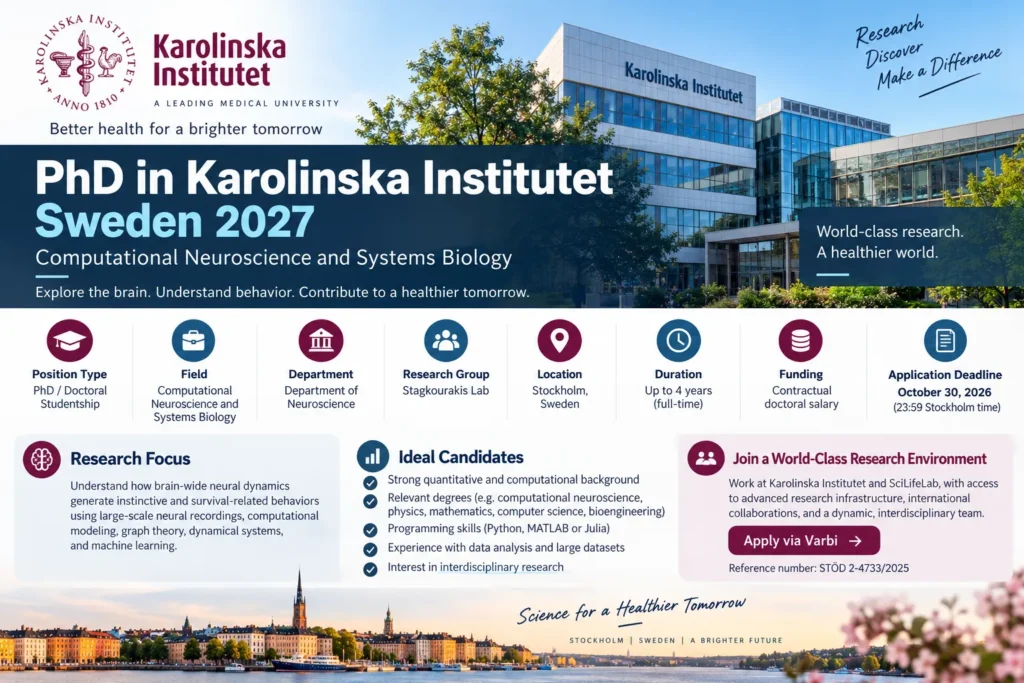
PhD in Karolinska Institutet, Sweden, is offering a position in Computational Neuroscience and Systems Biology focused on neural dynamics underlying survival behaviors. The project is based in the Stagkourakis Lab at the Department of Neuroscience and is affiliated with SciLifeLab. It focuses on analyzing and modeling large-scale neural population recordings from freely moving animals using computational neuroscience, graph theory, dynamical systems, and machine learning.
Candidates are encouraged to demonstrate a deep understanding of quantitative methods and their application in complex biological systems. The successful applicant will engage in interdisciplinary research, collaborating with experts across various fields to advance the understanding of neural mechanisms. This opportunity not only emphasizes theoretical knowledge but also practical skills in data interpretation and algorithm development, essential for addressing the challenges posed by large data sets in neuroscience. Interested individuals should possess a proactive approach to research and a passion for innovative problem-solving in the realm of systems biology.
The doctoral position is full-time and can extend for a maximum of four years. The position is offered as a doctoral studentship with a contractual salary rather than as an unpaid scholarship.
Quick answer: This Karolinska Institutet PhD focuses on understanding how brain-wide neural activity generates instinctive and survival-related behaviors. The doctoral researcher will analyze large-scale neural recordings from freely moving animals and develop computational models using methods such as network analysis, dynamical systems, machine learning, and neural population analysis.
PhD in Karolinska Institutet Sweden 2027: Position Overview
| Category | Details |
|---|---|
| University | Karolinska Institutet |
| Country | Sweden |
| City | Stockholm |
| Department | Department of Neuroscience |
| Research group | Stagkourakis Lab |
| Research area | Computational Neuroscience and Systems Biology |
| PhD theme | Neural dynamics underlying survival behaviors |
| Position type | PhD / Doctoral studentship |
| Study mode | Full-time |
| Duration | Maximum 4 years |
| Number of positions | 1 |
| Funding | Contractual doctoral salary |
| English requirement | English equivalent to Swedish English B/English 6 |
| Application system | Varbi |
| Application deadline | October 30, 2026 |
| Reference number | STÖD 2-4733/2025 |
| Location | Stockholm, Sweden |
The source material states that the position is full-time, 100% employment, with one available position and a monthly salary arrangement.
What Is This PhD in Karolinska Institutet Project About?
The project investigates how brain-wide neural dynamics generate behavior.
The Stagkourakis Lab studies the neural and neurohormonal mechanisms underlying instinctual and homeostatic behaviors. These include behaviors associated with:
- Aggression
- Fear
- Feeding
- Social interactions
- Internal physiological states
- Other survival-related behaviors
The doctoral researcher will work with large-scale neural population recordings obtained from freely moving animals during naturalistic behaviors. The objective is to understand how distributed neural ensembles encode internal states and contribute to the generation of behavior.
Rather than studying a single brain region in isolation, the project takes a broader systems-level approach. Neural activity can be analyzed as a dynamic network, allowing researchers to investigate how different populations interact over time and how those interactions relate to behavioral states.
What Will the PhD in Karolinska Institutet Student Do?
The doctoral student will contribute primarily to the analysis and computational modeling of large-scale neural data.
The project combines several quantitative approaches, including:
- Graph-theoretic methods – to investigate relationships and interactions between neural populations.
- Dynamical systems approaches – to model how neural states evolve over time.
- Machine learning – to identify patterns and relationships in complex datasets.
- Neural population analysis – to characterize coordinated activity across groups of neurons.
- Time-series analysis – to examine changing neural activity and behavioral states.
- Statistical modeling – to quantify relationships between neural activity and behavior.
The overall aim is to connect brain-wide neural dynamics, internal states, and observable behavior.
Research Environment at Karolinska Institutet and SciLifeLab
The position is located within the Department of Neuroscience at Karolinska Institutet and the Stagkourakis Lab is part of the broader SciLifeLab research environment.
The project provides access to a multidisciplinary setting involving computational researchers and experimental scientists. According to the position description, doctoral students benefit from research infrastructure, supervision, elective courses, international collaborations, and opportunities to work within leading research groups.
The advertised research environment includes:
- Advanced computational neuroscience research
- Network theory and data science
- Large-scale biological datasets
- Collaboration with experimental researchers
- Interdisciplinary research
- Access to KI and SciLifeLab infrastructure
- Training relevant to computational neuroscience and systems biology
This combination makes the position particularly suitable for researchers who want to bridge computational methods and experimental neuroscience.
Who Is Eligible for the PhD in Karolinska Institutet?
Applicants must satisfy both the general eligibility requirement and the specific English-language requirement for doctoral education.
General eligibility
According to the position description, applicants meet the general requirement if they:
- Hold a second-cycle/advanced/master’s qualification; or
- Have completed courses equivalent to at least 240 higher-education credits, including at least 60 credits at second-cycle/master’s level; or
- Can demonstrate substantially equivalent knowledge obtained in Sweden or another country.
Applicants relying on equivalent knowledge must follow KI’s procedure for assessing equivalent knowledge.
English-language requirement
Applicants must demonstrate English proficiency equivalent to English B/English 6 at Swedish upper-secondary-school level.
Applicants should check Karolinska Institutet’s current doctoral education documentation requirements to determine how their particular educational background and English proficiency should be documented.
What Academic Background Does KI Prefer?
The advertised position is aimed at candidates with a strong quantitative and computational background.
Relevant degree backgrounds include:
- Computational Neuroscience
- Physics
- Applied Mathematics
- Computer Science
- Bioengineering
- Related quantitative disciplines
The position specifically asks for strong programming and data-analysis skills, with Python, MATLAB, or Julia identified in the candidate profile.
Required skills
Applicants should ideally demonstrate:
- Strong programming ability
- Strong quantitative reasoning
- Data-analysis experience
- Experience with large datasets
- Signal-processing experience or statistical modeling
- Ability to work independently
- Ability to collaborate within an interdisciplinary research team
Desirable skills
The following experience can strengthen an application:
- Dynamical systems
- Network science
- Machine learning applied to neuroscience
- PCA
- UMAP
- Generalized linear models (GLMs)
- Hidden Markov models (HMMs)
- Graph-based models
- Time-series analysis
- State-space modeling
- Causal inference
- Multimodal neural datasets
- Git and reproducible data pipelines
These skills are explicitly identified in the supplied position description.
Is Programming Experience Important for This PhD in Karolinska Institutet?
Yes. Programming and quantitative data analysis are central to this particular PhD in Karolinska Institutet project.
The position is not primarily a traditional wet-laboratory neuroscience PhD in Karolinska Institutet. The advertised duties emphasize analyzing and modeling large-scale neural population recordings.
Candidates should therefore be comfortable working with computational tools and quantitative datasets.
Python, MATLAB, and Julia are specifically mentioned in the position description. Experience with machine learning, statistical modeling, time-series analysis, network science, or neural population analysis can further strengthen the application.
Is This a Fully Funded PhD in Karolinska Institutet in Sweden?
The position is advertised as a doctoral studentship with a contractual salary. This means the doctoral researcher is employed rather than simply receiving an academic scholarship. The position is full-time and has a maximum duration of four years.
The supplied position information also states that employees can access KI facilities such as its gym and receive reimbursements for medical care.
Applicants should distinguish between:
- Doctoral employment/salary, where the PhD in Karolinska Institutet researcher is employed by the university; and
- Scholarships, which may have different employment, taxation, and benefit arrangements.
For this vacancy, the advertised arrangement is a doctoral studentship with salary.
How Long Is the PhD in Karolinska Institutet?
The doctoral studentship is offered for a maximum of four years of full-time doctoral study.
Swedish doctoral education generally combines research with an individual study plan and doctoral-level coursework. The exact academic structure can depend on the doctoral programme and research project.
Where Is the PhD Located?
The research environment is based in Stockholm, Sweden.
The position description lists two relevant locations:
Biomedicum D8
Department of Neuroscience
Karolinska Institutet
Solnavägen 9
Solna, Sweden
SciLifeLab Gamma 5
Tomtebodavägen 23A
Solna, Sweden.
How to Apply for the PhD in Karolinska Institutet
Applications are submitted through the Varbi recruitment system.
The advertised application should contain:
- A personal letter
- Curriculum vitae (CV)
- Degree projects and previous publications, if applicable
- Documentation demonstrating relevant desirable skills and personal qualities
- Documents proving general doctoral eligibility
- Documents proving the specific English-language eligibility
The position description states that applications are preferred in English, although Swedish applications are also accepted.
What should your personal letter emphasize?
For a computational neuroscience PhD in Karolinska Institutet, the motivation letter should go beyond simply stating an interest in neuroscience.
A strong application should clearly connect the applicant’s experience to the project.
For example, candidates can highlight:
- Quantitative research experience
- Programming projects
- Data-analysis experience
- Statistical modeling
- Machine learning
- Signal processing
- Computational biology
- Neuroscience research
- Experience analyzing biological datasets
- Relevant publications
- Research questions they have previously investigated
The most convincing applications show why the candidate’s previous training makes them capable of contributing to this particular project.
How Are Candidates Selected?
Karolinska Institutet states that selection is made among eligible applicants based on their ability to benefit from doctoral education.
The assessment considers the applicant as a whole, including:
- Relevant documented subject knowledge
- Analytical ability
- Other documented knowledge and experience relevant to doctoral studies
All applicants are informed after the recruitment process has been completed.
This means that satisfying the minimum eligibility requirements does not by itself guarantee selection.
Application Deadline
The supplied vacancy information gives the application deadline as:
October 30, 2026 at 23:59 Stockholm time.
Because recruitment pages can change or close early, applicants should verify the deadline and application status on the current Karolinska Institutet/Varbi vacancy before submitting documents.
Key Takeaways
- Karolinska Institutet is offering a PhD in Karolinska Institutet position in Computational Neuroscience and Systems Biology.
- The research theme is neural dynamics underlying survival behaviors.
- The project analyzes large-scale neural recordings from freely moving animals.
- Important methods include graph theory, dynamical systems, machine learning, and neural population analysis.
- Relevant academic backgrounds include computational neuroscience, physics, mathematics, computer science, and bioengineering.
- Strong programming and quantitative data-analysis skills are important.
- The doctoral studentship is full-time and can last up to four years.
- The advertised position provides a contractual doctoral salary.
- The listed application deadline is October 30, 2026.
Frequently Asked Questions
What is the Karolinska Institutet PhD in Computational Neuroscience about?
It is a doctoral research position focused on understanding how brain-wide neural dynamics generate survival-related behaviors. The project analyzes large-scale neural population recordings from freely moving animals using computational and mathematical approaches.
Is this PhD at Karolinska Institutet funded?
The position is advertised as a doctoral studentship with a contractual salary. It is therefore an employed PhD position rather than an unpaid doctoral opportunity.
What degree do I need for this PhD in Karolinska Institutet?
Applicants generally need a second-cycle/master’s qualification or an equivalent educational background that satisfies KI’s doctoral eligibility requirements. Relevant fields for this position include computational neuroscience, physics, applied mathematics, computer science, bioengineering, and related disciplines.
Do I need programming experience?
Yes. Programming and data analysis are important components of the project. The position specifically mentions Python, MATLAB, or Julia.
Which computational methods are relevant?
Relevant methods include graph theory, dynamical systems, machine learning, neural population analysis, time-series analysis, state-space modeling, statistical modeling, and causal inference.
Can international students apply?
The position’s eligibility criteria are based on doctoral education requirements rather than Swedish citizenship. Applicants educated outside Sweden must provide documentation demonstrating that they satisfy KI’s eligibility requirements.
How long is the PhD position?
The doctoral studentship is offered for a maximum of four years of full-time study.
What is the application deadline?
The supplied vacancy information lists October 30, 2026 at 23:59 Stockholm time as the application deadline.