
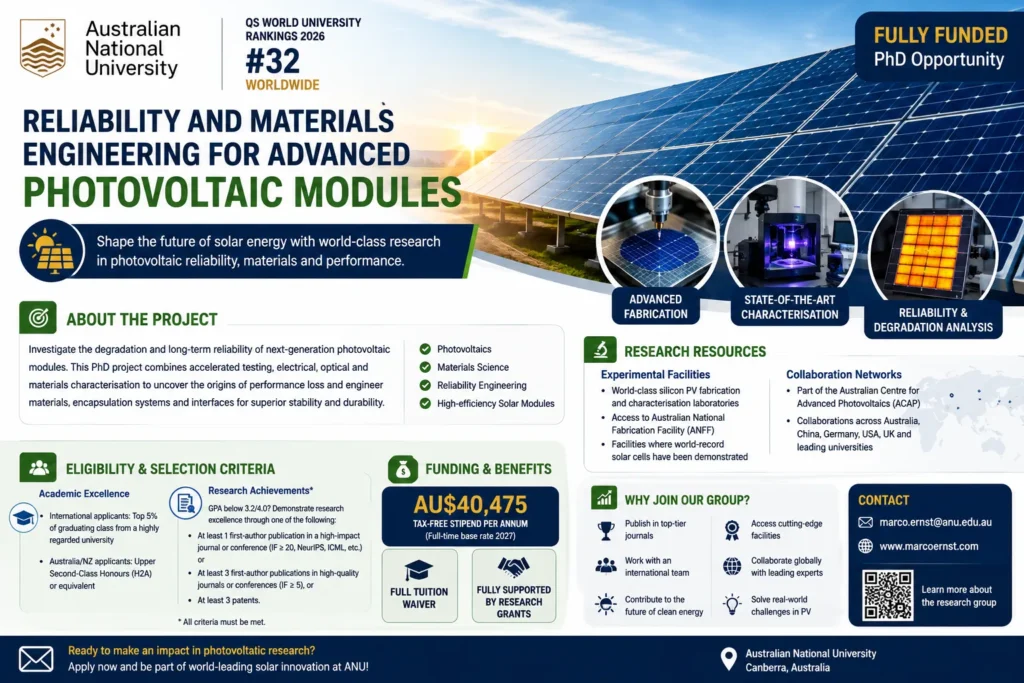
About the PhD Opportunity
The Australian National University (ANU) is offering a fully funded PhD opportunity in Reliability and Materials Engineering for Advanced Photovoltaic Modules.
The project is designed for highly motivated researchers interested in advancing photovoltaic technologies and addressing the reliability and durability challenges associated with next-generation solar modules.
ANU is ranked No. 32 worldwide in the QS 2026 rankings, and the research group publishes in leading scientific journals, including Advanced Materials and Advanced Functional Materials.
Only highly competitive candidates with strong academic and research backgrounds will be considered.
Research Project
As photovoltaic module architectures and materials continue to evolve, new technologies offer opportunities for improved efficiency while introducing additional challenges related to long-term reliability, degradation, and durability.
This PhD project will investigate the mechanisms responsible for degradation and performance loss in advanced photovoltaic modules.
The research will combine:
- Accelerated reliability testing
- Electrical characterisation
- Optical characterisation
- Materials analysis
- Degradation studies
- Interface investigation
- Encapsulation research
- Reliability engineering
The goal is to understand the origins of performance degradation and identify approaches for improving the long-term stability and reliability of photovoltaic modules.
Research Focus
The successful candidate will work at the intersection of:
Photovoltaics
Research will focus on next-generation, high-efficiency photovoltaic module technologies and their long-term performance.
Materials Science
The project will investigate module materials, interfaces, encapsulation systems, and material degradation mechanisms.
Reliability Engineering
Accelerated testing and characterisation techniques will be used to understand how photovoltaic modules degrade over time and under demanding operating conditions.
Device Characterisation
Electrical and optical measurements will help identify performance losses and connect changes in device performance with underlying material and interface degradation.
Key Research Objectives
The PhD project is expected to investigate:
- Degradation mechanisms in advanced photovoltaic modules
- Reliability and durability of next-generation module architectures
- Performance loss under accelerated testing conditions
- Electrical and optical degradation
- Material degradation and failure mechanisms
- Encapsulation systems
- Interfaces between module components
- Engineering of materials for improved stability
- Long-term module reliability
- Relationships between material properties and photovoltaic performance
The research will contribute to the development of more durable and reliable high-efficiency solar technologies.
Ideal Candidate
Applicants should have a strong academic and research background relevant to photovoltaic and materials research.
A strong background in Silicon Photovoltaics or Physics is expected.
Candidates with interests or experience in the following areas are particularly encouraged to apply:
- Photovoltaics
- Silicon solar cells
- Materials science
- Semiconductor devices
- Experimental engineering
- Photovoltaic characterisation
- Materials analysis
- Accelerated testing
- Device reliability
- Experimental research
Previous experience with photovoltaic characterisation, materials analysis, accelerated reliability testing, or related experimental research would be advantageous.
Academic Eligibility
International Applicants
International applicants are expected to demonstrate exceptional academic performance.
Candidates should generally rank within the top 5% of their graduating class at a highly regarded university.
Australian and New Zealand Applicants
Applicants from Australia and New Zealand should hold at least an Upper Second-Class Honours (H2A) qualification or an equivalent degree.
Research Achievement Requirements
Applicants with a GPA below 3.2/4.0 are expected to demonstrate research excellence through significant research achievements.
Applicants may demonstrate this through one or more of the following:
- At least one first-author publication in a high-impact journal or conference, such as a publication with an impact factor of 20 or above or recognised conferences such as NeurIPS or ICML.
- At least three first-author publications in high-quality journals or conferences, such as publications with an impact factor of 5 or above.
- At least three patents.
These requirements highlight the highly competitive nature of the PhD opportunity.
PhD Funding
The successful candidate will receive a tax-free annual stipend of AU$40,475 based on the full-time 2027 rate.
The scholarship also includes a:
Full tuition fee waiver
The research project is fully supported through the lead supervisor’s active research grants.
Funding Summary
| Funding Component | Details |
|---|---|
| Annual Stipend | AU$40,475 per year |
| Tax | Tax-free stipend |
| Tuition Fees | Fully waived |
| Funding Basis | Full-time 2027 base rate |
| Project Support | Supported through active research grants |
Research Facilities
The successful PhD candidate will have access to advanced computational and experimental facilities supporting cutting-edge photovoltaic research.
Experimental Facilities
Researchers will have access to world-class silicon photovoltaic fabrication and characterisation laboratories, including facilities where world-record solar cells have been demonstrated.
The project also provides access to national research infrastructure, including the:
Australian National Fabrication Facility (ANFF)
This provides opportunities for advanced device fabrication and materials characterisation.
Research Collaboration Network
The project is embedded within the Australian Centre for Advanced Photovoltaics (ACAP), with the ANU research group serving as a key member.
The research environment includes extensive national and international collaboration networks involving institutions and researchers across:
- Australia
- China
- Germany
- United States
- United Kingdom
These collaborations provide opportunities for interdisciplinary research and international scientific engagement.
Why Apply?
This PhD offers an opportunity to contribute to the development of next-generation high-efficiency photovoltaic technologies while addressing one of the major challenges facing advanced solar modules: long-term reliability.
Key benefits include:
- Fully funded PhD
- AU$40,475 annual tax-free stipend
- Full tuition fee waiver
- Access to advanced photovoltaic laboratories
- Access to national fabrication infrastructure
- Research within the ACAP network
- International research collaborations
- Exposure to advanced materials characterisation
- Work on high-efficiency solar technologies
- Opportunities to publish in leading scientific journals
- Interdisciplinary research spanning photovoltaics, materials science, and reliability engineering
Supervisor and Contact
For enquiries about the PhD project, prospective applicants can contact:
Email: marco.ernst@anu.edu.au
Research Website:
https://www.marcoernst.com/
Prospective applicants are encouraged to review the research group’s work and contact the supervisor to discuss their research background and suitability for the project.
PhD Opportunity at a Glance
| Detail | Information |
|---|---|
| Program | PhD |
| Project | Reliability and Materials Engineering for Advanced Photovoltaic Modules |
| University | Australian National University (ANU) |
| Country | Australia |
| Research Area | Photovoltaics, Materials Science & Reliability Engineering |
| Preferred Background | Silicon Photovoltaics or Physics |
| Funding | Fully Funded |
| Annual Stipend | AU$40,475 tax-free |
| Tuition | Full tuition waiver |
| Funding Rate | Full-time 2027 base rate |
| Facilities | ANU laboratories + ANFF |
| Research Network | Australian Centre for Advanced Photovoltaics (ACAP) |
| International Collaboration | Australia, China, Germany, USA and UK |
| Academic Requirement – International | Top 5% of graduating class |
| Academic Requirement – Australia/NZ | H2A or equivalent |
| GPA Benchmark | 3.2/4.0 |
| Supervisor Contact | marco.ernst@anu.edu.au |
| Research Website | marcoernst.com |
Important Note for Applicants
This is a highly competitive PhD opportunity. The research group specifically indicates that only top-performing candidates will be considered.
Applicants should therefore demonstrate both academic excellence and strong research potential, particularly in areas connected to photovoltaics, physics, semiconductor devices, materials science, or experimental engineering.
Candidates whose GPA is below 3.2/4.0 should pay particular attention to demonstrating research excellence through publications or patents that satisfy the stated criteria.
Final Overview
The Fully Funded PhD in Reliability and Materials Engineering for Advanced Photovoltaic Modules at ANU is an excellent opportunity for researchers interested in the future of high-efficiency solar energy.
The project combines photovoltaic technology, materials science, device characterisation, accelerated testing, and reliability engineering to address degradation and durability challenges in advanced solar modules.
With a tax-free annual stipend of AU$40,475, a full tuition waiver, advanced research facilities, and access to the ACAP collaboration network, the opportunity provides a strong platform for developing expertise in next-generation photovoltaic research.